
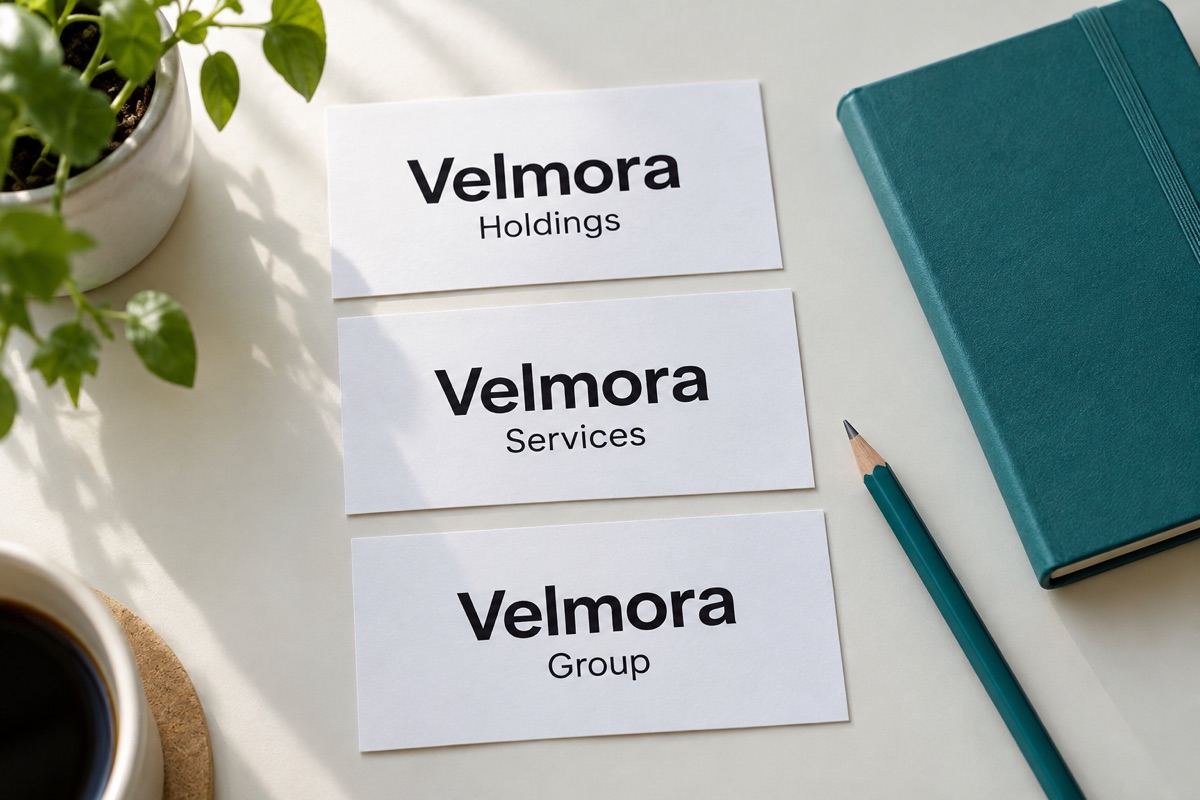
You find a company with the name you wanted, so you add Holdings, Services or Group and search again. The full phrase may look different, but the recognisable part is still the same. This is a common point of uncertainty when a founder is ready to pay for formation and wants a quick fix.
The important question is whether the full proposed name is sufficiently distinguishable, not simply whether more characters have been added. This guide explains that difference and shows how to build useful alternatives. Official guidance was reviewed on 12 October 2026. All named comparisons below are fictional examples, not register results, infringement findings or predictions of a CRO decision.
More words do not necessarily mean a different identity
CRO's naming guidance identifies weak qualifications such as holding, group, services and international as potentially insufficient differences. It also warns about additions to made-up words. In practice, a reader may still recognise the same core even when the descriptive wording changes. Our examples illustrate that risk rather than declaring a list of forbidden names.
Take the fictional core Velmora. Velmora Holdings and Velmora Services both keep Velmora as the part people are likely to remember and say. A founder who is concerned about a conflict should investigate that shared element instead of assuming the changed description has solved it.
This is a screening question, not a legal formula for deleting words from every application. The full context matters. Do not use this article to assert that two real companies are unlawfully named or that a particular candidate must pass; those conclusions need the appropriate assessment.
Compare hypothetical changes before relying on them
The following comparisons are a founder's preparation exercise. They are deliberately not search results. Imagine that a close name has been found and ask what has really changed. If the answer is only the service description or presentation, keep the concern open and ask for review.
Do not confuse a stronger candidate with an accepted candidate. Replacing the core gives you a genuinely different idea to research, but that new idea may have its own conflict. Research the replacement from the beginning rather than treating originality in your workshop as availability in the register.
| Fictional comparison | What changed? | Why review it? |
|---|---|---|
| Velmora / Velmora Services | Activity description | The core remains the same |
| Velmora / Velmora Holdings | Function description | A weak addition may not distinguish it |
| Velmora / Velmora Ireland | Location | Geography is not a reliable workaround |
| Velmora / Vel-mora | Presentation | It still reads and sounds close |
| Velmora / Orvessa | A new fictional core | A fresh candidate still needs full checks |
Services, Group and International describe more than they distinguish
A descriptive word can communicate something useful about the business without doing the separate job of distinguishing it from another name. Services tells a customer very little about whose service it is. Group or International may communicate ambition, but they do not necessarily alter the memorable part of the identity.
Use a simple workshop test: cover the additional word on the page and ask what remains. Then say the names aloud as a customer referring a supplier would. If your team keeps shortening both candidates to the same core, treat that as a practical reason to investigate further, not as an official refusal test.
An activity descriptor may still belong in an appropriate name. Choose it because it accurately describes the business, not because you expect it to neutralise a close match. Marketing descriptions can also appear in a tagline; they do not all have to be loaded into the corporate name.
Ireland, punctuation, spelling tweaks and years are weak fixes
The CRO incorporation leaflet says place names, accents and punctuation are not sufficient distinctions, and addresses phonetic or visual similarity. It also rules out using a year to differentiate otherwise identical company names. Review that guidance rather than assuming a hyphen, location or launch year creates a separate identity.
Try a spoken comparison as well as a visual one. A spelling change that is hard to notice in speech may be inconvenient for customers and leave the substantive naming concern unresolved. Different typography, colour or a logo should not be treated as evidence that the legal words have become distinct.
Keep a note of the original match when proposing a variant. If you simply replace the searched phrase and delete the old result from your file, the concern can disappear from the paperwork without disappearing from the actual application. A reviewer needs the comparison, not just the founder's latest preferred spelling.
Limited and Holdings answer different questions
Changing Ltd to Limited does not create a distinctive core. Section 26 governs the legal ending and permitted abbreviations for the ordinary private company covered by that section. The legal form is not a branding workaround. Confirm the correct structure and proposed wording with the presenter.
Holdings is not another company type like LTD. CRO guidance indicates that wording implying functions such as a holding company or group can prompt a request for supporting information. Explain the intended activity honestly; do not add a function word merely to make the business sound larger or to avoid a conflict.
Ask two separate questions: does the descriptor accurately fit the intended operation, and does the whole name raise a similarity concern? A satisfactory answer to one does not settle the other. The ownership structure and actual business arrangements also need their own formation and professional advice.
A letter of no objection is not a universal shortcut
Where a no-objection or association letter is required, CRO guidance specifies a letter from the relevant party on its own headed paper, signed by an identifiable director. It is not an automatic right to approval. Ask whether this route is relevant and what evidence the actual application requires.
Do not obtain a casual message from someone who cannot speak for the existing company and describe it as formal consent. Equally, consent about one company-name issue should not be assumed to settle every brand, regulated-word or third-party rights question. Explain exactly what permission you are requesting and retain the authorised response.
For companies genuinely connected through a group, supply the facts rather than pretending two unrelated businesses are associated. If there is a dispute or uncertainty about authority, get appropriate advice. A formation service should not be expected to manufacture consent or decide another party's rights.
No exact match is different from a cleared name
An exact search asks whether the precise phrase appears in the tool's results. The Registrar's assessment of a name is a different task; Section 26 provides discretion over undesirable names. A proposed phrase can therefore need review even when its exact characters are not returned by your preliminary search.
Our checker helps with registered-company matches, not comprehensive rights advice. Review similar results and the core word, and separately consider business names and trade marks. A technical error, an empty cached page or an incomplete query should never be recorded as evidence that a proposed name is acceptable.
Prepare a research note with the date, queries used, relevant matches and unresolved questions. Send that note to the presenter if the similarity issue matters. The useful output is a transparent decision record, not a screenshot cropped to make the result look more reassuring.
Rebuild the shortlist around genuinely different cores
If a meaningful concern remains, stop generating versions of the same core. Return to the commercial brief and create candidates from different ideas: a combination of concepts, an evocative word, a founder-related term or a newly coined expression. Keep the useful service description separate while you explore the core.
For a fictional shortlist, replacing Velmora Services with Orvessa Studio illustrates a change of core rather than another suffix. It is not a recommendation to register either name. The exercise is about the type of change to investigate; every candidate still needs its own research and assessment.
Write down why the new name suits the business, how it is pronounced and whether a customer can recall it. Ask someone outside the founding team to read it and say it back. Build two credible alternatives with different cores so the next conversation is a real choice rather than another minor variation.
- Separate the distinctive core from activity, location and legal ending.
- Carry forward the original match and the unresolved concern.
- Generate alternatives from different concepts, not only different suffixes.
- Test pronunciation, recall and suitability for intended customers.
- Repeat company-register and separate rights checks for each candidate.
- Agree the exact wording and backup order before the filing is prepared.
Keep company-name acceptance separate from brand rights
IPOI explains trade marks as signs that distinguish the goods or services of one undertaking from another's. That is a different system from registering the company's legal identity. Obtain advice about the relevant markets and activities where there is a close brand concern; do not assume incorporation settles it.
Registering a business name is also not exclusive protection. CRO's business-name guidance expressly distinguishes registration from protection against duplication and permission to use a name. A trading-name application should not be used as a way to bypass a rights problem or establish that a similar company name must be accepted.
If a brand is central to your launch, make the scope of the research explicit. Ask what registers, goods or services and territories have been reviewed and what remains uncertain. Do not label a basic company-register check as a full trade-mark clearance service.
If the proposed name needs revision, coordinate the paperwork
Ask what the query actually says before changing the application. A similarity concern, missing consent and a document inconsistency may need different responses. Confirm the revised candidate and any evidence with the presenter, and check that documents prepared for the former candidate are no longer being used by mistake.
An already incorporated company needs a different route from a new application. CRO's change-of-name procedure requires the relevant resolution, Form G1Q and amended constitution, and the company should not use the new registered name before the certificate issues. Do not treat a website edit as a completed legal name change.
StartCompany.ie can help prepare a formation application and review a proposed name, but CRO acceptance remains a separate decision. Start with the checker, bring genuinely different backups and compare the package scope and total payable. For an existing company, discuss the name-change service rather than ordering another incorporation to solve a branding issue.
StartCompany.ie service
Check your Irish company name
Official information and next steps
These examples explain a screening approach; they are not determinations about real companies or legal rights. Check current CRO guidance and seek specialist advice for a dispute, consent requirement or material trade-mark concern.