
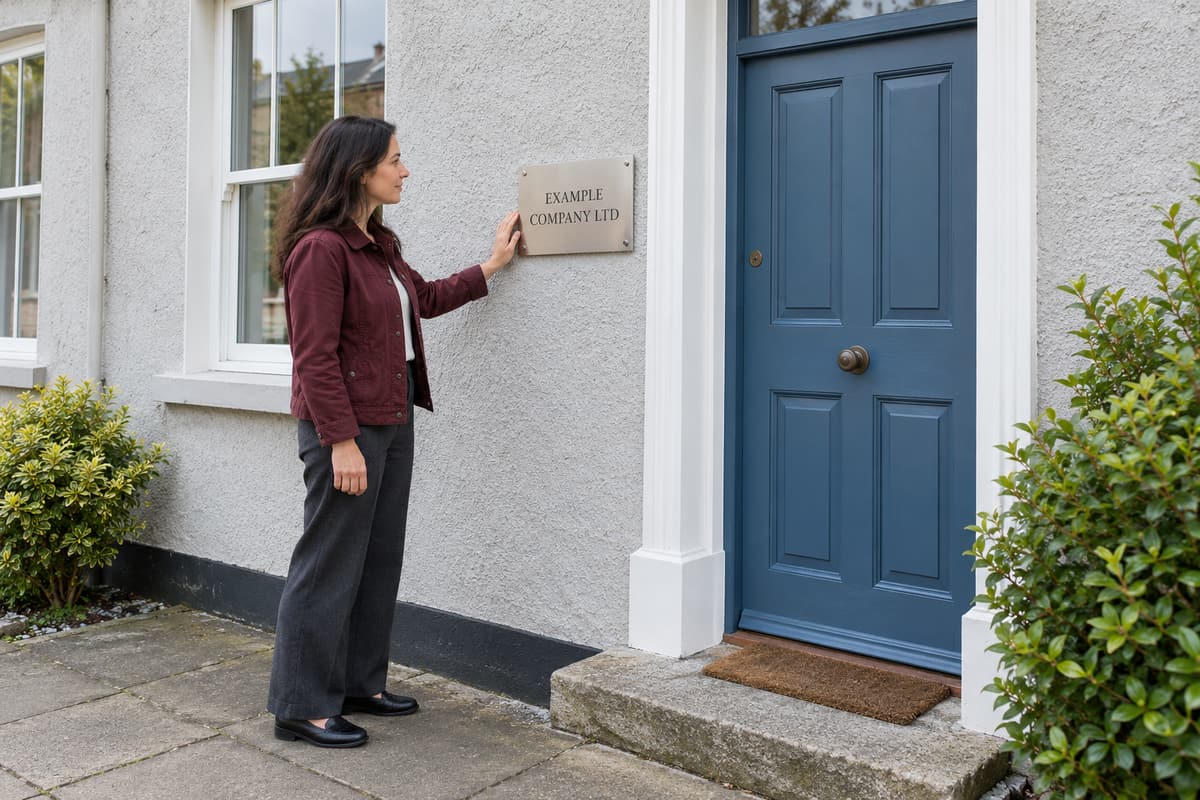
You are forming an Irish LTD and buying a professional registered office so that the company does not use your home as its public office address. The work itself will still happen in a room at home. Does the separate address mean there is no company-name display to consider at the house?
That question is different from which addresses appear on CRO records. This guide focuses on physical name display for an ordinary Irish private LTD, with practical checks for home working and shared premises. Official guidance and legislation were checked on 26 October 2026. It is general preparation, not a legal determination about an occasional workspace, a lease or a particular sign.
Separate the registered office from the place you work
The registered office is the company's statutory contact point in the State. A founder may use a professional address while carrying out the business elsewhere. Section 50's address requirement and Section 49's name-publication requirement answer different questions.
Start with a short location list: the registered office, any office, shop or workshop, and any home workspace used for the company's business. State what actually happens at each place. Do not classify a location solely by the heading used on an invoice or a bank onboarding form.
A director's residence is not automatically a company workspace merely because the director lives there. Equally, a place where the business is genuinely carried on does not cease to be relevant simply because you call the registered office the company's only official address.
Home working is not a blanket exemption
The CRO's incorporation guidance says the name must be conspicuous and legible outside every office or place where the business is carried on, even if that is a director's home. Do not assume that a home-business exception from another country's checklist applies in Ireland.
Consider a fictional design consultancy whose founder regularly performs client work and runs the company from a dedicated home room. Using an outside registered office addresses one statutory location; it does not, by itself, answer the name-display question at the home operation.
Different facts may need advice. An occasional email while travelling, a short visit to a customer's site and a stable home office should not be treated as identical without review. This guide does not declare that every place where a laptop is opened becomes an office requiring a sign.
What name should the sign identify?
Use the registered company identity, not just an attractive logo or a shortened brand that leaves the legal name unclear. Check the certificate and current CRO record before ordering permanent artwork. Section 49 permits the relevant 'Ltd' abbreviation for 'Limited'; it does not generally authorise dropping the distinctive part of the name.
For example, if the legal entity in a fictional exercise is Example Studio Limited and its brand is North Window, a North Window logo alone does not display Example Studio Limited. You can plan brand and legal identification together, but assess whether the required company name is actually legible.
If several group companies use the same location, review the companies individually. A parent brand is not automatically the name of every subsidiary. Give the sign-maker an approved list of the entities using the premises rather than a single informal group label.
Conspicuous and legible are practical requirements
Section 49 specifies the visibility and legibility standard; it does not set a universal plaque material or a standard lettering size in millimetres. This article therefore does not prescribe a supposedly CRO-approved sign template.
Inspect the proposed position from the normal approach to the premises. Ask whether planting, glare, an opaque door or a closed shutter hides the name. A tasteful design can still be hard to read if contrast is poor or the lettering is tiny.
A saved artwork file, a company certificate in a drawer or a website contact page is not the same as the required physical display. Keep a dated record of the arrangement as an internal check, but do not treat a photograph as official approval or publish your home's location merely to prove the task was completed.
Shared buildings need a specific arrangement
A multi-tenant office may have an entrance directory, separate suite signs and controlled access. Ask how the arrangement meets the requirement for your company and the actual premises. Do not assume that a name visible only on a receptionist's private screen is equivalent to a conspicuous outside display.
The same care applies to a shared home or leased unit. Discuss installation permission, building rules and maintenance with the owner or manager. These commercial arrangements do not, by themselves, cancel a statutory duty; obtain advice if the permitted installation and the company's obligations appear to conflict.
Make the responsibility concrete: who orders the display, who checks the wording, who can authorise changes and who replaces a damaged or missing sign? Avoid promising customers that a shared-address service automatically provides a private entrance, individual office or customer meeting facility.
| Location | Question to resolve |
|---|---|
| Registered office provider | How is this company's name displayed? |
| Regular home workspace | Is business carried on here, and what display is needed? |
| Shared building | Where is the legible company identification? |
| Additional shop or workshop | Has this location been checked separately? |
A trading name brings separate checks
Registering a business name is not the same as incorporating or changing the company's legal name. The CRO explains that a company trading under a name different from its full corporate name may need a business-name registration.
The CRO also requires the business-name registration certificate to be exhibited conspicuously at a corporate proprietor's registered office and at the relevant branches, offices or places where the business is normally carried on. That is a separate certificate-display issue, not a replacement for company-name publication.
Keep a simple record matching the legal entity to each trading name. When instructing an address provider or sign-maker, supply both where relevant and explain which is the registered company name. Do not present a business-name certificate as evidence that a new limited company has been created.
A physical sign and website disclosure are different tasks
Section 151 separately addresses company particulars on business letters, order forms and websites. Having a compliant website does not replace Section 49's physical name display, and fitting a plaque does not complete the website's legal-information work.
Review templates and web pages alongside the sign project, but keep the checks separate. A logo-only email or an old registered office in an order form can persist after a new sign has been fitted. Use the existing website and invoice guides linked below for those broader document questions.
Do not assume the same information must appear on every surface in precisely the same format. For instance, the full set of business-letter particulars and the company-name requirement on an invoice are not interchangeable rules. Ask for a review of the actual document rather than copying the sign wording into every template.
Name changes and moves need a coordinated update
CRO guidance says a changed company name may not be used until the change-of-name certificate has issued; the change takes effect from the certificate date. Ordering a sign does not change the legal name, and an application still awaiting approval is not the final naming record.
Once the change is effective, coordinate the physical display at each relevant location with stationery and website updates. Use the company's number to keep the same legal entity identifiable during the handover, rather than implying that a new sign means a newly incorporated business.
If the registered office moves, arrange the required CRO notification and service continuity separately. CRO guidance explains that the change becomes legally effective when registered, and Section 51 protects service at the address on the register notwithstanding a move. A replacement plaque does not update that record or ensure urgent post is forwarded.
Address privacy is useful but has limits
A professional registered office can keep the home from being used as the company's public registered office. It does not automatically remove officer-address disclosures, historic filings or physical identification duties at a place where the company operates.
If there is a genuine safety concern, seek specific advice before choosing the operating arrangement or commissioning a sign. Do not assume that the exceptional CRO process concerning officer residential-address information creates a general exemption from company-name display. The linked privacy guide explains that separate process.
An address service also does not give permission to use a dwelling commercially, resolve planning or lease questions, or establish banking, tax-residence or immigration outcomes. Tell the adviser what actually happens at the premises and resolve the relevant issues on their own facts.
What to ask a registered office provider before ordering
Ask how the provider will identify your specific company at the allocated address, when the arrangement starts and who must supply the final registered name. A provider's marketing photograph or general contact address is not confirmation that your company may use that premises.
StartCompany.ie's published address service covers an Irish registered office with receipt and forwarding of official CRO and Revenue correspondence under the agreed terms. It does not automatically include producing or installing signage at your home, shop or other workspace.
StartCompany.ie works with authorised partners. That wording is not a claim that StartCompany.ie itself is an Irish CRO-approved Registered Office Agent. Where an approved-agent arrangement is used, obtain the correct agent details and filing instructions rather than inventing them from the service seller's name.
Confirm any separate sign work, filing assistance, permissions, renewal arrangements and total payable in writing. For an existing company, the address service and any required B2 filing are separate tasks unless expressly agreed. The company should retain responsibility for checking its other operating locations.
Use a location-by-location launch checklist
Before formation, agree which addresses will serve the statutory and operational roles. Once incorporated, check the final legal name before releasing permanent artwork. This avoids paying for branding based on a spelling or name that the CRO has not approved.
Allocate one person to complete the review and retain the instructions given to the provider or installer. Repeat it when the company changes name, opens another workplace or changes address. The purpose is a maintained identification arrangement, not a one-time photograph that is forgotten after launch.
- Confirm the exact company name and any separate registered trading names.
- List the registered office and each place where the company's business is actually carried on.
- Review home-working or occasional-location questions with an adviser where the facts are unclear.
- Agree the display position, installation permission, readability and maintenance responsibility.
- Confirm the provider's arrangements for the specific company, not just the building's general branding.
- Review any business-name certificate display and the separate letter, invoice and website requirements.
- Coordinate effective name changes, CRO address updates and continued receipt of official correspondence.
- Keep the service scope, any additional work and total payable in writing.
StartCompany.ie service
Registered Office Address
Official information and next steps
Official sources checked on 26 October 2026. This guide concerns ordinary Irish private LTDs. Particular premises, shared-building arrangements and safety concerns may need legal or other professional advice.
- Companies Act 2014, Section 49: publication of the company name
- Companies Act 2014, Section 50: the registered office
- Companies Act 2014, Section 51: service of documents
- Companies Act 2014, Section 151: business letters, order forms and websites
- CRO: company incorporation and displaying the name at a director's home
- CRO: name display and publication requirements
- CRO: physical registered office and address updates
- CRO: business-name registration and certificate display
- CRO: changing a company name and the effective certificate date