
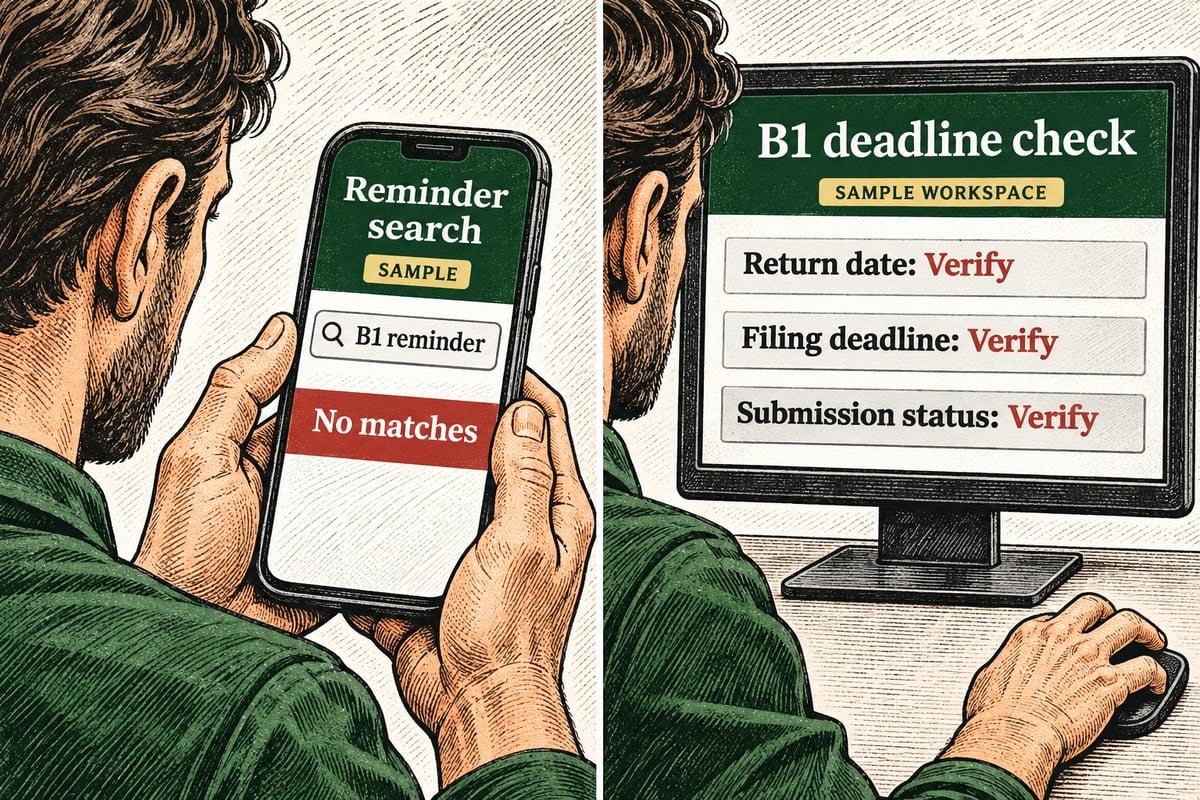
You expected an annual-return reminder but nothing arrived. Perhaps the company is new, an accountant used to handle the filing, or the email address changed. The important question is not whether a message can be found: it is whether the company's return is due, complete or already late.
This guide helps an Irish LTD investigate that communication gap without mistaking an inbox search for a compliance check. It separates dates, CORE profile details, presenter correspondence and paid reminder arrangements. It does not promise that CRO will issue a particular advance reminder or that updating one address redirects every notice.
1. Start with the company record, not your inbox
Use the exact company number to identify the right entity in CORE. CRO says each company has an allocated Annual Return Date, which can be checked there. Record the current ARD, the period you are investigating and any relevant submission references. A similarly named company or an old calendar entry is not a reliable starting point.
An ARD is the latest date to which the annual return is made up, not necessarily the final filing day. Section 343 normally requires delivery within 56 days after the ARD, or after an earlier date used for the return. Where accounts are required, the financial year-end can also affect the deadline. Have the presenter confirm the applicable date rather than adding days to a guessed anniversary.
Save a dated note of what you checked and who confirmed it. If the displayed dates or previous filings are unclear, ask the accountant or company-secretarial adviser to reconcile them. Do not edit a working diary to make it agree with a reminder whose underlying date has not been established.
2. A missing reminder is not extra filing time
CRO's electronic-filing guidance expressly puts the onus on the company to file on time. Treat an email reminder as a secondary control, not the event that creates the obligation. No message in the inbox is not evidence that there is no return due, that the company is exempt, or that a filing has already been accepted.
This matters for new companies too. CRO states that the first annual return falls six months after incorporation and normally needs no attached financial statements. It is not postponed until the business starts trading, opens a bank account or receives its first customer payment. A quiet or non-trading company still needs its filing position checked.
If you discover the issue close to the deadline, prioritise the missing documents, approvals and submission work. Investigate why email failed alongside that work, not instead of it. Asking for a reminder to be resent does not complete a B1 or reserve a filing slot.
3. Identify which address and which message you expected
Do not treat every contact point as one registered email address. The CORE user account, contact details in a submission, a presenter's office mailbox and a provider's reminder list can involve different people and systems. The practical question is which route is used for the particular communication you are missing.
CRO's CORE FAQs describe correspondence to the email supplied for the user account and explain that a practice can use its own account for companies it represents. Separately, CRO tells companies and presenters to provide monitored addresses for sent-back notices. A director's empty personal inbox therefore does not establish that the presenter received nothing.
Prepare an address map rather than requesting a vague email change. Identify the account holder, person monitoring correspondence, backup contact and purpose of each address. Ask the presenter to verify the relevant submission contacts. If the company cannot establish the destination for a particular notice, raise that specific question with CRO through its published help route.
| Contact point | What to verify |
|---|---|
| CORE user profile | Correct account holder, monitored email and authorised access |
| Company or presenter submission contacts | Actual details used for this filing and who receives follow-up |
| Provider's reminder arrangement | Active engagement, recipients, backup and work included |
| Registered-office post | Separate physical-mail handling; not an automatic email redirect |
4. Update the right profile and preserve authorised access
CRO's account-system guidance says account email and contact details can be edited through My Profile, accessed from the top-right menu. That is guidance about the account profile. Do not assume the edit rewrites every historical submission, changes another presenter's account or updates a separate provider's mailing list.
Use an account you are authorised to manage. If a former accountant or employee used their own account, ask for a proper handover and copies of relevant records rather than requesting their private password. Where access cannot be recovered through the normal process, contact the CRO helpdesk and explain the specific account or submission problem.
After an agreed update, record which contact was changed and tell the people responsible for the filing. Check spam, quarantine, forwarding rules and abandoned staff mailboxes as practical delivery checks. These housekeeping steps do not replace verifying the statutory deadline or confirming whether an open filing needs attention.
5. Ask the presenter for evidence, not reassurance alone
Request the company number, return date, submission reference, current status and any outstanding action. Ask for copies of the submitted documents and correspondence. A statement that the return was started does not show that it was completed; a signed page sent to an adviser does not establish delivery to CRO.
CRO's filing guidance distinguishes completion of the B1, the required attachments and the filing fee. Its peak-filing page also warns that a B1 is not submitted until after the payment stage. Ask the presenter to check the actual submission record and follow-up rather than relying solely on a payment receipt or draft PDF.
A professional may prepare or present a return without being the company's secretary. Electronic Filing Agent authority is another separate question: CRO describes a B77 notification for the appointment and joint document-control responsibilities. Agree who signs, who submits and who watches for returned documents. Do not infer an unlimited monitoring service from the word agent.
6. A sent-back notice needs a different response
An advance reminder, a sent-back notice and a rejection are different messages. If something has already been submitted, check for correspondence about that submission even if no reminder was found. CRO specifically advises monitoring email and preventing its messages being blocked or sent to spam because sent-back alerts are electronic.
Obtain the actual notice, its issue date, stated defect and required action. Do not assume every problem receives the same correction window, that a rejected return is preserved by an earlier draft, or that changing an email address restarts time. Use the detailed correction guide linked below and have the presenter establish the route for that notice.
Where a technical problem prevents filing, retain the error, timestamp and submission details and contact the published support channel promptly. A support email is evidence of a query, not proof of an extension or a completed filing. Continue coordinating the work and checking the record.
7. If the deadline has passed, get the position assessed
Late filing can bring late fees, enforcement and possible strike-off. Do not assume the absence of a reminder removes those consequences. Ask for the outstanding returns, applicable accounts, filing history and any enforcement correspondence to be reviewed together, especially if more than one year is unresolved.
Audit exemption needs its own current assessment. CRO's regime effective from 16 July 2025 addresses repeated late filing within a five-year period, rather than automatically treating every first late filing as a loss of exemption. Other conditions and transition rules apply. Do not rely on an older general warning or assume a company in a group has the same position as a standalone LTD.
Section 343 provides a court route for extending delivery time for a particular return, subject to an application and court decision. It is not an automatic email-based waiver. If that route may be relevant, obtain specific advice promptly and distinguish it from changing a future ARD. A routine filing order does not include court proceedings.
8. Example: the email changed but the work did not move
Consider a fictional two-director consultancy. Its previous accountant prepared last year's return using the practice's CORE account. The directors appoint a new accountant for bookkeeping and change the company's general mailbox. Neither instruction expressly assigns the next B1 or the monitoring of the old submission.
When no reminder arrives, the directors initially assume the new accountant has filed. The sensible next step is to check the live company record, ask both firms what work is open and obtain the relevant references and correspondence. The bookkeeping engagement and mailbox change are not evidence of a filing handover.
The team then agrees a named presenter, signatories, contact addresses and a follow-up owner. Any change of secretary or EFA authority is considered separately where needed. This example illustrates a responsibility gap, not a claim that an accountant caused a breach or that the same handover procedure fits every company.
9. Build a reminder system that ends with verification
Use a company-controlled checklist with a named owner and backup. A calendar notification should trigger a documented check, not merely be dismissed. Reconfirm the dates after any ARD change and keep preparation milestones separate from the legal deadline. The checklist below is a recommended workflow, not an additional statutory timetable.
- Identify the company by number and confirm its current ARD and applicable filing deadline.
- Record whether accounts are needed and who provides the approved filing copy.
- Name the presenter, required signatories and person checking submission status.
- Verify relevant account and submission contacts without assuming one global email setting.
- Agree who monitors sent-back messages and who covers leave or staff departures.
- Set internal preparation and escalation dates early enough to resolve missing work.
- Retain the submission reference, documents and evidence of the checked outcome.
- Review the next cycle and provider scope instead of relying on an expected future email.
10. Order filing support, not just a promise of reminders
StartCompany.ie's Annual Returns service covers B1 preparation and filing, company-detail checks, required financial-statement attachment, the CRO filing fee and filing confirmation. Check the current service page for the total payable. Accounts preparation and late penalties are not included; establish what is ready before ordering.
If no reminder arrived, explain the current ARD, suspected deadline, last known filing and any live notice when requesting help. Confirm whether the return is still within time and whether correction, accounts, enforcement or court work requires separate support. A service purchase does not extend a deadline or guarantee that an incomplete return can be filed on time.
For ongoing secretary support, agree the appointment and reminder scope separately. A registered-office service handles its defined address and post functions, not automatic control of every digital mailbox. The useful outcome is a completed, checked filing process with responsibilities understood, not simply an extra email in the inbox.
StartCompany.ie service
Annual Returns
Official information and next steps
Primary CRO and legislative sources checked on 5 November 2026. Read current filing rules and the particular notice, not an old reminder. Some general CRO pages retain older audit-exemption wording; the July 2025 commencement notice and current conditions must be read together. This guide gives general information and fictional workflow examples, not a deadline calculation or legal advice for your company.
- Companies Act 2014, section 343: annual-return obligation and court extension
- CRO: Annual Return Date
- CRO: missed deadlines and accounts-related timing
- CRO: filing an annual return on CORE
- CRO: annual-return requirements and completion
- CRO: CORE FAQs, correspondence and account recovery
- CRO: account system and changing profile details
- CRO: peak filing, monitored addresses and submission checks
- CRO: Electronic Filing Agents and document control
- CRO: July 2025 commencement and audit-exemption transition
- CRO: audit-exemption conditions