
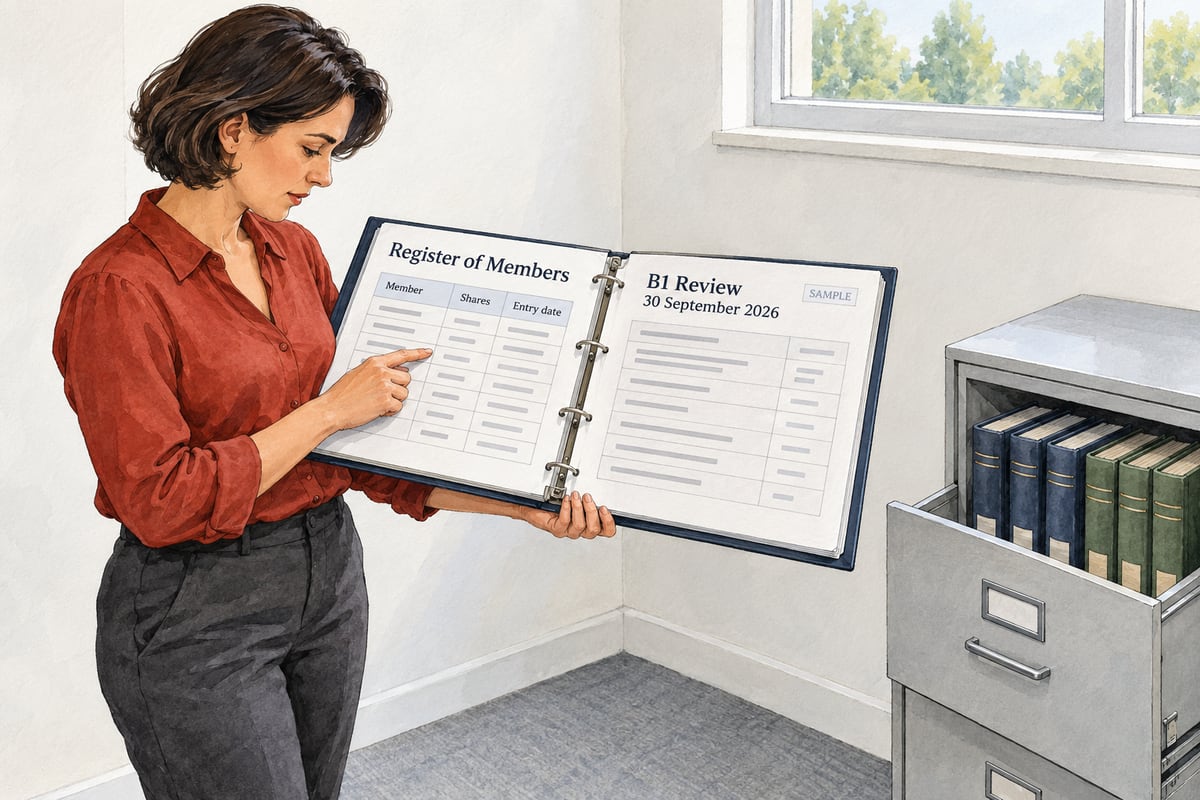
You are preparing an Irish company's annual return after a shareholder has sold some shares. The old annual return shows one owner, today's records show two, and the deal happened close to the Annual Return Date. Which position belongs on Form B1?
The answer starts with the date the return is made up to and the company's membership history, not the date you open CORE. This guide helps directors brief an annual-return presenter and identify unfinished share work before approving a filing. It concerns an ordinary Irish LTD; disputed ownership and defective records need specific advice.
1. Write down the return date before comparing shareholders
CRO describes B1 as an annual snapshot at the date of the return. Its share-transfer guidance says transfers are reflected in the next annual return. Read those points together: the date a return is actually submitted does not turn an earlier snapshot into a current-day ownership statement.
Distinguish the company's recorded ARD, the B1 made-up-to date, the preparation or submission date, and the relevant membership dates. Section 343 requires the return to be made up to no later than the ARD. Where an earlier return date is used, its own filing window applies. Do not choose a later made-up-to date just to include a recent shareholder.
For example, assume a company has a 30 September 2026 ARD and makes its return up to that date. The ordinary 56-day filing period reaches 25 November 2026. Preparing it in October or November does not make October or November the shareholder cut-off. This is an example, not the deadline for every company; accounts and the company's actual filing position also need checking.
| Date to identify | What it answers |
|---|---|
| ARD | Latest permitted made-up-to date |
| B1 made-up-to date | Date of the return's snapshot |
| Register entry and cessation dates | Who was a member at that point |
| Submission date | When the return was delivered |
2. Reconcile the statutory register, not only the latest spreadsheet
Section 169 requires a register of members containing names, addresses, share details, amounts paid or treated as paid, entry dates and cessation dates. A cap table is helpful management information, but a spreadsheet without this history may not answer who held the shares at the B1 date.
Section 94 addresses written transfer instruments, delivery to the company and the point at which the transferor stops being the deemed holder: entry of the transferee in the register. Check constitutional restrictions and the proper approval and registration steps, rather than using an investor announcement or payment date as the only evidence.
Ask for the signed instrument, relevant approvals, register entries and certificate records as a coherent pack. If they disagree, record the discrepancy and obtain a review. Do not choose whichever document gives the preferred percentage, and do not backdate or delay register entries to manufacture a preferred B1 result.
This is a reconciliation exercise, not a way to cure an invalid transaction. A presenter preparing an annual return needs an established ownership position; they should not be expected to resolve a shareholder dispute simply by selecting names in CORE.
3. Compare transfers before and after the made-up-to date
These fictional examples use 100 fully paid ordinary shares, one share class, a 30 September 2026 made-up-to date and a valid ordinary transfer process. They illustrate the dated membership comparison, not tax treatment or the validity of a real transaction.
Before the date: Mara initially holds all 100 shares. A transfer of 20 shares to Niall is properly completed and Niall is entered in the register on 18 September. At 30 September, the holding position is Mara 80 and Niall 20. A previous B1 showing Mara with 100 shares is not a reason to copy that old position unchanged.
After the date: change only the registration date to 15 October. At 30 September, Mara still holds the 100 shares for this example. The October transfer is a later event, even if the September B1 is being prepared after 15 October. Keep the October records for the appropriate later annual-return reporting and act on other obligations now.
Agreement before, entry afterwards: suppose the transfer instrument is signed on 28 September but Niall is entered on 2 October. Do not use the signature date alone to put Niall into the 30 September holding position. The legal-member timing needs to be assessed under section 94; beneficial ownership and tax timing are separate questions.
Give the presenter both sides of the date, with the supporting evidence. If an entry was omitted, made incorrectly or is disputed, these examples are not permission to treat the error as a convenient October transaction. Ask what review or correction is needed before the B1 is approved.
4. Supply the history as well as the closing holding position
A list headed 'shareholders today' is not enough if the presenter needs to reconstruct an earlier return. Provide the register and a movement schedule covering the relevant return period, including anyone who joined, left or transferred part of a holding. Follow the instructions for each B1 field rather than reducing the task to one current percentage chart.
Reconcile the share classes, numbers and amounts against the underlying records. A transfer of existing shares normally changes who holds them, not the total number issued. New shares issued to an investor are a different event. Do not increase issued capital merely because a new name appears in the ownership list.
CRO provides a specific format for a separate shareholder-list PDF, including a company-name and Annual Return Date title row, name and address columns, and holdings. Follow the current CORE requirements if using that route. Uploading a sales brochure or a chart of ultimate owners is not an equivalent working record.
Keep the approved schedule alongside the filed copy. It should be possible for the director to see where each figure came from without relying on the memory of the adviser who completed the form.
5. Do not wait for B1 to update beneficial ownership
The register of members and the beneficial-ownership register answer different questions. A company can be the legal member while natural persons ultimately own or control it. Do not replace a corporate shareholder in the B1 working list with the individuals identified for RBO simply to make the two lists look alike.
RBO guidance requires changes to be notified within 14 days of the change to the entity's internal beneficial-ownership register. It also says there is no separate annual RBO return. An annual CRO filing is therefore not the mechanism for postponing or completing an RBO amendment.
Review whether a transaction changes reportable ownership or control and when the internal beneficial-ownership record must change. Do not automatically import the legal-member entry date into every beneficial-ownership question. Allocate the assessment and any amendment to a named person, with separate completion evidence.
If the transfer happened after the B1 snapshot date, that does not make it irrelevant until next year. The dated B1 position and a current RBO obligation can legitimately involve different records and timetables.
6. Check Stamp Duty and new-share filings separately
CRO says the stock transfer form is not a CRO form and should not be sent to it. A chargeable stock transfer requires a Stamp Duty return with Revenue. Identify any applicable exemption or relief with an adviser instead of assuming that no immediate CRO transfer form means no other action.
Revenue's published guidance says to file and pay Stamp Duty within 44 days of execution of the instrument to avoid the stated late-filing and late-payment consequences. Have the responsible adviser identify the instrument, relevant execution date and applicable requirements. The B1 made-up-to date is not an extension of that timetable.
If the investor receives newly allotted shares rather than buying existing shares, the separate allotment route matters. Section 70 requires allotment particulars to be delivered to the Registrar within 30 days. B1 reporting does not replace Form B5 or the underlying allotment approvals.
Tell the presenter exactly what occurred: an existing-share transfer, new allotment or a combination. A label such as 'gave my partner 20%' does not establish the documents, share totals or filing obligations.
7. Treat a pre-filled or accepted B1 as something to check
Do not assume a prepared draft proves the shareholder section is correct. Compare it to the approved dated schedule, including changes since the earlier return. A filing acknowledgement is evidence of a submission, not a legal opinion confirming the underlying share transaction.
If a previous B1 contains a wrong holding, ask the presenter to identify the return, date and discrepancy and confirm the appropriate CRO route. Do not assume that putting a different figure into this year's return rewrites the earlier public document. Where a return has been sent back, follow the actual notice and correction instructions.
The shareholder snapshot also does not decide who is currently entitled to sign. CRO's common-error guidance flags signatories who are not current officers. Check any separate officer-change notification and the current signing arrangement; do not use a former officer merely because they held office at the snapshot date.
Keep the financial-statement pack on its own review track. The accountant needs to assess relevant transactions and disclosures under the applicable reporting requirements. Do not infer that an event after the B1 date can be ignored for every accounts, tax or governance purpose.
8. Prepare a useful shareholder handover pack
Give the filing provider a concise brief before sending an unlabelled folder of documents. Start with the company number, return being prepared, actual deadline and whether accounts are ready. Explain any recent ownership event or known inconsistency immediately.
Use a secure channel for the personal details and signed documents the provider requests. A general quote enquiry needs the issue and dates, not passwords, PPSNs or an unrestricted public link to the entire statutory register.
Use this checklist to organise the review:
- Confirm the recorded ARD, B1 made-up-to date, accounts period and complete filing deadline.
- Provide the register of members with entry, cessation, share-class and paid-up details.
- List transfers and allotments in the relevant period and flag events immediately after the return date.
- Supply the transfer instruments, approvals and supporting certificate or register records requested.
- Reconcile the dated holding position and issued-share totals with the draft B1.
- Allocate any RBO amendment, Stamp Duty or B5 work separately and retain its completion evidence.
- Confirm current officer signatories, the accounts attachment and who monitors CRO feedback.
- Approve the final filing copy and retain the acknowledgement, not merely a started draft.
9. Order the filing work that is actually ready
StartCompany.ie's Annual Returns service provides B1 preparation and filing support, including the CRO filing fee. Tell us about recent transfers and supply the records needed to establish the correct dated position. Check the current service details and total payable before ordering.
Routine annual-return support does not automatically include completing a share transfer, resolving disputed ownership, reconstructing missing registers, preparing accounts or giving tax advice. If the ownership position is unfinished, ask what additional review is available before treating the B1 order as the solution.
Our share-transfer service is a separate route for transfer documentation and company-record support. Confirm whether the work you need, any RBO amendment and applicable Stamp Duty are included or separate. Buying one service does not establish that another filing has been completed.
Agree responsibilities and the timetable in writing. If a deadline is close or a notice is live, say so at the start. Neither an enquiry nor an order receipt is an accepted B1, and a prepared ownership schedule is not a guarantee of CRO acceptance.
StartCompany.ie service
Annual Returns
Official information and next steps
CRO, Revenue, RBO and revised legislation were checked on 28 October 2026. Examples assume valid ordinary-share transfers and accurate membership records. This guide is general filing-preparation information, not a determination of title, beneficial ownership, tax liability or the correction required for a particular transaction. Obtain appropriate advice for disputed, late or defective records.
- CRO: annual-return snapshot, filing and shareholder-list format
- Companies Act 2014, section 343: annual-return dates and delivery
- Companies Act 2014, section 94: transfer instruments and registered holders
- Companies Act 2014, section 169: register of members
- CRO: stock and share transfers
- CRO: share capital and resolutions, current web leaflet
- Companies Act 2014, section 70: allotment particulars
- RBO FAQs: amendments and follow-up timing
- Revenue: late Stamp Duty filing and payment
- CRO: common Form B1 errors
- CRO: duties of directors and secretaries