
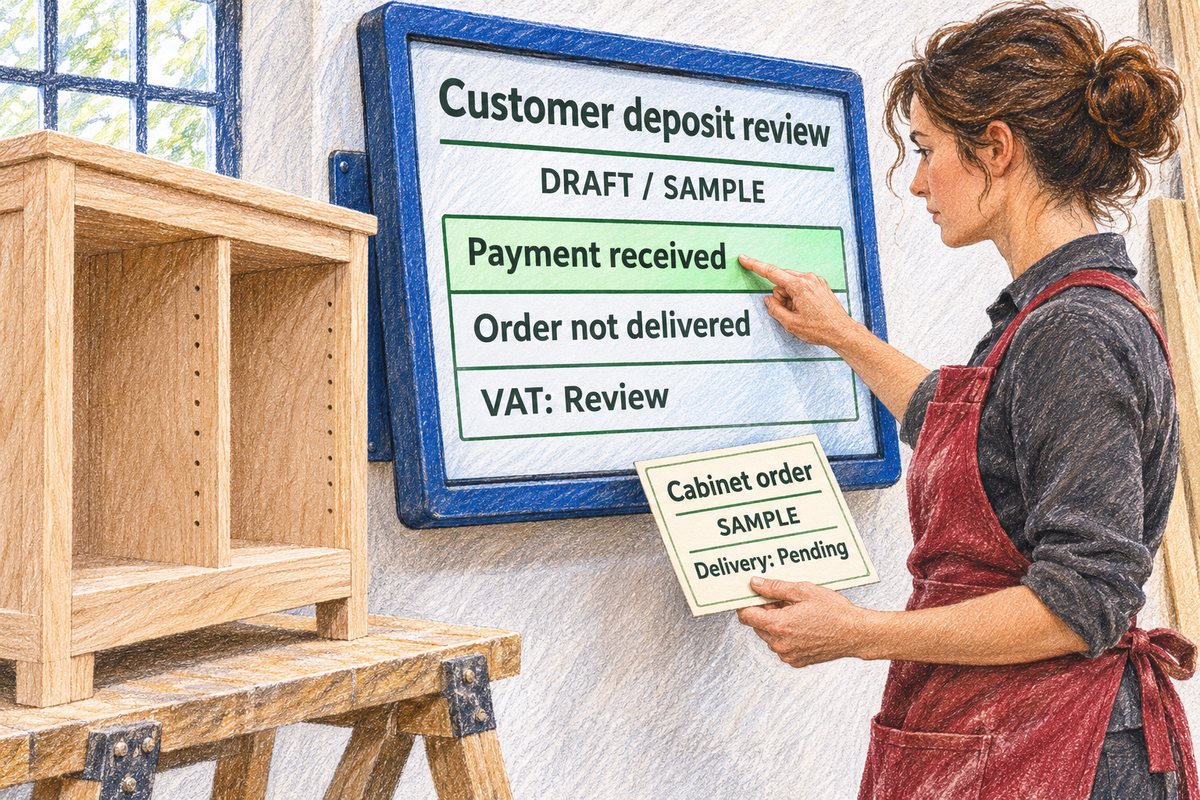
A customer pays to reserve a furniture order, a website project or a future service. The money reaches the Irish company's account before the work is delivered. Should it all appear as sales, can the director treat it as available profit, and can the VAT review wait until the final invoice? These are different questions, even when they concern the same receipt.
This guide concerns ordinary customer advances received by an Irish LTD, not money held as trustee, regulated client funds, property deposits or vouchers. Official Revenue, CRO and financial-reporting sources were checked on 13 November 2026. Ask your accountant to confirm the applicable reporting framework, contract and tax treatment; the examples are deliberately limited, not instructions for every industry.
1. Start with the agreement, not the bank description
Write down what the payment actually covers. Is it part-payment for a specified order, a fee for a service already provided, or genuinely refundable security? The word deposit in a bank reference does not settle that classification. If part of the payment buys an immediate service and part relates to future work, flag the split for review rather than assigning the whole receipt one label.
Keep the accepted quotation, payment terms, cancellation conditions and delivery timetable together. Record whose company contracted with the customer. A receipt for the director's former sole-trader business does not become the LTD's sale merely because the cash was transferred into its account. Unclear contracting parties need correction before entries are finalised.
The CRO's proper-books guidance requires records that explain transactions and allow assets, liabilities and results to be determined with reasonable accuracy. For an advance, that means explaining the outstanding customer obligation, not only proving that money arrived.
2. Separate the cash receipt from earned revenue
Under FRS 102 paragraph 23.125, consideration received or due before goods or services transfer can create a contract liability. That balance represents an obligation to the customer. Revenue is recognised as the relevant transfer occurs, rather than simply because the customer has funded the order. A non-refundable advance is not automatically earned on receipt either; the contractual promise still matters.
Confirm which accounting framework your company uses. The FRC's revised FRS 102 revenue model generally applies for accounting periods beginning on or after 1 January 2026, not merely because an invoice happens to carry a 2026 date. Do not import this model into an FRS 105 or other-framework engagement without asking the preparer.
For your working records, keep four questions separate. A single software category called deposits should not hide whether the payment is outstanding work, a tax amount, a refund obligation or completed income.
| Question | Evidence to review | Not established by |
|---|---|---|
| Cash received? | Bank or processor record | An unpaid quotation |
| Revenue earned? | Contract and performance | Receipt alone |
| VAT due? | Supply and invoice timing | Year-end revenue entry |
| Refund owed? | Terms and cancellation facts | A deposit label |
3. VAT can need attention before delivery
Revenue's advance-payment guidance explains that VAT can arise on money received before goods or services are supplied. This is separate from when revenue is earned in the financial statements. First establish whether the company must account for VAT, what the supply is, where it is taxable and which rate applies. Incorporation alone does not answer those questions.
The exact tax point needs care. Revenue distinguishes transactions where an invoice is issued from those without an invoice; invoice-based rules look at issue or the deadline for issue. Section 74 also contains a specific interaction with the moneys-received basis. Do not replace that assessment with a blanket rule that every deposit goes into the receipt month's VAT return, or that every advance waits until delivery.
Tell the VAT preparer about the advance immediately, including the receipt date, invoice date and customer status. An accounting entry to deferred income is not a VAT exemption. Cross-border supplies, reverse charges, security deposits and unusual cancellation terms need their own assessment rather than the domestic example below.
4. Issue the right advance-payment document
Revenue says VAT invoices for advance payments must be issued by the 15th day of the following month, with an exception for intra-Community supplies of goods. For a payment received on 20 November, that general deadline is 15 December, not the eventual delivery date. The invoice obligation and applicable VAT treatment must still be checked for the transaction.
A quotation, pro-forma request or processor receipt is not automatically the required VAT invoice. Give each document a clear purpose and reference. When completing the final bill, show how the advance has been applied so the customer is not asked to pay it twice and the books do not count the same sale or tax twice.
Have the accountant review how your software handles deposits before issuing a large batch. Some workflows post an advance invoice directly to sales, while the accounts may need an adjustment for unperformed work. Correct the workflow with a traceable entry; do not delete previously issued documents to make the reports appear to agree.
5. Worked example: cash received, cabinet not delivered
Consider a fictional cabinet maker receiving EUR1,230 before a 31 December year-end for delivery the following February. For illustration only, assume an ordinary domestic taxable supply, an agreed 23% rate and a reviewed VAT tax point. Also assume the accounts use FRS 102 and the single obligation transfers at delivery, with no earlier transfer of control. These assumptions are not a determination of the correct rate or timing for your business.
The assumed payment splits into EUR1,000 net consideration and EUR230 VAT: EUR1,230 / 1.23 = EUR1,000. Before delivery, the illustrative receipt entry increases bank by EUR1,230, records EUR230 as output VAT and EUR1,000 as a contract liability. It does not create EUR1,230 of earned sales. The exact ledger route depends on the invoice workflow and existing entries.
If the full agreed price is EUR5,000 plus EUR1,150 VAT, the remaining customer balance after the deposit is EUR6,150 - EUR1,230 = EUR4,920. On the assumed delivery, recognise the EUR5,000 revenue once, release the advance liability and reconcile the earlier VAT against the final billing. Do not add the EUR1,000 advance to EUR5,000 and report EUR6,000 revenue. Costs and tax adjustments remain separate; revenue is not profit.
6. Part-completed work needs more than a cash percentage
A 40% deposit does not prove 40% of the job is earned. For an obligation satisfied over time, FRS 102 requires a suitable measure of progress; other obligations transfer at a point in time. Give the accountant the actual work evidence instead of using the payment schedule as a completion certificate.
For a website project, preserve milestones, acceptance correspondence, work delivered and unresolved changes. For a product order, keep dispatch, delivery and acceptance evidence. Ask the preparer to decide whether the contract supports recognition over time or at a specific point. Do not defer every job entirely until the last payment, or recognise every deposit immediately, merely to simplify bookkeeping.
7. Refunds and retained deposits are different events
If the order changes or is cancelled, record what happened before changing the books. Link the customer agreement, original invoice, any credit note and the actual refund. Revenue's credit-note guidance covers invoice corrections for price adjustments or incorrect rates; the note must identify its reason and refer back to the original invoice. A bank refund alone does not explain the whole correction.
Keeping the money is a different case from returning it. Do not automatically reverse VAT because no work ultimately went ahead. Revenue's concession described for deposits received and cancelled before 1 January 2022 is historical, and the revised section 74 shows the former subsection (4) removed from that date. Do not apply the old relief to a new retained deposit.
Have the adviser assess the current contract, any cancellation service or benefit, the tax treatment and when the amount becomes income. A description such as non-refundable does not decide every accounting, VAT or consumer-rights question. If entitlement to retain the money is disputed, obtain separate legal advice rather than treating a bookkeeping entry as permission.
8. Prepare a customer-deposit handover schedule
Use one row per order, not one total copied from the bank. A useful monthly reconciliation starts with advances still unearned at the previous review, adds new advances, and identifies amounts released for performance, refunded or otherwise resolved. Keep VAT separately identifiable and investigate unmatched balances rather than forcing the schedule to equal the bank account.
Before the year-end meeting, send the accountant the schedule and explain every old or disputed item. Revenue requires detailed, current transaction evidence; directors retain responsibility for records even when an adviser holds them. Its general business guidance calls for originals to be retained for six years. Check longer retention needs before deleting evidence about an unresolved contract or enquiry.
- Customer and order reference, contracting company and agreed currency.
- Contract price, what must be delivered and refund or cancellation terms.
- Each receipt date, gross amount, invoice reference and VAT treatment to confirm.
- Processor fees, payout differences and refunds reconciled separately.
- Performance and delivery evidence at the reporting date.
- Net advance still outstanding and the proposed release or refund, with reviewer.
- Disputes, credit notes and changes of scope linked to the original record.
- Who prepares invoices, checks VAT periods and approves year-end adjustments.
9. Scope accounting help before taking the next large advance
Ask for a review when advances are material, old balances remain unexplained, or the bookkeeping system automatically treats all receipts as sales. Describe the number of orders, the value still undelivered, currencies, sales channels, VAT registrations and the next reporting deadline. Attach a redacted sample schedule at enquiry stage, not customer banking or identity data.
StartCompany.ie's accountant service connects businesses with accounting support. Ask whether deposit reconciliation, contract-based revenue assessment, invoice workflow review, VAT corrections and year-end adjustments can be provided, then agree the accepted scope, responsible adviser and total payable. Matching with an accountant is not itself a completed review or an approved tax treatment.
Historic corrections, consumer disputes, contract drafting, safeguarded client-money arrangements and specialist sector advice are separate questions, not automatically included. If cash is tight, tell the adviser before making spending or owner-payment decisions. The bank balance alone is not a measure of distributable profit or permission to use restricted funds.
StartCompany.ie service
Accountant Services in Ireland
Official information and next steps
Checked on 13 November 2026 against Revenue, CRO, the revised VAT Act and FRC publications. Accounting-framework choice, contract performance and VAT timing require a transaction-specific assessment. Examples use stated assumptions, not a universal rate or tax outcome.
- CRO: adequate accounting records
- FRC: FRS 102, contract liabilities and non-refundable advances
- FRC: June 2026 explainer and effective periods
- FRC: Factsheet 10, revenue and contract balances
- Revenue: payments in advance and deposits
- Revenue: when VAT is due
- Revised VAT Consolidation Act, section 74
- Revenue: invoices for advance payments
- Revenue: when VAT credit notes are issued
- Revenue: credit-note information
- Revenue: keeping VAT records
- Revenue: business records and retention