
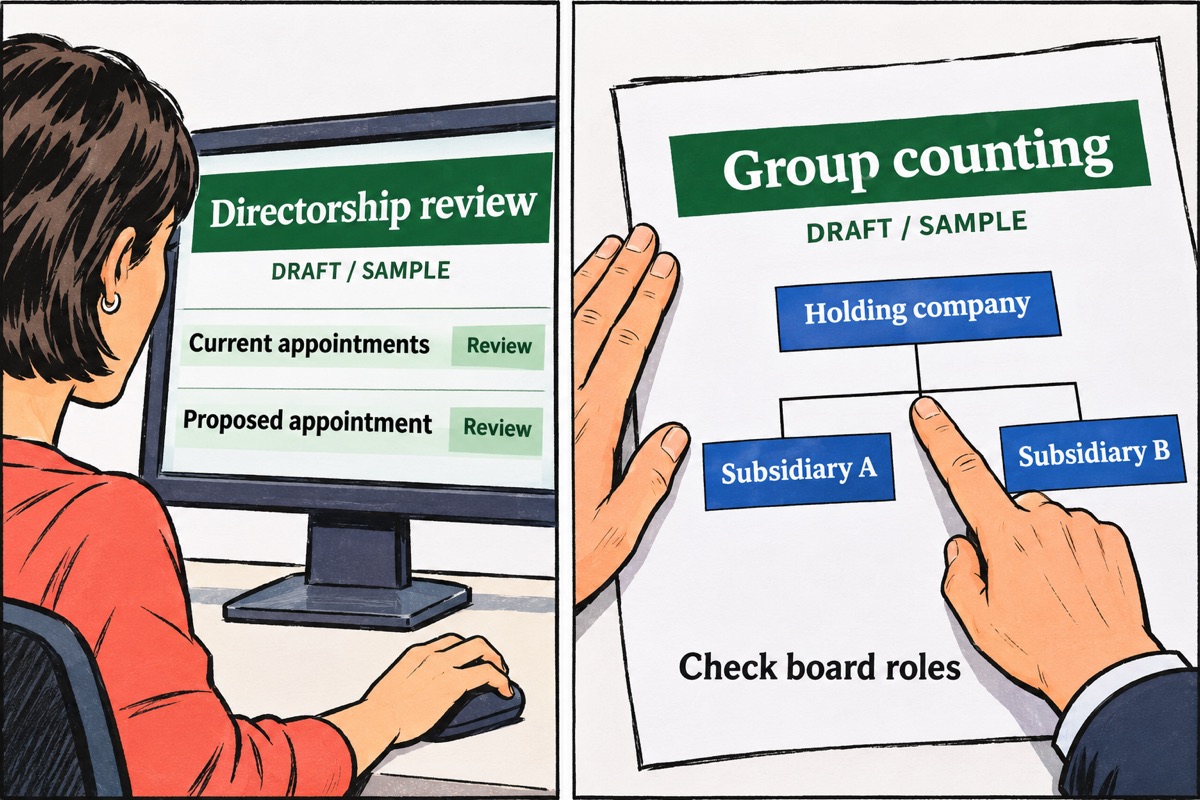
You already sit on several company boards and want to form another Irish LTD. Perhaps some companies are dormant, several belong to a group, and others appear only in your past employment history. Counting names on a biography will not reliably tell you whether you can accept the proposed directorship.
This guide focuses on the 25-directorship limit and preparation before another appointment, not the full director-eligibility assessment. Official sources were checked on 11 November 2026. Examples are fictional and simplified. This is general information, not a legal opinion on your portfolio, a complex group or an appointment already made in breach. Obtain specific advice where the count or the company's status is uncertain.
1. Start with the director, not the company portfolio
CRO guidance explains the 25-company limit and the existence of exclusions. It is a check on the proposed person's directorships. Owning shares, advising a company and being its appointed director are different roles: do not turn a list of investments or trading brands into a directorship count.
Prepare a current schedule for each proposed director individually. Include exact company names, registration numbers, jurisdiction, company type, appointment dates, any cessation dates and the evidence behind them. Record the proposed new appointment separately. Two founders on the same boards still need their own assessments because their other appointments may differ.
Do not remove an appointment merely because the company pays no director fee, has no sales or is described informally as dormant. Those descriptions do not establish a statutory exclusion. Equally, distinguish a genuine past appointment from an active one rather than keeping every role ever held in the current total. Flag conflicting dates for review instead of choosing the most convenient version.
2. Fix the date and scope of the count
Section 142 frames the limit at a particular time and provides the categories, exclusions and counting rules. For an ordinary new Irish LTD, do not use an annual average or assume the figure is reset by a new calendar year. Assess the position at the intended appointment, including other changes occurring around it.
Keep the raw list before making adjustments. Beside each company, record whether the adviser considers it within the relevant scope and why. Supply overseas appointments too; do not assume that everything disclosed for incorporation must be counted identically, or that a foreign address alone resolves the legal classification. Mixed company types and unusual entities deserve individual analysis.
Date the completed review and ask the proposed director to report changes before filing or appointment. An accurate schedule prepared earlier can become stale if the person joins another board in the meantime. Where several formations are being coordinated, give one person responsibility for maintaining the sequence and sharing changes with each presenter.
3. Check holding-company relationships, not just shared ownership
The CRO describes a holding company and its subsidiaries as counted together. Read that summary alongside section 142(5): the person must be a director of two or more companies, one of which is the holding company of the other or others. Do not automatically combine every company connected with the same founder.
Section 7 contains the subsidiary tests. Companies owned personally by the same individual are not, for that reason alone, a holding-company and subsidiary structure. Shared branding, the same registered office or the same accountant is not a substitute for checking the legal relationship and the individual's actual board appointments.
Provide the ownership and control records and mark which boards the person sits on. If the director is on two subsidiary boards but not the parent's board, do not assume that a group label supplies the missing condition. Seek advice on the actual structure. Joining another board simply to alter a calculation is not a decision to make without considering its duties and wider consequences.
4. Support every exclusion with the right evidence
CRO guidance identifies PLCs and companies with a section 140 certificate among the exclusions, and describes the B68 route for specified categories. Do not broaden this to every public-type company, every regulated business or every company with an Irish customer. Ask which exact provision applies to the particular entity.
For section 140, check that the certificate is actually in force. That section provides for proof of a real and continuous economic link and possible revocation. A company's belief that it qualifies, a Revenue-related document or a pending application should not be labelled an in-force certificate without checking the outcome. The separate B67 guide linked below explains that process in more detail.
For the section 142(4) route associated with B68, examine the statutory notice and certification or direction requirements and their effective timing. Do not treat sending a form as proof that the exclusion has already become available. Keep the relevant evidence and decision date beside the company entry, and have the adviser explain any conditions rather than marking the row exempt without a reason.
5. Understand why appointment timing matters
Section 143 makes a contravening appointment void and creates a category 4 offence for purporting to become or remain a director contrary to the limit. It also protects an earlier, non-excess appointment from becoming void merely because a later appointment exceeds the limit. This is not simply a choice to pay an extra registration fee.
The section contains an ordering rule where appointments occur at the same time or their times cannot be distinguished, using the order in which the companies were registered. Do not assume two same-day appointments can be treated as whichever sequence suits the applicant. Put the actual dates and evidence before the adviser.
If there may already be an excess appointment, pause new appointments and obtain advice promptly about the actual position and any corrective work. Do not backdate a resignation or describe a proposed cessation as completed. A later filing does not itself answer whether an earlier appointment was valid or what happened to decisions taken meanwhile.
6. Keep the legal count separate from A1 disclosures
Form A1 preparation has its own information requirements. Section 22 links the initial director particulars to section 149. The latter covers other directorships in bodies corporate in Ireland or elsewhere, including relevant past roles, with five-year and specified wholly-owned-group exceptions. Those disclosure exceptions are not a second version of the section 142 count.
Give the presenter the full background and ask them to identify the information required for the current form. A role excluded from one exercise is not automatically omitted from the other. In particular, do not submit only the adjusted numeric total when the presenter needs company names and numbers, or delete overseas roles because the proposed company is Irish.
Use two outputs from the same evidence: a dated eligibility-count working paper and the checked incorporation particulars. This reduces the risk of a shortened form list being mistaken for a complete eligibility review. Ask who keeps each record and how corrections will be communicated if a late change occurs.
| Exercise | Focus | Key caution |
|---|---|---|
| Section 142 count | Current relevant roles | Check adjustments |
| A1 particulars | Required role history | Separate exceptions |
| Evidence schedule | Names, dates and proof | Keep full background |
| New appointment | Proposed timing | Recheck before acting |
7. Two fictional counting examples
Example A: a founder holds 24 separate, countable Irish LTD appointments and proposes another unrelated LTD board seat. With no relevant exclusions or group adjustment, the new total is 25, not 26. If the founder accepts a further unrelated countable appointment while all those roles continue, that next appointment raises the excess-limit issue. The example assumes the existing count is properly established; it is not confirmation of anyone's actual eligibility.
Example B: a director sits on a holding company's board and the boards of its two wholly owned subsidiaries. Assuming the statutory relationship and conditions are established, those three appointments count as one for this exercise. By contrast, three unrelated LTDs personally owned by the same individual do not acquire that result merely from having a common owner.
Keep the documents behind the arithmetic. A group chart should show real relationships, and any claimed exclusion needs its own basis. The examples do not recommend restructuring, resigning from a board or adding a parent-company appointment. Each action can affect governance and other obligations beyond this narrow calculation.
8. Complete the review before ordering a routine formation
Build a short evidence pack rather than asking a presenter to guess from a search result or biography. The CRO identifies A1, B67, B68 and B10 as different forms for different purposes. If an existing appointment is ending, coordinate the actual cessation, any replacement and the required notification separately from the new incorporation.
A person leaving a board can affect the existing company's minimum-director or residence arrangements. Explain that issue before treating a resignation as a quick way to create capacity. Use the existing eligibility and officer-change guides for the wider checks, and obtain advice if the history is disputed.
- List current and relevant past appointments, proposed roles, company types, numbers, jurisdictions and dates.
- Reconcile internal records, appointment or cessation evidence and public-register information; flag discrepancies.
- Supply the actual group structure and identify the boards on which the person sits.
- Support any exclusion with its legal basis, outcome evidence and effective date.
- Keep the current statutory count separate from the A1 information exercise.
- Confirm the appointment sequence, named reviewer, unresolved questions and any separate professional work.
9. Agree formation scope without assuming an exemption opinion
StartCompany.ie's formation packages describe incorporation documents and their particular included services. Compare the live packages once the proposed directors and structure are clear. If an applicant has a large portfolio, explain that before a routine order and ask what information the formation team needs.
A formation package does not automatically include a legal opinion on section 142, a B67 or B68 application, a group restructuring or remedying a possibly void appointment. Confirm suitability, the review and filing work required, who supplies professional advice, and the total payable before instructing work. Do not assume identity verification or a PPSN/IPN check decides director eligibility.
Being below the numeric limit is not the whole assessment. Age, bankruptcy, disqualification or restriction, residence arrangements, consent and the ability to perform the role still need appropriate attention. Incorporation does not guarantee tax treatment, banking approval, residency or immigration permission. A clear pre-appointment brief helps the team identify the appropriate formation route and any separate work.
StartCompany.ie service
Irish Company Formation Packages
Official information and next steps
StartCompany.ie provides preparation and filing support for the service described above. Final acceptance, registration, tax treatment or court approval remains with the relevant authority. Check the current official guidance before acting, particularly where a deadline, tax position, dispute or unusual transaction is involved.
- Companies Act 2014, section 142: directorship limitation and counting
- Companies Act 2014, section 143: void appointments and sanctions
- Companies Act 2014, section 7: subsidiary relationships
- Companies Act 2014, section 140: real-and-continuous-link certificates
- Companies Act 2014, section 22: formation particulars
- Companies Act 2014, section 149: registers and other-directorship particulars
- CRO Leaflet 36: director requirements
- CRO Leaflet 1: incorporation and directorship limit
- CRO: officer requirements and changes
- CRO: current forms