
Your Irish LTD now owns another company, but the parent itself has few transactions. Can the accountant prepare only its individual accounts, or must you pay for consolidated group accounts as well? The answer depends on the group, not just the holding company's own turnover.
This guide is for an ordinary private Irish LTD with subsidiaries. It separates the small-group assessment from audit, accounts preparation and annual-return filing. Primary sources were checked on 15 November 2026. It is a preparation guide, not an accounting opinion for your structure or a checklist for regulated or listed groups.
1. Identify the parent and subsidiaries, not just the brand names
Section 274 distinguishes entity financial statements, concerning one company, from group financial statements, concerning the parent and subsidiaries together. A spreadsheet adding two bank balances is not a consolidated set. Start with a dated structure chart showing which undertaking controls or owns which other undertaking.
The subsidiary definition in section 7 includes ownership, voting and control routes, not just a single share-percentage shortcut. It also extends through subsidiary chains. Overseas incorporation does not, on its own, take a subsidiary outside that assessment. Give the accountant constitutional rights, shareholder agreements and acquisition dates as well as the share register.
Two LTDs owned directly by the same individual do not become a parent-and-subsidiary group merely because that person owns both. Conversely, a parent with no sales can still own a substantial trading subsidiary. Explain the legal relationships rather than asking the accountant to infer them from matching directors or similar names.
2. Check the current small-group limits and exclusions
The CRO's current group-company guidance gives the following qualifying limits. At least two of the three conditions must be met. These are aggregate group measures, not a separate allowance for each subsidiary. They are size criteria, not a tax exemption or a statement about profitability.
Net means after the appropriate eliminations of group transactions; gross means before those eliminations. Where relying on turnover and balance-sheet total together, use the net pair or the gross pair, rather than mixing bases to create a favourable result. Ask the accountant to label the chosen basis clearly.
Balance-sheet total means total assets, not assets minus liabilities and not just cash. Average employees is not necessarily the headcount on the final day. For a non-twelve-month financial year, the turnover limit is proportionately adjusted. Provide the period and the underlying figures rather than rounding a near-limit result down.
An ineligible entity anywhere in the group prevents the section 280B route. Section 275 includes regulated-market issuers, credit institutions, insurance undertakings and other designated categories. This is not an exhaustive regulated-business assessment: flag licences and unusual activities before treating the group as an ordinary small LTD structure.
| Measure | Net limit | Gross limit |
|---|---|---|
| Turnover | EUR15m | EUR18m |
| Total assets | EUR7.5m | EUR9m |
| Average employees | 50 | 50 |
3. Work through gross and net figures without double counting
Consider a fictional group's twelve-month figures: gross turnover of EUR17 million, gross total assets of EUR8 million and average employees of 55. The turnover and asset measures are below the gross limits, while employees exceed 50. That meets two size conditions on the stated gross basis; it is not yet a conclusion that every eligibility condition is satisfied.
Suppose proper consolidation adjustments remove EUR3 million from turnover and EUR1 million from assets. The net figures become EUR14 million and EUR7 million. Both are below their net limits. Keep a reconciliation showing what was eliminated and why. Do not subtract every payment between group companies from turnover or erase a balance merely because the counterparty is related.
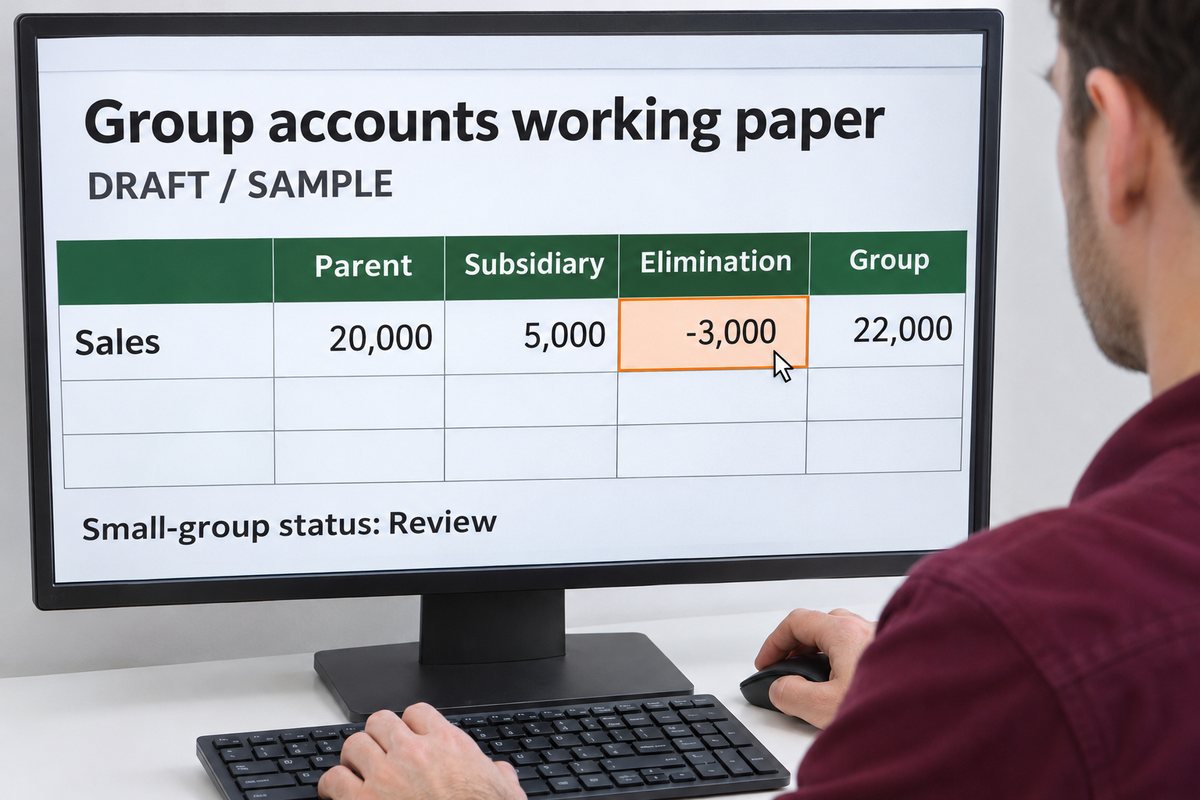
At a smaller scale, the cover's sample sales calculation is EUR20,000 + EUR5,000 - EUR3,000 = EUR22,000, assuming EUR3,000 is a valid internal-sales elimination. It illustrates removing duplication, not a complete consolidation method. Acquisitions, unrealised profits, investments, loans and different accounting policies can need additional treatment.
Ask for the size-assessment working paper separately from any full group accounts. The first establishes the classification calculation and evidence. The second is a statutory reporting engagement under the relevant framework, with statements and notes. A size worksheet is not a substitute for that finished reporting package.
4. Check the first holding year and the continuity rules
Under section 280B, the first holding-company financial year is the first year ending with one or more subsidiaries. It is not necessarily the parent's first year after incorporation. Later-year qualification looks at conditions and qualification in the preceding year as well as the relevant year.
For example, assume an eligible group qualifies in its first holding year and meets the size conditions. In year two it exceeds two limits. The continuity rule can preserve small-group qualification because the preceding year both met the conditions and qualified. If year three also exceeds two limits, that preceding-year support is no longer available. This example assumes no other change affecting eligibility.
Have the accountant document the route used for the actual year. Do not turn the rule into 'both years must always be below every limit', or assume that one bad year permanently prevents a return to small status. Preserve the prior assessment when changing advisers; last year's abbreviated accounts may not explain how the conclusion was reached.
5. Include the right subsidiary periods and reporting scope
The size test has a specific period rule. Under section 280B(9), use the subsidiary's financial year ending with the parent's year, or, if different, its financial year ending last before the parent's year-end. Do not automatically use only the months since acquisition for this classification calculation. Ask the accountant which entity statements support each figure.
Give the adviser foreign accounts, trial balances, currency information and accounting policies early. Explain acquisitions, disposals, dormant entities and newly formed subsidiaries. The assessment of periods for size classification should not be confused with how acquisition results are included in a consolidated set under the applicable reporting framework.
Where consolidated accounts are required or elected, section 294 addresses the Companies Act group reporting requirements. An alternative IFRS route also exists under section 293. Agree the framework and necessary reconciliations before requesting a price; a parent-company bookkeeping quote may not cover translating and aligning an overseas subsidiary's records.
Nor does a parent with very few staff automatically qualify for micro treatment. Section 280D requires small-regime qualification first and contains additional exclusions, including financial holding undertakings. Do not bypass the group assessment by applying only the parent's standalone micro numbers.
6. Keep consolidation, audit and each B1 on separate checklists
Section 293(1A) exempts a qualifying small-regime holding company from preparing group accounts, while allowing it to elect to prepare them. It does not waive the parent's entity accounts under section 290. Keep the subsidiaries' own accounting records and reporting obligations on their respective timetables too.
Audit exemption is a separate decision. Section 359 addresses the group size condition for that route, subject to the rest of the audit-exemption chapter. Do not treat the consolidation exemption as an audit opinion. Ask the accountant to check the relevant group, exclusions, filing history, member requests and any contractual audit requirement.
There is no single B1 that replaces every Irish group member's return. CRO describes an annual return for each company, including non-trading companies. Confirm the actual delivery deadline and attachment requirements for each Irish entity. The first return's accounts-attachment position is a distinct rule, not a permanent exemption for a holding company.
Section 347 governs the documents annexed to the annual return, subject to applicable exemptions. Have the preparer and presenter agree the final approved package, reports and certification. Ordering an annual-return service does not mean missing group accounts will be prepared or that an unresolved exemption has been approved.
7. If the small-group route is unavailable, ask about the actual alternative
Some intermediate holding companies may have another consolidation exemption where a higher parent prepares qualifying larger-group accounts. Sections 299 and 300 distinguish higher parents established under EEA law from those outside it. Both have detailed conditions; an overseas annual report alone is not enough.
Ask the adviser to identify the precise provision, ownership and member-notice conditions, inclusion in larger-group accounts, required audit, disclosures and documents to be delivered. Do not borrow a favourable condition from a different route. If no exemption applies, arrange the necessary group reporting before the Irish filing deadline becomes urgent.
Section 357 is a different subsidiary filing route involving a qualifying parent guarantee and other conditions. It is not the holding company's small-group consolidation exemption. Our separate Section 357 guide explains that distinction; it should not be used as a shortcut for a parent wishing to avoid its own assessment.
8. Prepare the accountant's group-assessment handover
Use this practical list before seeking an engagement. It is not an official universal attachment list. Send a short outline first and agree secure sharing for detailed financial records; do not paste bank credentials or sensitive shareholder information into a general enquiry.
- A dated ownership and control chart, with entity names, jurisdictions and changes during the year.
- The parent's year-end, first holding year and each subsidiary's reporting dates.
- Current and prior entity accounts or trial balances, with turnover, total assets and average employees.
- Intercompany sales, balances and supporting reconciliations for proposed eliminations.
- The prior small-group assessment, calculation basis and reasons for any carried qualification.
- Details of regulated activities, licences, ineligible status concerns and shareholder or lender requirements.
- The audit position, each Irish B1 deadline and any larger-parent accounts or proposed exemption.
- A task list allocating classification, accounts, consolidation if needed, audit, tax and CRO filing.
9. Request a quote for the work the group actually needs
StartCompany.ie's accounting service is an accountant-matching and quotation route. Describe the group, periods, records and unresolved classification questions. Ask whether an appropriately experienced accountant can provide the group assessment or consolidation work before relying on support.
Confirm the accepted scope and total payable in writing. An accounting referral is not an automatic consolidation engagement. Entity bookkeeping, group classification, consolidated accounts, statutory audit and specialist cross-border advice may be separate tasks with separate providers or fees.
Our Annual Returns service provides B1 preparation and filing support, including attachment of required financial statements. It does not automatically include preparing group accounts or a specialist exemption opinion. Agree who supplies the final accounts and who completes each filing. Buying support is neither an exemption decision nor evidence that a B1 has been delivered.
StartCompany.ie service
Accountant Services in Ireland
Official information and next steps
Primary sources checked on 15 November 2026. Limits shown are those in the current revised legislation and CRO group-company guidance, not an older leaflet's thresholds. Worked figures are fictional applications of the stated assumptions, not individual exemption rulings.
- CRO: group-company accounting and exemptions
- Companies Act 2014, section 7: subsidiaries
- Companies Act 2014, section 274: reporting definitions
- Companies Act 2014, section 275: measures and ineligible entities
- Companies Act 2014, section 280B: small-group qualification
- Companies Act 2014, section 280D: micro-company conditions
- Companies Act 2014, section 293: consolidation and exemption
- Companies Act 2014, section 294: group reporting
- Companies Act 2014, section 290: entity financial statements
- Companies Act 2014, section 359: group audit-exemption condition
- Companies Act 2014, section 347: B1 attachments
- Companies Act 2014, section 299: EEA higher-parent route
- Companies Act 2014, section 300: non-EEA higher-parent route
- CRO: filing each company's annual return