
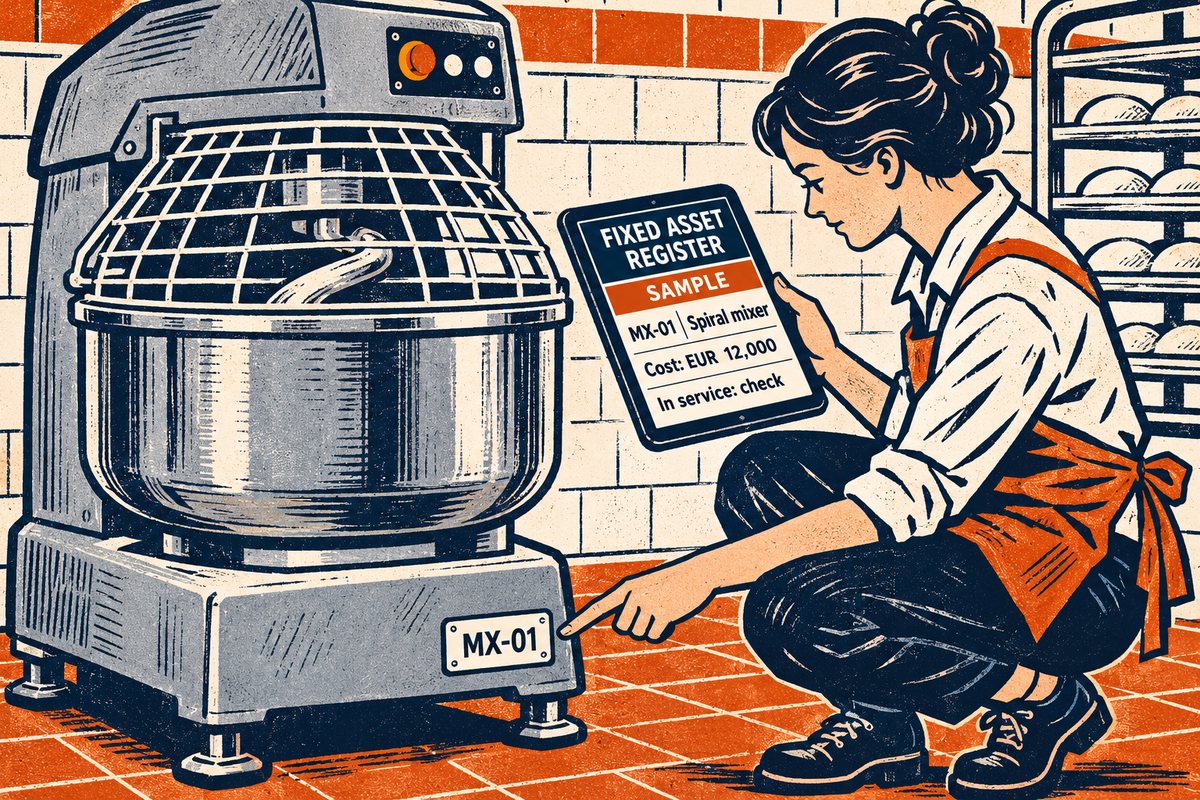
The company has bought its first serious piece of equipment: a EUR 12,000 mixer for a bakery. The bank account shows a payment, the supplier has emailed an invoice and the founder wants to know how much comes off this year's profits. The answer depends on which set of figures you mean.
This guide covers ordinary production equipment bought and owned by an Irish trading LTD, including a purchase financed with a separate bank loan. It does not classify leases, hire purchase, vehicles, buildings or special relief schemes. Official sources were checked on 21 November 2026.
1. Start with what the company actually acquired
A mixer bought for the bakery's own production line is not the same as flour that will be consumed or a mixer bought for resale. Identify what was bought, its expected use, who owns it and whether it will serve the business for more than one accounting period. Under FRS 102 Section 17, eligible tangible equipment held for production or business use is recorded as an asset when future benefits are probable and cost can be measured reliably.
Read the invoice and agreement, not just the bank description. A single payment labelled bakery equipment might cover installation, consumables, routine servicing and a replacement component. Ask the accountant to separate the lines. Directly attributable delivery and installation can form part of the accounting cost of getting a machine ready; ongoing service is a different question.
Do not use a guessed universal euro cutoff for expensing tools. Discuss materiality and the company's accounting policy, particularly if it purchased several related items. Confirm which reporting framework applies; the example here uses FRS 102 and is not an election to use that standard.
| Item | What to check |
|---|---|
| Production mixer | Asset recognition, cost and useful life. |
| Flour and packaging | Inventory or production cost, not a fixed asset simply because bought in bulk. |
| Routine service agreement | Separate from the asset price; check the period covered. |
| Separate bank loan | Track principal and interest; it does not replace the equipment record. |
2. Identify the buyer and track the financing separately
Check that the company is the purchaser on the agreement and invoice. If a director bought the equipment personally before incorporation or is transferring a used machine to the company, flag it as a different transaction. A reimbursement or a journal entry does not by itself establish that the company acquired title or that the invoice supports its tax claim.
For a straightforward owned purchase funded by a separate bank loan, keep the invoice and the lender's drawdown, repayment and year-end statements. The asset cost is not the amount of the down payment. Loan principal reduces the financing liability when repaid; the interest and fees need their own accounting and tax review. The bank feed alone rarely gives a good split between the two.
In the example, the bakery pays EUR 4,000 from its own cash and finances EUR 8,000 with a separate loan. The simplified starting records show the EUR 12,000 asset and EUR 8,000 borrowing, ignoring any separate VAT and fees. Paying instalments does not turn the cost into a series of equipment expenses. If the finance paperwork is a rental agreement or title remains with the supplier, do not apply this example without review.
3. Record the date the equipment is ready and the date it is used
Save the order, invoice, delivery and commissioning dates. Under the accountancy rules in FRS 102, depreciation starts when the asset is available for use: in the necessary location and condition to operate as intended. A deposit paid in October for a mixer still awaiting electrical installation in December does not establish that point.
For ordinary wear and tear allowances, Revenue's example conditions the claim on the machine being in use for the trade at the end of the relevant accounting period. Give the adviser evidence of actual business use and the period end. The accounting readiness date is not a substitute for the tax use check; nor is a supplier's invoice date proof that the equipment was installed.
If the machinery is not commissioned until January, show the accountant what actually happened rather than changing the date on the asset register to force a December claim. Also flag a first Corporation Tax accounting period shorter than 12 months, equipment used outside the trade, a move between businesses, or an asset acquired before the trade began. The standard annual allowance may not apply in full, even when there is a valid invoice.
4. Work the numbers from accounts profit to taxable profit
Assume the mixer is available for the full 12-month period, still owned and in use wholly for the bakery trade at the period end, with an eligible cost of EUR 12,000. Assume a four-year useful life, nil residual value and straight-line depreciation under the accounting policy. The full-year depreciation is EUR 3,000. This is a useful-life estimate for the illustration, not a standard four-year write-off for mixers.
The ordinary wear and tear allowance in this example is EUR 1,500, calculated as EUR 12,000 multiplied by 12.5%. Suppose trading profit in the accounts is EUR 24,000 after the EUR 3,000 depreciation. For this simplified computation, add back the depreciation, then deduct the EUR 1,500 allowance. That gives EUR 25,500 taxable trading profit before any other adjustments. It is not the tax bill.
Keep the bookkeeping and tax schedules together so nobody deducts the invoice, the depreciation and the allowance for the same expenditure. An allowance reduces the profit subject to tax if usable under the relevant rules. It is not a refund of EUR 1,500 or proof that tax is due in a loss-making year. Do not budget on accelerated relief unless the adviser has confirmed the specific scheme, asset and timing.
5. Separate recoverable VAT and keep the disposal evidence
If VAT is shown on the invoice, record the amount separately instead of automatically using the gross bank payment as the tax allowance base. Revenue links recovery to taxable supplies and qualifying activities, and requires records such as a valid VAT invoice. Mixed, exempt or private use can restrict recovery. Explain which activities use the equipment and ask how any unrecoverable amount affects the accounting cost and the tax computation.
Keep notes of grants, supplier credits and trade-in terms as well. A net payment cannot necessarily tell an accountant the price of the replacement asset or what you received for the old one. Keep the disposal date, sale invoice, settlement statement and any proceeds from insurance or salvage. The company should be able to connect those numbers with the original asset.
An accounting gain or loss on disposal is measured against the carrying amount in the accounts. The tax balancing calculation compares the relevant proceeds or other statutory value with the expenditure still unallowed. The results can differ. Ask for a balancing allowance or charge assessment where applicable; do not assume writing off an item in the books ends its tax treatment.
6. Send an asset register the accountant can reconcile
A simple asset list is enough to start. Give each machine a stable identifier. Link it to the source documents and keep the accounting value and tax value in separate columns or schedules. Reconcile purchases and disposals to the ledger and check that the listed machines are actually at the site. Section 282 sets requirements for adequate accounting records; Revenue also lists invoices and other documents businesses should keep.
Bring the open questions to the accounting quote rather than asking only for a generic year-end price. StartCompany.ie connects businesses with Irish accountants. Specify whether you need advice before signing, bookkeeping and reconciliation, the asset and capital allowances schedules, or accounts and CT1 preparation. Confirm what the accountant can take on, which periods are covered and the total payable before instructing work.
- Supplier invoice and quote, with the company named and the lines split.
- Asset ID, description, site and the part of the business using it.
- Order, delivery, installation, availability and actual-use dates.
- Finance agreement, loan statements, payments and unsettled balance.
- Tax invoice, business-use breakdown and any claim already made.
- Grants, credits, trade-ins, disposals or changes of use.
- Opening carrying amounts and previous capital allowances, if applicable.
- Accounting and tax period ends and the exact work needed from the adviser.
StartCompany.ie service
Accountant Services in Ireland
Official information and next steps
Official Revenue, Financial Reporting Council and revised Companies Act sources checked 21 November 2026. The worked example is illustrative and does not cover every financing, accounting or tax situation.
- Revenue: Corporation Tax capital allowances and deductions
- FRC: FRS 102, Section 17, property, plant and equipment
- FRC: UK and Ireland accounting frameworks
- Revenue: claiming a deduction for expenses
- Companies Act 2014, section 282: accounting records
- Revenue: who can reclaim VAT and invoice requirements
- Revenue: Part 9 notes, sections 284 and 288 to 290
- Revenue: records to keep