
You are ready to form an Irish LTD, but the founders want different things from their shares. One wants a larger say in decisions; another wants an agreed share of future income. Someone suggests A and B shares. Does typing those letters into the formation instructions solve the problem?
This guide helps buyers distinguish share numbers from the rights attached to them, and a straightforward incorporation from a structure needing bespoke advice. It concerns an ordinary private LTD, not a ready-made investment document, employee equity plan or drafting template. Settle the intended rights before authorising documents or promising an investor a particular outcome.
1. Start with rights, not the alphabet
Section 66 permits preferred, deferred or other special rights and restrictions, including for dividends, voting and return of capital, without prejudicing rights already conferred. The practical implication is that a class name alone cannot tell you the full arrangement. Do not assume Class A always means voting and Class B always means non-voting.
Likewise, ordinary is not a substitute for reading the documents. Ask which voting, income and capital provisions apply to the proposed ordinary shares and which other agreements affect decisions. Two companies can use familiar labels while their actual arrangements differ.
Write down the commercial outcome in plain English before asking for a class structure. Explain what should happen when profits are available, a founder leaves, an investor joins or the business is sold. A legal adviser can then assess which documents and rights are appropriate rather than translating an unexplained preference for alphabet shares.
2. Separate four questions in the ownership brief
A percentage table is useful, but it is not the entire agreement. Prepare a rights brief alongside the proposed share count so the presenter and advisers can see what is agreed and what remains unresolved.
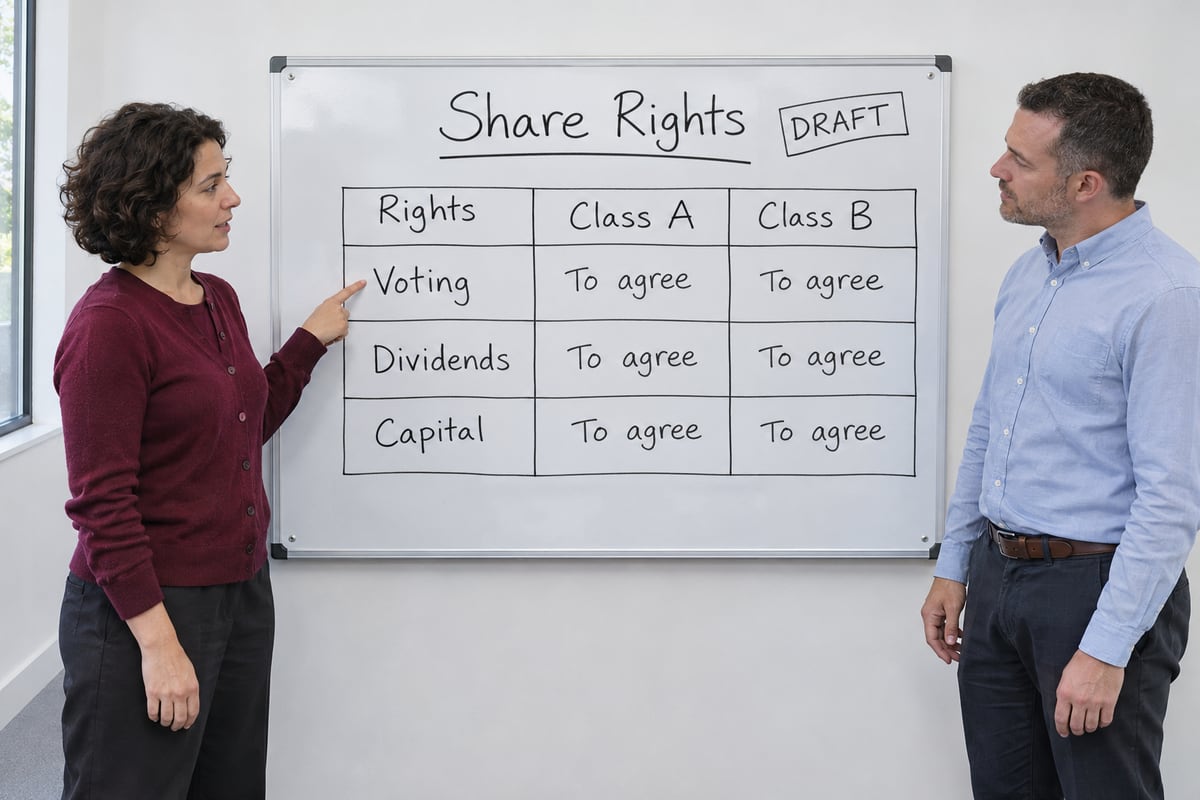
The table below is a discussion checklist, not standard wording to insert into a constitution. It deliberately asks questions rather than assigning a supposedly automatic privilege to Class A, Class B or ordinary shares.
| Question | What to settle |
|---|---|
| Share count | Who holds how many shares, of which class and nominal value? |
| Voting | Which member decisions can each holder vote on, and how? |
| Dividends | How do the documented rights govern any lawful distribution? |
| Capital | What rights apply to a return of capital or winding up? |
3. When one ordinary class may be enough
One class can be a sensible starting point where the founders intend the same rights per share. A larger holding then represents more shares of that same type, rather than a separate kind of entitlement. Still review the constitution and any founder agreement instead of assuming the share count resolves every issue.
Consider a fictional consultancy issuing 100 identical ordinary shares: Sam takes 60 and Lea takes 40. They have expressed the allocation clearly, but have not answered who sits on the board, what needs joint agreement or what happens if one founder stops working. Those are separate governance questions.
Unequal workloads do not automatically require separate share classes. Salary, service obligations, future funding and ownership should be discussed separately with the relevant advisers. Do not create a complicated capital structure merely because one founder expects to work more hours during the first few months.
Use our minimum-share-capital guide for the separate decision about share numbers and nominal value. More shares do not, by themselves, create better rights or a higher business valuation.
4. Voting rights are not the same as board management
Section 188 supplies voting rules subject to the constitution and attached class rights or restrictions. Its defaults distinguish a show of hands from a poll; the familiar one-vote-per-share rule applies on a poll, not as a universal description of every decision.
A proposal for 60 A shares and 40 B shares therefore needs more explanation than a simple 60/40 label. Establish what each class can vote on and how the relevant decision is taken. Check class consent, reserved matters and other agreed protections rather than promising that one founder will always control everything.
Do not treat a shareholding as a director appointment or a job description. Ask separately about the proposed board, authority to manage the business and decisions requiring member involvement. A non-voting description also needs careful review of statutory and class protections; do not promise that a holder can never have a say.
Give the adviser a short list of decisions you actually worry about, such as a new investor, major borrowing or a founder exit. That is more useful than asking for maximum control without explaining the intended relationship.
5. Dividend rights do not manufacture distributable profits
Section 117 prohibits distributions except from profits available for the purpose. A class carrying dividend rights is not a guarantee that cash can be paid whenever a founder asks. The company's accounts, applicable law and decision process remain relevant.
If the founders want different income arrangements, ask the lawyer and accountant to assess the proposal together. Clarify the rights, whether any preference is intended and the circumstances in which a distribution may be considered. Do not copy a clause from another company's documents or rely on an informal promise to sort dividends out later.
Keep work payments and investment returns distinguishable. Paying a director for services is not automatically the same task as declaring a dividend. Class labels are not a tax calculation: obtain advice on the actual payments and recipients instead of choosing A and B because somebody promised a tax result.
6. Capital and exit expectations need their own wording
Section 66 also recognises special rights concerning return of capital. A founder should not infer a liquidation or capital entitlement from the voting description alone. If an investor expects priority, explain the proposed order and limits to the drafting adviser.
Distinguish a company winding up from shareholders selling their shares. Ask how the intended exit works under the relevant transaction documents, rather than assuming one capital clause determines every sale price or distribution. This article does not supply an investment waterfall or recommend a priority arrangement.
Use a fictional example to test the commercial understanding: if the company closes after paying its liabilities, what does each founder expect? Then separately ask what they expect if a buyer offers to acquire their shares. Different answers are a reason to clarify the documents, not to leave everyone using the word exit differently.
7. Align the constitution, issue terms and founder agreement
Under section 31, the registered constitution binds the company and its members, subject to the Act. CRO's incorporation guidance requires the constitution and Form A1, including subscribers and their shares. The rights discussion should therefore be resolved in time for consistent formation documents.
A private shareholders' agreement can address additional commitments, but do not assume it silently rewrites the constitution or binds everyone who may later join. Have the drafting adviser align the relevant documents, parties, rights and decision rules.
Before signing, ask each founder to explain the outcome back in ordinary language. Can both describe the voting arrangement, lawful income rights, capital position and what remains subject to separate agreement? If the answers differ, pause rather than hoping that a class name will settle the disagreement.
Keep the final agreed versions together. Do not let the presenter work from one email, the accountant from another and the founders from an older draft. Formation instructions should identify the actual approved structure rather than a plan still under negotiation.
8. Changing class rights later is not always a simple rename
Section 88 sets different routes for varying class rights depending on how the rights are attached and what the constitution provides. In the section 88(2) case, written consent from holders of 75% in nominal value of that class, or a separate class special resolution, is required alongside other applicable requirements. That is not a universal rule that 75% of all shareholders can always rewrite every class.
For example, section 88(5) addresses rights attached by the constitution where it has no variation provision and requires agreement of all members. Have a solicitor assess the actual route, protections and documents before describing a proposed change as routine.
Section 90 separately addresses registration of specified special-rights, variation and designation particulars, with 30-day deadlines in its stated cases. A CRO notification records the relevant particulars; it is not permission to bypass the underlying legal decision.
If the company already exists, provide its current constitution, issue terms, registers and agreements. Do not simply edit a certificate from ordinary to A or B, overwrite the member record or backdate instructions. Agree the legal work and relevant filing responsibilities first.
9. New shares and beneficial ownership remain separate checks
Creating or issuing shares is not the same as changing rights on shares already held. Section 69 requires allotment authority and contains pre-emption provisions and exceptions. Do not assume a new class can be issued to an investor without reviewing the company's existing documents and holders' position.
Beneficial ownership also needs its own analysis. The RBO identifies more than 25% of shares, more than 25% of voting rights and control through other means as relevant routes. Its guidance warns against using the share percentage as the only test.
After designing different voting rights, revisit the ownership assessment rather than copying an old share-count spreadsheet into the RBO process. A class label does not create an exemption. Use the linked RBO guide for that separate exercise, and keep the reasoning and agreed company records consistent.
10. Send a usable rights brief before buying formation
Prepare a concise brief that distinguishes agreed commercial outcomes from open legal questions. Share it through the agreed onboarding process, without putting identity documents, private investment papers or unnecessary personal details into a general website enquiry.
StartCompany.ie's published packages include the listed incorporation work and core documents. The inclusion of a constitution and share certificates does not automatically include bespoke share-rights drafting, an investment agreement, employee equity advice or a legal opinion on an existing structure.
Compare the current formation scope, explain any special rights and ask whether the intended structure can be handled and which separate advice is needed. Confirm responsibilities, availability and the total payable before ordering. Do not authorise a straightforward setup while assuming a negotiated structure will be added unnoticed.
Where the rights are unresolved, contact the team first. Buying a formation package does not settle a founder dispute, approve a dividend, guarantee a tax result or make every share-rights arrangement appropriate.
- Identify the proposed holders, classes, numbers and nominal values.
- Describe the intended voting outcome and decisions needing special consent.
- Explain intended dividend and capital rights separately.
- Record founder departure, funding and investor expectations for legal review.
- Align the constitution, issue terms and any shareholders' agreement.
- Identify existing rights, consents and filing work if a company already exists.
- Arrange separate accounting, tax or employee-equity advice where needed.
- Confirm the formation scope, remaining decisions and total payable.
StartCompany.ie service
Compare Irish company formation packages
Official information and next steps
Official sources were checked on 2 November 2026. Class labels and fictional examples are discussion aids, not standard legal terms or approved rights. Obtain advice on the proposed constitution, issue terms, existing rights and any tax consequences before implementation.
- Companies Act 2014, section 66: special share rights
- Companies Act 2014, section 188: member voting
- Companies Act 2014, section 117: profits available for distribution
- Companies Act 2014, section 31: effect of the constitution
- Companies Act 2014, section 88: variation of class rights
- Companies Act 2014, section 69: allotment authority and pre-emption
- Companies Act 2014, section 90: registration of special-rights particulars
- RBO: beneficial ownership and voting control
- CRO: incorporation documents and subscribers' shares