
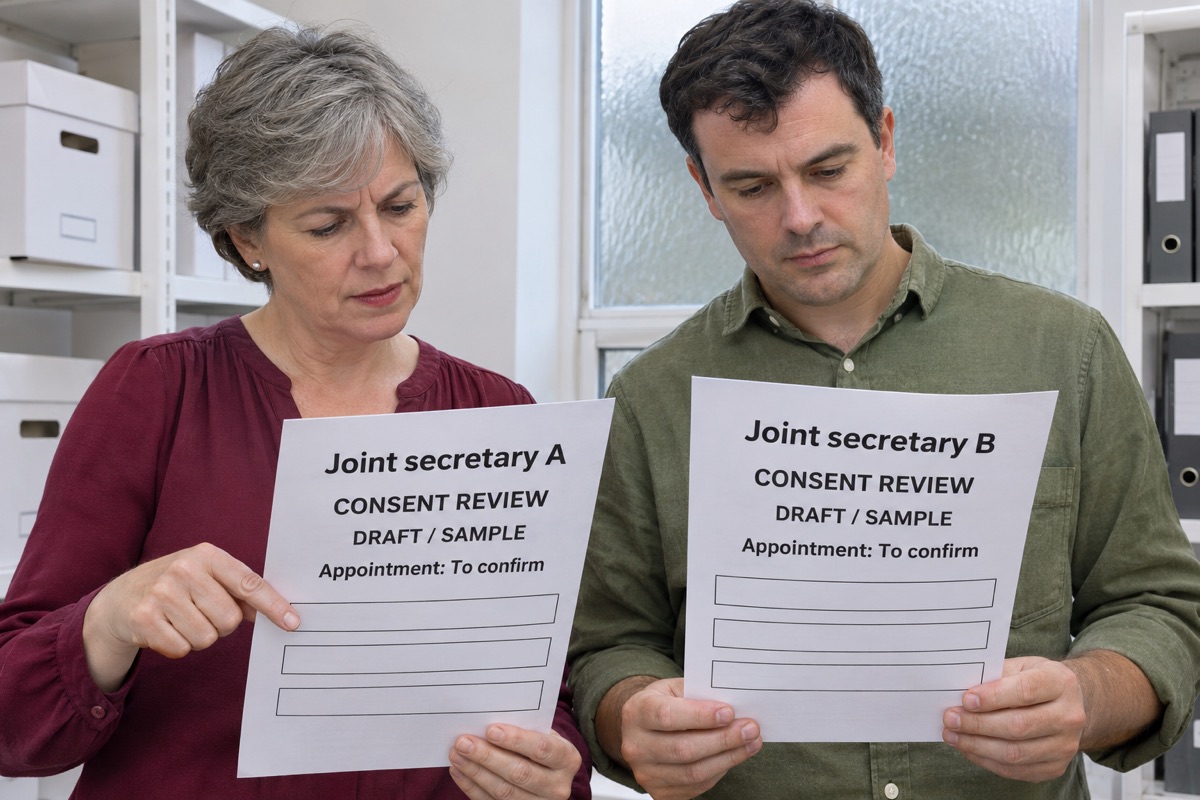
A founder wants an in-house administrator and an external professional to share company-secretary work. Another company wants holiday cover without losing its existing secretary. Both may ask for two secretaries, but they may need different arrangements. Start by identifying the proposed legal appointees, not merely counting the people replying to company emails.
This guide concerns an ordinary Irish private company limited by shares, or LTD. It explains the joint-appointment decision and a practical handover, not a universal consent template or advice on a disputed removal. CRO guidance and relevant legislation were checked on 12 November 2026. Check the constitution, existing appointments and proposed service terms before changing the officer position.
1. Decide whether you need two appointees or two working contacts
Section 129 expressly extends its appointment and related provisions to joint secretaries. A company can therefore consider two genuine office-holders, rather than treating secretary as a role that must always have one named individual. That does not mean every two-person support arrangement is a joint appointment.
Ask who will legally hold the office. If one corporate secretary provides two staff contacts, the appointee may still be one entity. If two individuals are to be appointed personally, record that clearly. A company email account, assistant job title or second contact on a service proposal is not a substitute for establishing the appointment.
The comparison below is a planning aid. Choose the arrangement that solves the actual problem: holding the office, maintaining records, obtaining signatures or simply having someone available to answer administrative questions. Do not buy another annual appointment before checking whether the existing engagement already provides the cover you need.
| Arrangement | Identify | Do not assume |
|---|---|---|
| Joint secretaries | Each appointee | Two contacts suffice |
| Corporate secretary | Legal entity | Staff hold office |
| Assistant or deputy | Role and authority | Same as joint office |
| Filing support | Agreed filing work | Secretary appointed |
2. A sole director cannot become one of the joint secretaries
An LTD with one director needs a separate secretary. Section 129(6) prohibits that director from also holding the secretary office, and subsection (7) applies the relevant provisions to joint secretaries. Adding another secretary does not create an exception that allows the sole director to join them in that office.
Consider a fictional founder who is the company's only director. The founder proposes to be joint secretary with an external professional. That is not a valid way around the restriction. The founder should remain outside the secretary appointment and arrange a suitable separate appointee; a second external appointee should serve a real need rather than repair an invalid combination.
For an LTD with more than one director, review the proposed roles and eligibility on their own facts. Do not confuse holding two offices, where permitted, with performing a particular document's director and secretary acts alone. The signing restriction discussed below remains a separate check.
3. Prepare an appointment pack for the actual people or entity
For an existing company, establish the board decision, proposed appointees, effective date, agreed term and scope. Review the constitution and current appointment documents first. Distinguish an invitation to discuss the role from a decision and consent that have actually been completed; do not record a proposed arrangement as already in force.
Section 149 addresses particulars for each joint secretary. Individual and corporate appointees require different details. The appointment notification also needs signed consent, with a specific statutory provision where all partners in a firm are appointed jointly. Do not assume a provider's trading name can replace the required particulars.
Use the proper current consent and filing process, including the statutory acknowledgement of legal duties. Check names, dates and capacity carefully, arrange secure collection of personal particulars, and keep the completed records together. Keep blank working templates separate from signed consents so a draft is not mistaken for evidence of an appointment.
4. Tell the presenter whether this is an addition or a replacement
Section 149 requires relevant officer changes to be notified within 14 days. CRO identifies Form B10 through CORE as the post-incorporation notification route. The company decision, consent, internal register and notification should describe the same event. Agree who prepares and reviews the submission rather than assuming the annual service purchase completes it.
If the current secretary remains, tell the presenter explicitly that the proposal is an additional joint appointment. Do not include an invented resignation to make the submission resemble a standard replacement. If someone is genuinely leaving, identify that separate cessation and its actual effective date.
CRO's B10 error guidance warns that a previous secretary's cessation is not inferred from appointing a new one, and stresses accurate event dates. Ask how the intended continuing joint position will be recorded under the current filing process. Do not guess an interface option, backdate a decision or treat an upload receipt as proof the officer record is correct.
5. Agree a work split without inventing a split in legal duties
Section 226 addresses board-delegated work without removing statutory and other legal duties, and expressly includes joint secretaries. It also concerns the skills needed to maintain, or arrange maintenance of, required non-accounting records. Two appointees are not a reason to leave the company without a clear records process.
Write a responsibility list in operational terms. For example, one person may collect director decisions and maintain the working register, while another coordinates a particular filing. Identify who reviews each update, where the current record is stored and who tells the other appointee about a change. These are proposed working arrangements, not an automatic statutory division.
Do not describe the role as each person taking half the liability or assume an internal allocation removes a legal duty. Equally, do not assume both must duplicate every administrative task. Discuss the actual engagement and obtain advice for disputed responsibility or liability rather than relying on a homemade percentage split.
6. Plan signatures by document and capacity, not headcount
Section 134 prevents a requirement for a director and secretary act from being satisfied by one person acting in both capacities. CRO's dual-capacity guidance highlights A1 and B1 and requires different people for those two roles. A joint appointment does not allow a person to sign twice under different labels.
For each forthcoming submission, identify the actual director signatory, secretary signatory and filing route. Check the constitution and appointment terms, including any relevant joint-action arrangements. Do not infer from the word joint that every document needs two secretary signatures, or promise that either appointee can independently do everything. Confirm the requirements for the particular act.
Also distinguish signing the annual return from certifying copies of the supporting accounts. Section 347 addresses certification of the filed copies by a director and secretary. An appointment does not prepare the accounts or approve the financial statements for the board. Give the accountant and presenter one agreed document list and the final versions to be signed.
7. Compare two practical setups before paying
In the first fictional setup, an existing secretary wants to remain in office while a second person helps with statutory records. Ask whether a formal joint appointment is intended, or whether the second person is providing defined support without becoming an office-holder. If both are to hold office, the records and engagement should say so; do not leave the answer buried in an informal email.
In the second setup, a professional firm promises cover from several colleagues. Establish whether the secretary will be the firm as an eligible corporate appointee or a particular individual. Cover by another employee is not necessarily a new appointment, while a personally appointed individual's departure needs separate attention. The corporate-secretary guide linked below explains that identity check.
In both cases, ask what problem the second person solves and what additional cost or administration follows. One capable appointee with a reliable contact process may meet the need. Two genuine appointees may be useful where the board has a reason and a workable scope. Neither headcount nor a professional label guarantees compliance.
8. Document absence cover and later departures
Keep planned leave, incapacity and resignation separate. Section 129(2) provides a hierarchy for functions where the office is vacant or no secretary is capable of acting: an assistant or deputy, then an appropriately authorised company officer where necessary. That is not a blanket authorisation for any colleague to sign any document.
Build an absence plan before a deadline. Record contact details, who checks incoming notices, who can obtain the latest company records and what authority must be checked before an urgent act. If joint secretaries are appointed, confirm their availability and the relevant signing arrangements rather than assuming that the other person will always be reachable.
When a joint appointee leaves, review the remaining officer position, engagement and open work. CRO says a notification leaving the company without a secretary will be returned. Do not treat a second name as proof of ongoing availability, or ignore a real cessation because another appointee remains. Record and notify the actual change using the appropriate process.
9. Confirm the secretary-service scope before ordering
StartCompany.ie's published company secretary service is a 12-month nominee engagement with compliance reminders, officer-filing guidance and statutory-record guidance. A bespoke joint arrangement is not promised by that description. Explain the existing office-holders and ask whether the proposed arrangement can be accepted, who would be appointed and what signing cover is available before ordering.
Annual-return preparation, registered office, share transactions and other filings are separate unless expressly included. Changing an existing secretary is also a distinct service. Confirm the appointment, any change-filing work and total payable separately; do not buy two appointments on the assumption that this automatically creates a suitable joint setup.
Renewal is arranged separately, not by an automatic subscription through the published checkout. Before engaging a provider, keep this brief ready and request an agreed secure route for personal records:
- Current directors, secretary appointees and the reason for proposing a joint arrangement.
- Whether each existing appointee will remain or genuinely cease.
- Exact proposed appointees, consent status and intended effective dates.
- Constitution or engagement conditions needing review.
- Upcoming filings, distinct signatories and any absence-cover requirement.
- Responsibility for registers, notices, drafts and submission follow-up.
- Appointment, notification and additional work accepted, with the total payable.
StartCompany.ie service
Company Secretary Service Ireland
Official information and next steps
CRO guidance and the Companies Act 2014 provisions linked below were checked on 12 November 2026. Examples are fictional planning scenarios. This guide does not provide a consent template, determine disputed appointment rights or confirm that a particular joint arrangement is available through a service provider.
- Companies Act 2014, section 129: appointment and joint secretaries
- Companies Act 2014, section 149: particulars, notifications and consent
- Companies Act 2014, section 226: duties and non-accounting records
- Companies Act 2014, section 134: separate director and secretary capacities
- Companies Act 2014, section 347: certification of filed copies
- CRO: officer-change notifications and Form B10
- CRO: common Form B10 errors, cessation and effective dates
- CRO: dual capacity and two distinct signatories
- CRO: duties of directors and secretaries