
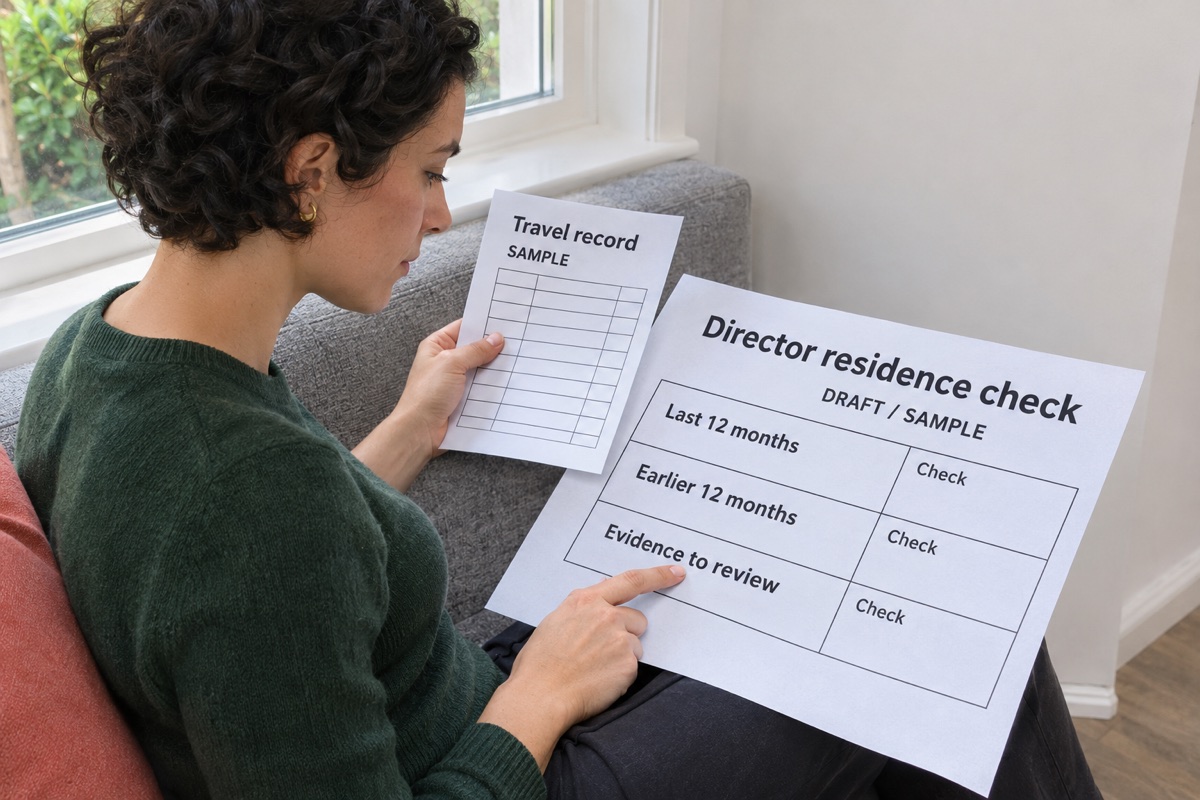
You have moved to Ireland, signed a tenancy and want to register an Irish LTD. The formation provider asks whether any director is EEA-resident. It is tempting to answer yes because you now have an Irish address, but company law asks a more specific question when Irish residence is the basis relied on.
This guide is for recent arrivals choosing a formation route, especially someone arriving from outside the EEA with no other qualifying director. It explains the day-count review and the separate tax-election alternative, rather than repeating our general bond guide. Official sources were checked on 9 November 2026. Obtain advice on your actual facts before declaring residence or making a tax election.
1. Check the board, not the passport or package label
Section 137 normally requires at least one director resident in an EEA state, subject to its bond exception and section 140. It does not require every director or shareholder to live in Ireland. An Irish registered office, secretary or shareholder is not a substitute for a qualifying director.
Start by listing the actual proposed directors and the residence basis for each. The EEA includes EU member states, Iceland, Liechtenstein and Norway; the UK is outside it. Citizenship alone does not answer where a person resides. A package described as 'resident' is a commercial description, not a legal finding about the buyer.
If you have moved from another EEA country, do not assume the only possible basis is your new Irish residence. Ask about the actual continuing residence position. Section 141 determines residence in Ireland for the specified company-law purposes; it is not a universal Irish day-count test imposed on residence in every other EEA state.
2. Use rolling periods for the Irish company-law test
Section 141 assesses the position at a particular relevant time. Its physical-presence routes are at least 183 days in the immediately preceding 12 months, or at least 280 days across that period and the preceding 12-month period, subject to the 30-day restriction discussed below. These are not simply January-to-December totals.
The section counts personal presence in the State, with presence during any part of a day counting as a day. Remote work for an Irish company while physically abroad does not turn that day into an Irish-presence day for this test. Nor do future planned days supply a completed travel history.
Ask the adviser to identify the relevant assessment time and the exact window boundaries before counting. Label the worksheet with those dates and retain the calculation. If filing is delayed or travel plans change, ask whether the assessment must be refreshed rather than recycling an earlier answer.
3. Do not overlook the 30-day restriction
For the 280-day physical-presence route, a large older total is not sufficient where presence in the immediate 12-month period is 30 days or less. Section 141(2) contains that restriction. Do not add the two columns and stop as soon as the sum reaches 280.
The examples below use fictional, already-verified day totals in the correct windows. They isolate the physical-presence calculation only. They do not assess another EEA residence, an election, immigration conditions or whether the individual is otherwise eligible to be a director.
| Immediate / earlier 12 months | Physical-presence result | Reason |
|---|---|---|
| 183 / 0 days | Meets the 183-day route | Immediate-period threshold reached |
| 120 / 165 days | Meets the 280-day route | 285 combined; immediate period exceeds 30 |
| 20 / 270 days | Does not meet these presence routes | Only 20 immediate days, despite 290 combined |
| 45 / 0 days | Does not meet these presence routes | Neither numerical threshold reached |
4. Keep this separate from personal tax-residence counts
Revenue's ordinary personal tax-residence guidance also uses 183-day and 280-day figures, but its periods are tax years. An Irish tax year runs from 1 January to 31 December. Similar numbers do not make that calculation interchangeable with section 141's rolling windows.
Maintain clearly labelled calculations rather than one spreadsheet headed 'resident'. Ask the tax adviser and formation presenter which question each conclusion answers. A personal tax return, payroll setup or bank onboarding answer should not be copied into the formation file without checking its basis and relevance.
For a founder who travels often, identify where every day actually falls and avoid counting the same day twice within one calculation. Give the adviser any uncertain journeys to resolve. This is a record-preparation exercise, not permission to extend tax exceptions automatically into company law or select whichever period produces the preferred answer.
5. A tax-residence election is a real alternative to review
The physical-presence routes are not the only wording in section 141. Subsection (1)(b) also recognises a relevant time falling in a year of assessment for which the person has made an election under section 819(3) of the Taxes Consolidation Act 1997. Therefore, 'you must always wait 183 days' is not a complete explanation.
Revenue's residence manual explains that the individual must elect and satisfy an authorised Revenue officer that they are in Ireland with the intention and circumstances to be resident in the following tax year. It says the election should be written and that there is no provision for withdrawal. An intention to investigate an election is not the same as having made one.
Ask a qualified tax adviser whether the conditions are met, what year is involved and what evidence supports the position. Have the formation presenter confirm how that assessed position will be documented before relying on it. Do not declare the election completed merely because you ticked a residence box on an incorporation questionnaire.
6. Assess the tax consequences before trying to save a bond premium
Revenue warns that choosing Irish tax residence brings worldwide income into the tax picture. Obtain a personal assessment of the election's consequences, including overseas employment, business income, investments, reliefs and any relevant treaty or domicile issues. Do not treat a formation-provider quotation as that assessment.
Prepare an income-and-country summary for the adviser before making the decision. Explain the expected residence pattern next year, any continuing overseas business and whether another country also regards you as resident. An election is not just an administrative substitute for an insurance document.
Revenue also limits its Letter of Residence to confirming tax residence to a foreign tax authority under a double-taxation agreement. Do not assume that requesting that letter supplies a general-purpose CRO residence certificate or establishes that an election has been made. Ask precisely which evidence the recipient needs.
7. Prepare evidence, not just a proof-of-address document
A utility bill may be useful for an identity or address check, but it is not a day-by-day travel record. Prepare the chronology first, using available travel confirmations and other reliable evidence of actual presence. Explain gaps or uncertain dates instead of filling them from memory to reach a target.
The following is a suggested adviser briefing pack, not an official CRO attachment list. Agree what must be supplied, through which secure channel and to whom. Do not send a full personal tax file to every formation contact when an appropriate assessed conclusion or narrower evidence will do.
- Proposed directors and the residence basis relied on for each.
- The relevant assessment time and both rolling-window boundaries.
- Actual Irish-presence days, source records and unresolved journeys.
- Any election already made, its year and relevant correspondence for adviser review.
- Separate immigration and personal-tax questions needing specialist advice.
- A named person to confirm the formation route before filing.
8. Choose a compliant formation route while the position is unresolved
Section 22(6) requires the prescribed bond at incorporation where none of the first directors is EEA-resident. Do not file on the assumption that residence will be established later. Explain the uncertain point to the presenter before submitting or buying a package on an unsupported basis.
The section 137 bond has prescribed coverage of EUR 25,000; that is not its purchase price or general business-debt insurance. Compare the actual package inclusions and total payable. A genuine qualifying co-director is another possible arrangement, but appointing someone is not the same as borrowing their address.
Section 140 provides a separate certificate route for a company with a real and continuous economic link to the State. A plan to apply is not a certificate in force. Our B67 guide covers that process; it should not be presented as an automatic incorporation-day exemption for a newly arrived founder.
9. Agree the formation instructions and keep the questions separate
Imagine a fictional founder who recently arrived from outside the EEA, has 45 verified Irish-presence days and no earlier Irish visits. No other proposed director is EEA-resident. The founder should not choose a standard route solely because a lease is now in their name. They first obtain the residence and election assessment, then agree the appropriate formation instructions.
If the election route is unsuitable, unavailable or not established for the relevant position, they discuss the bond package rather than changing their travel dates on paper. If a qualifying basis is established, the presenter can assess the appropriate package. Neither outcome guarantees incorporation, a bank account or a tax result.
Company tax residence is another question. Revenue generally treats a new Irish-incorporated company as Irish tax resident unless a relevant treaty treats it as resident elsewhere. That does not turn its founder into an Irish-resident individual. Personal permission to live or work in Ireland also remains separate from incorporation.
StartCompany.ie offers formation packages, including the Non-Resident route with a two-year director bond. Compare current inclusions and total payable, explain the recent move and ask which evidence is needed. Do not assume a package includes a personal tax-residence opinion, election preparation, immigration advice, a nominee director or foreign-country tax advice. Resolve that scope before ordering.
StartCompany.ie service
Irish Company Formation Packages
Official information and next steps
Official CRO, Revenue, Immigration Service Delivery and revised Companies Act sources checked on 9 November 2026. Revenue's linked residence manual was last updated February 2025. This is a formation-planning guide, not a personal residence opinion, day-count certification, tax election or tax/immigration advice. The relevant time, presence evidence, any election and residence in another EEA state require case-specific assessment.
- Companies Act 2014, section 141: residence in the State
- CRO: company officers and EEA residence
- Revenue: personal tax residence, elections and letters
- Revenue: residence of individuals, Part 34-00-01
- Companies Act 2014, section 22: formation particulars and bond
- Companies Act 2014, section 137: director residence and bond
- Companies Act 2014, section 140: economic-link certificate
- Revenue: company residency rules
- Immigration Service Delivery: immigration permission conditions