
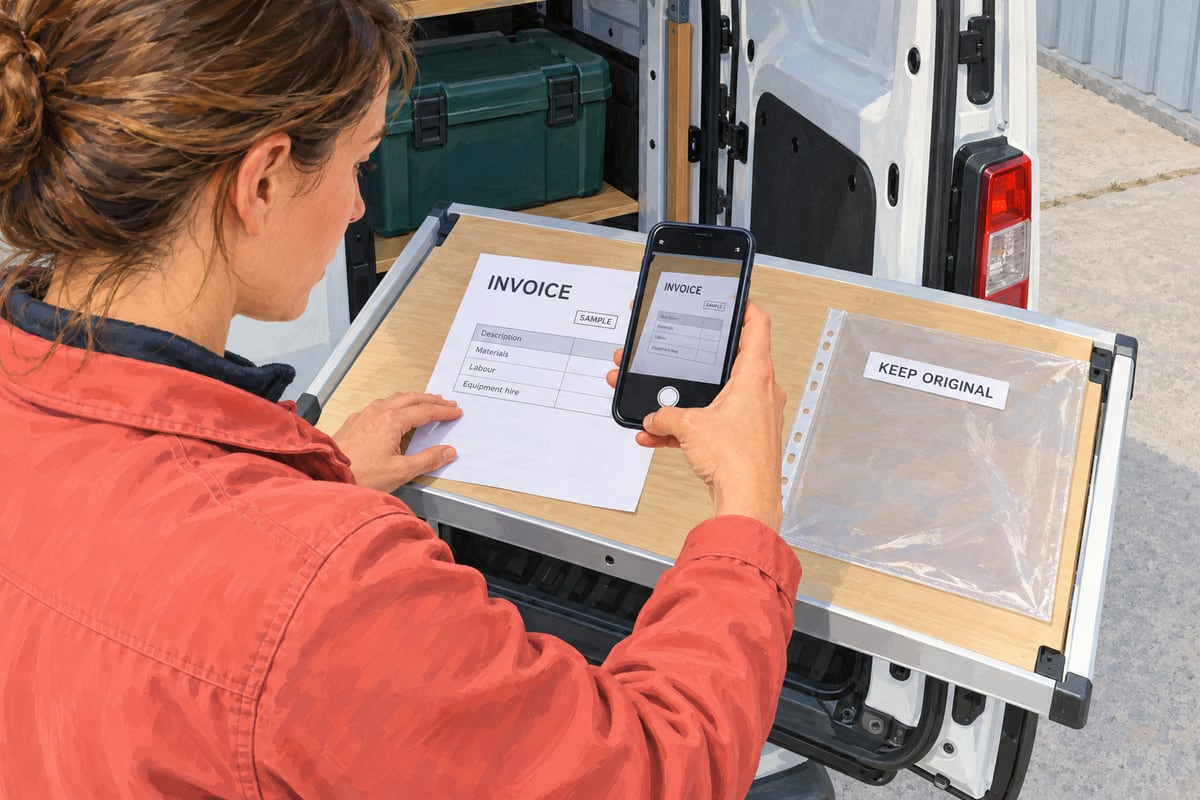
A box of invoices is taking up space, your accountant accepts uploads, and a phone can scan a page in seconds. Can an Irish limited company photograph everything and shred the paper? That is a different question from whether digital bookkeeping is convenient.
This guide helps a small Irish LTD plan document capture, retention and accountant handover. It focuses on the decision to replace originals, not the separate question of whether an expense is deductible or VAT is recoverable. It is not approval of a particular app, a destruction authorisation or a complete records policy for a regulated business.
1. Separate capture, bookkeeping and permission to discard
Taking a photograph creates an image. Posting a purchase to the ledger creates an accounting entry. Deciding whether the original can be discarded is a third task. An app completing the first two does not automatically answer the third.
Start with a small inventory rather than a box marked old paperwork. Identify paper invoices, originally electronic documents, bank records, payroll evidence and company documents. Note what the accountant already holds and what exists only on a director's phone or in a supplier portal.
Use the comparison below as a triage tool, not an exhaustive legal classification. A document may support more than one obligation. Where the applicable rules are unclear, keep the original while obtaining advice; storage inconvenience is not a reason to guess.
| Record type | First decision |
|---|---|
| Paper VAT invoice | Retain paper; check the VAT-specific rules |
| Original electronic invoice | Preserve the electronic record and supporting trail |
| Poor or incomplete scan | Resolve the capture problem; do not discard evidence |
| Signed company document | Assess its own execution and retention requirements |
2. General electronic storage is conditional, not a blanket exemption
Revenue manual 38-03-14 requires complete, unchanged, readable records, a scanning audit trail and reproducible copies. Electronic originals cannot be replaced by paper printouts alone. Its conditional treatment of third-party paper originals does not override additional VAT requirements. Poor-quality originals or physical alterations invisible in a scan can require paper retention.
For a practical review, ask the accountant which categories your proposed process can cover and which remain outside it. Avoid asking only whether a named product is popular. A good product can still be used badly, with missing pages, inaccessible accounts or records assigned to the wrong company.
Write down the agreed decision for each category before a clearance day. Make unknown, awaiting review and retain paper legitimate outcomes. Do not treat an informal instruction to upload this month's invoices as permission to destroy every historic document in the building.
3. Paper VAT invoices need a separate answer
Revenue's VAT retention page specifically says to keep paper-issued invoices in paper form. It also says paper records should be kept within the State, with exceptions requiring Revenue agreement and conditions. Scanning for convenient processing does not remove those instructions.
Electronic VAT invoicing is separately subject to agreement between the parties. Revenue describes retrievable records, reproducibility, source validation, content integrity and a reliable transaction audit trail. A photo of a paper invoice and a supplier's originally electronic invoice should not be treated as interchangeable merely because both display on a screen.
Keep a clear note of how each invoice arrived. Do not relabel a scanned paper invoice as originally electronic to fit your storage plan. If an adviser proposes a different arrangement, ask for its basis and any necessary Revenue agreement before implementing it.
This is educational VAT guidance about record format. It does not establish that the company may reclaim a particular invoice's VAT. The supplier document, purchaser, transaction and other entitlement conditions still need their own review.
4. The company needs usable accounting records, not only a photo archive
Section 282 requires records that explain transactions and support an accurate understanding of the company's position and financial statements. Entries must be timely and consistent. Records outside bound books require safeguards against falsification, and the information must be accessible and convertible into written form in an official language.
Design the link between the document and the transaction. For a purchase, can the reviewer identify the supplier, invoice reference, business purpose, payment and ledger entry? For a customer refund, can they find the original sale and the correction without reconstructing a conversation from memory?
A directory containing hundreds of images called scan001 is not a useful handover just because every file opens. Conversely, a tidy spreadsheet without the underlying evidence leaves another gap. Agree which system holds the ledger, which holds the source documents and how they connect.
Keep source material and your working explanations distinguishable. A note explaining a cost is useful context, but it should not be edited to look like a supplier-issued invoice. Corrections should be understandable to someone who did not perform the original bookkeeping.
5. Put the retention date on the record category
Section 285 requires accounting records to be preserved for at least six years after the end of the financial year containing the latest date to which they relate. That is not simply six years from the day a phone took the photograph.
For example, take a fictional company with a 31 December 2026 year-end and a record relating only to March 2026. The company-law minimum runs to the end of 2032. If that record relates to a later date as well, or another obligation applies, reassess the period instead of using this example as a universal deletion date.
Revenue's VAT guidance also identifies extended retention situations involving claims, appeals and enquiries or investigations. Do not let automatic deletion remove records relevant to an unresolved matter. Ask the adviser how tax, company-law, contractual and sector-specific requirements interact for the actual material.
The Data Protection Commission explains that GDPR does not impose one fixed retention period for every data type; statutory obligations matter. Keep a justified retention schedule, restrict access and arrange secure disposal when continued retention is no longer necessary. Neither keep everything forever nor GDPR means delete all old invoices is a sound policy.
6. Make capture quality a routine check
Choose a practical capture point: after a purchase, when opening post or during a regular bookkeeping session. Allocate responsibility so that two people do not both assume the other uploaded a document. For recurring suppliers, identify whether the original normally arrives by email, portal or post.
As a practical quality check, open the saved file rather than relying on a tiny thumbnail. Check every page, the edges, orientation and legibility. Look for folded corners, glare, cropped totals, missing reverse-side information and attachments. If the original is fading, raise the problem promptly while a genuine replacement may still be available.
Use a consistent reference that a colleague can search. A useful naming convention might combine date, supplier and invoice reference, while the ledger carries the matching document identifier. This is an organisational example, not a prescribed Revenue filename or scanning resolution.
Test one complete purchase from capture to the accountant's review. Ask the reviewer to find it without being told which folder contains it. If that takes a chain of personal messages, fix the process before expanding it to several years of records. A readable image still needs the correct filing and accounting treatment.
7. Protect access and test recovery
The DPC's security guidance covers risk-appropriate safeguards, access limited to what people need, backups and regular review. A receipt archive may contain personal addresses, employee information and bank details as well as commercial data.
Give the company a clear ownership and access plan for its records. Ask who can administer the storage account, how an accountant receives appropriate access and what happens when a director or staff member leaves. Avoid building the only archive inside a departing worker's personal account.
As a practical recovery exercise, retrieve a selected older file from a backup and check that its related ledger reference still works. Document who performs this check and what happens if it fails. Syncing a deletion across devices is not a useful answer to a request to recover the missing record.
Keep passwords and private records out of general website enquiries. Use the secure channel agreed with the adviser for samples and handover. Accountant access should support the agreed work without becoming an excuse to circulate an unrestricted download link to everyone involved.
8. A fictional contractor's mixed paper and digital handover
Imagine a small electrical contractor operating through an LTD. The director captures a paper supplier invoice at the van after a job, then places the original in a retained-paper file. The image helps with timely bookkeeping; it is not used as permission to discard the paper VAT invoice.
A second supplier emails its invoice. The company saves the original electronic document with the purchase record instead of depending on a portal that might later close. A payment is then matched to the correct purchase; the bank entry is not substituted for the supplier document.
At month-end, the accountant receives an indexed handover identifying missing pages and unresolved items. The director can distinguish captured, checked, posted and queried transactions. None of those status labels is presented as proof of deductibility, a completed tax return or an approved storage system.
This example shows a practical mixed-format approach. Going digital need not mean removing every paper file immediately. The better buying question is what process will let this company produce reliable evidence with manageable recurring work.
9. Do not cancel old systems before the retention question is settled
Revenue's manual addresses continuing old systems or applications for required retention periods unless specific approval to discontinue support is obtained. It also calls for an annual systems audit and leaves responsibility with the taxpayer when storage is outsourced.
Before changing software, ask what the export actually contains: ledger detail, original attachments, references, corrections and usable supporting information. Arrange a trial retrieval with the adviser. Do not assume a year-end PDF summary is equivalent to the full record set.
Agree the transition and any required approval before cancelling access. Ask what the provider retains after termination, what remains available to the company and how historic requests would be answered. Do not interpret buying a new subscription as resolving those questions.
Record location is another separate issue. For cloud or overseas arrangements, use the linked records-kept-abroad guide and have the actual location, access and notification requirements assessed. A convenient login is not, by itself, a conclusion that every storage-location rule is satisfied.
10. Scope the accounting help before ordering
StartCompany.ie's accountant service connects businesses with qualified Irish accountants. Explain your record volumes, formats, software, financial period and the decision you need reviewed. Accountant matching is not itself approval to destroy originals.
Ask whether the proposed engagement includes reviewing the storage process, setting up bookkeeping, checking a sample capture, reconciling historic records or preparing accounts and returns. Scanning a backlog, configuring software and assessing retention are not automatic inclusions merely because you asked for an accountant.
Confirm availability, responsibilities and the total payable for the agreed scope. A short general enquiry can describe the issue without attaching private documents. Keep the existing evidence while the review is arranged; no service order repairs a destroyed original or guarantees Revenue acceptance.
- Inventory paper, originally electronic and signed company documents separately.
- Identify the applicable retention and format rules for each category.
- Keep unresolved and paper-retention categories out of any disposal process.
- Test a complete capture and its link to the ledger.
- Agree company ownership, authorised access and recovery arrangements.
- Review historic access before changing software or provider.
- Assign ongoing checks, review dates and an escalation contact.
- Confirm the accounting engagement, remaining founder tasks and total payable.
StartCompany.ie service
Accountant Services in Ireland
Official information and next steps
Official sources were checked on 1 November 2026. Revenue manual 38-03-14 is marked last reviewed November 2025; the VAT retention page is dated 27 April 2026. Practical examples are fictional workflow aids, not approval of a system, tax claim or document destruction.
- Revenue: keeping business records
- Revenue manual 38-03-14: electronic record retention
- Revenue: VAT record format and retention
- Revenue: electronic VAT invoicing requirements
- Companies Act 2014, section 282: adequate accounting records
- Companies Act 2014, section 285: retention period
- Data Protection Commission: data security guidance
- Data Protection Commission: personal-data retention