
You have kept the receipts, reconciled the company bank account and found a software report labelled profit and loss. Can you turn those records into the Irish LTD's annual accounts yourself, or must you pay an accountant? The answer depends on more than the number of transactions.
This guide is for directors deciding how to organise year-end accounts preparation, not just company incorporation. It explains where DIY work can fit, what a bookkeeping export does not prove and how to obtain a useful quote for the remaining work.
1. What the law actually requires
Section 290 of the Companies Act 2014 places the duty to prepare annual entity financial statements on the directors. Section 281 requires adequate accounting records. Those obligations are not expressed as a universal requirement to buy an external accountant's preparation service. The practical conclusion for an ordinary audit-exempt LTD is that competent in-house preparation is possible; it is not a finding that every director or software package is competent.
Section 291 requires the relevant Companies Act statements to comply with applicable accounting standards and the Act. A business being small, owner-managed or simple does not make an improvised cash summary sufficient. Identify the reporting framework and eligibility for any small or micro regime before choosing a template.
This article does not assess a regulated company, complex group or specialist reporting framework. If an audit is required, accounts preparation and the independent statutory audit are different engagements. Do not treat the ability to prepare a draft as permission to replace the required auditor.
2. Separate the jobs before comparing costs
Bookkeeping supplies the evidence and ledger, but year-end accounts turn those records into financial statements. Filing is the delivery step. A quote for one job should not be read as including all three, or the company's tax work.
CRO's records guidance explains that records must support the company's financial position and preparation of the required statements. Use the distinctions below when asking what is included. A report being available for download does not establish that all necessary review and adjustment work has happened.
| Work | What to confirm |
|---|---|
| Bookkeeping | Source documents, coding and reconciled balances. |
| Annual accounts | Year-end adjustments, framework, notes and complete statements. |
| CRO annual return | B1 details, required attachments and filing confirmation. |
| Company tax | Tax computation, CT1 and any required iXBRL submission. |
3. When self-preparation is a realistic option
DIY is more realistic where someone within the company understands double-entry accounting, the applicable reporting rules and year-end adjustments, and has time to document their work. Few transactions help with workload; they do not substitute for that knowledge. Being comfortable with a spreadsheet is not the same as understanding statutory accounts.
Ask yourself whether you can explain each balance, reconcile it to evidence and identify what has not yet been recorded. Could another competent person follow the adjustments from the ledger to the final statements? Can you explain why a director's payment is salary, an expense repayment or a loan rather than choosing a convenient label?
Bring in support early where there are unresolved director loans, missing records, stock valuation, leases, investment, group balances, overseas activity or uncertain tax treatment. You may still handle day-to-day records. Outsourcing the difficult year-end work does not require outsourcing every transaction.
4. Example: a balanced bank account is not a finished year-end
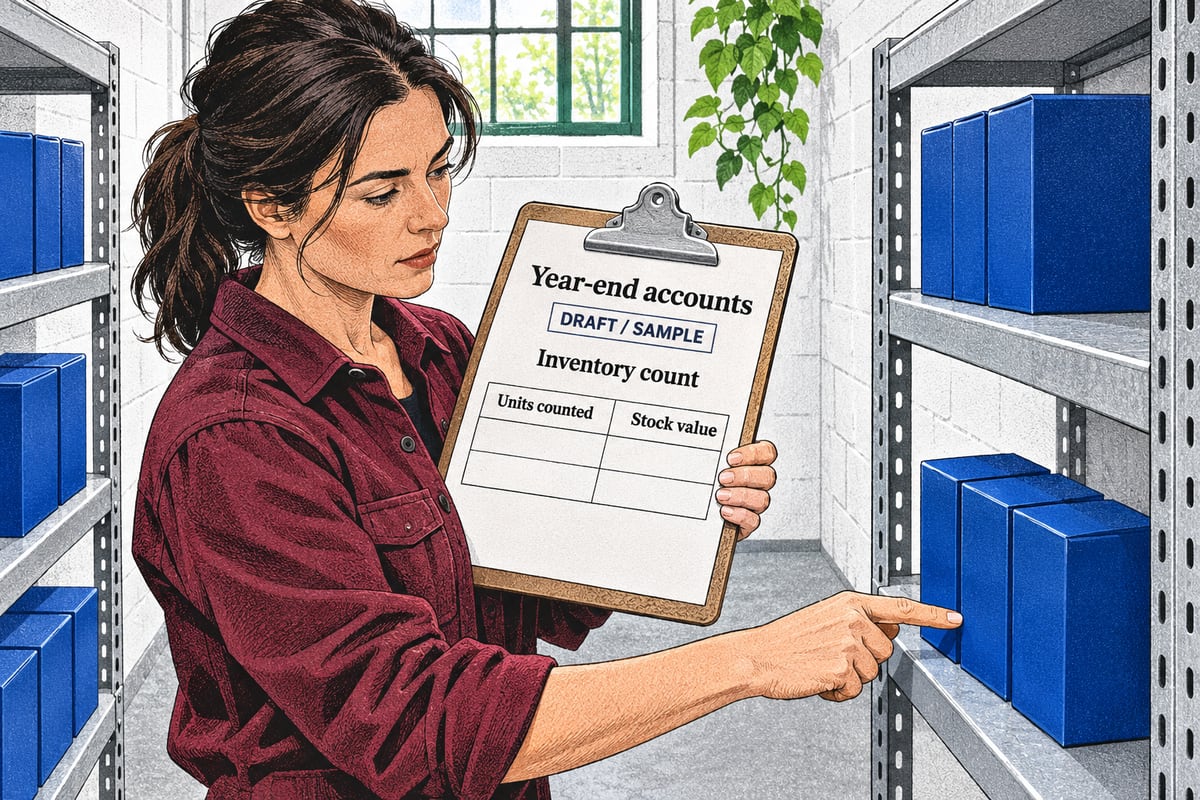
Consider a fictional small online retailer. The owner has reconciled every bank transaction and recorded all supplier payments as purchases. Some products remain unsold on the shelf at the year-end. A count and valuation review are still needed; assuming everything purchased was consumed or sold can misstate the result.
The owner also needs to identify customer amounts still receivable, supplier invoices not yet paid, relevant prepayments and accruals, equipment and the director's funding. These are illustrative review questions, not instructions to post a particular journal without assessing the facts. A loan from the founder is not sales income simply because cash entered the bank.
CRO specifically identifies year-end stock statements and the supporting stocktaking records for businesses dealing in goods. For a service company, equivalent care is needed over the relevant assets, liabilities and transaction records. No stock does not mean no year-end decisions.
A useful handover gives the preparer the reconciled ledger, supporting schedules and a list of uncertainties. It does not hide unresolved items in miscellaneous expenses or replace missing evidence with invented invoices.
5. Audit exemption is not accounts exemption
CRO distinguishes audit exemption from abridgement and financial-statement filing exemptions. A qualifying LTD may avoid an audit, but that does not remove its annual accounts-preparation duty. Reduced public disclosure is not permission to prepare only the reduced public version and ignore the underlying statements.
Check the relevant company, group, shareholder and filing-history conditions rather than relying only on turnover. CRO's current guidance says the repeated-late-filing rule effective from 16 July 2025 removes audit exemption where annual returns are filed late more than once within a five-year period. Do not copy an older claim that every first late return automatically has that consequence.
Where exemption eligibility is uncertain, resolve it before assuming an unaudited preparation quote is sufficient. The applicable audit route can affect the work, timetable and cost. The absence of an audit is also not an accountant's assurance that internally prepared figures are correct.
6. Company tax is a separate competence check
Revenue says a tax agent is not mandatory. That does not make the company's tax computation identical to its accounting profit. Decide who will assess the tax treatment of the actual transactions, complete the CT1 and check any other returns. Do not assume the CRO annual return files the company's Corporation Tax return.
Revenue's iXBRL requirements have their own scope and exclusions. Where iXBRL applies, financial information is tagged for electronic submission through ROS as part of the company-tax process. A PDF prepared for CRO is not, merely by being uploaded there, an iXBRL submission to Revenue.
If you retain an accountant only for tax work, confirm whether they will prepare, review or simply receive the accounts you supply. Neither party should assume the other has checked every accounting balance. Use a named responsibility list and keep confirmation of the returns actually submitted.
7. What to check before relying on software
Ask whether the product is a bookkeeping ledger, a management-report tool or statutory accounts-production software for the relevant Irish company and period. Those are not interchangeable descriptions. A polished balance sheet can still omit required notes, use an unsuitable reporting regime or contain unreconciled figures.
Check the period dates, opening balances, comparative information where required, chosen framework, relevant disclosures and adjustments. Identify who checks that the software's rules remain current. Reusing last year's document without review can carry forward obsolete wording or a prior-year error.
Keep an export of the final ledger, adjustments, supporting schedules and statements. Record which draft was approved. A later software change should not leave the company unable to explain the figures that were filed. Do not insert a fictitious accountant's report, audit opinion or signature to make a template look complete.
8. Directors approve the accounts, whoever prepares them
Section 289 says directors must not approve statements unless satisfied they give the required true and fair view. Section 324 addresses board approval and signing: two directors sign where there are two or more, while the sole director approves and signs in a sole-director company. Preparation by an external accountant does not transfer that board decision to the accountant.
Read the statements before approval. Ask about unexpected balances, director transactions, accounting policies and material uncertainties. Resolve queries and make sure the version signed is the version intended for use. This is different from signing or certifying documents for the annual-return filing process.
CRO states that the first six-month annual return does not need financial statements attached. That first-return exception is not a permanent accounts exemption. Keep the accounts timetable, approval steps and subsequent CRO filing requirements separate from the first B1 reminder.
9. Buy the work you actually need
A practical middle route is owner-maintained bookkeeping with professional year-end preparation and tax work. Ask the proposed accountant what condition the records must be in, which reconciliations you supply and whether fixing errors is included. A review of finished accounts and preparation from an incomplete ledger are different briefs.
StartCompany.ie's accounting service connects businesses with qualified accountants. Describe your company, period, transaction volume, current records and unresolved issues when requesting a quote. Confirm acceptance, availability, deliverables, exclusions and total payable before relying on an engagement. An introduction is not completed accounts preparation or acceptance of an urgent deadline.
A B1 filing order is not an order to prepare annual accounts. Our annual-return service has its own published scope; accounts preparation and other accounting work must be arranged separately where needed. Likewise, formation, registered-office and secretary services do not automatically include a year-end accounting engagement.
10. A checklist for the DIY or accountant decision
Use this list before committing to self-preparation or comparing quotes. Where an answer is uncertain, identify the work required and its owner. It is better to request a specific review early than discover near the deadline that the quoted service assumed complete accounts already existed.
- Identify the company type, reporting period and applicable accounting framework.
- Check the actual audit-exemption and public-filing position, including group and filing-history conditions.
- Reconcile bank, payment-provider, customer, supplier and relevant tax balances.
- Prepare stock, assets, loans and other year-end schedules, listing unresolved judgements.
- Assign statutory accounts, tax computations, CT1, iXBRL assessment and CRO filing separately.
- Confirm who reviews the draft, resolves questions and arranges directors' approval.
- Agree deliverables, information deadlines, exclusions, availability and total payable in writing.
- Retain the approved statements, supporting records and actual submission confirmations.
StartCompany.ie service
Accountant Services in Ireland
Official information and next steps
Official sources checked on 4 November 2026. This guide concerns an ordinary Irish LTD's decision about accounts preparation; it is not a statutory-accounts template, audit-exemption determination, tax computation or opinion on a particular reporting framework. Groups, regulated entities and complex transactions need individual assessment. The in-house-preparation conclusion is a practical reading of the directors' statutory duties, not a statement that every director has the necessary expertise.
- Companies Act 2014, section 290: preparation of annual entity financial statements
- Companies Act 2014, section 281: adequate accounting records
- Companies Act 2014, section 291: financial-statement content and accounting standards
- CRO: records, stocktaking and annual accounts
- CRO: audit and abridgement exemptions and late-filing conditions
- Revenue: appointing a tax agent is not mandatory
- Revenue: submitting financial statements in iXBRL
- Revenue: iXBRL filing scope and exclusions
- Companies Act 2014, section 289: directors' true-and-fair approval duty
- Companies Act 2014, section 324: board approval and signatures
- CRO: annual-return documents and first-return exception