
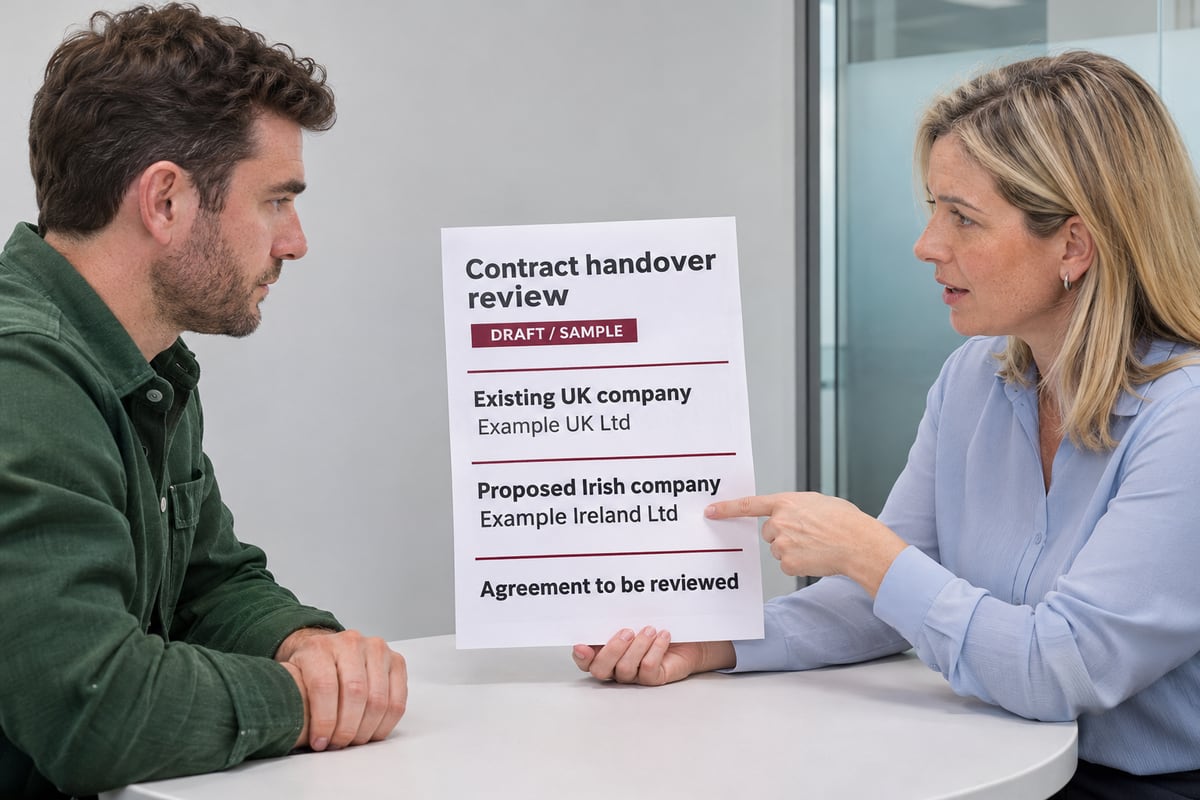
You already own a UK limited company and want to move the business to Ireland. You may want to keep its customers, trading history, contracts and bank account while replacing the UK registration with an Irish one. Before ordering formation, clarify whether you need the same legal company or a new company carrying on some of its business.
Those are different projects. This guide addresses the continuity question before the formation file, rather than repeating the full subsidiary setup checklist. It concerns an ordinary UK limited company, not a specialist regulated entity or a legal opinion on a particular restructuring.
1. An Irish address is not a Companies House migration
GOV.UK says a company's new registered-office address must remain in the same part of the UK in which it was incorporated. An Irish address is therefore not a destination for an ordinary UK registered-office change. A registered-office service and a change of incorporation jurisdiction are different matters.
Moving the owner, a home office or some work to Ireland does not itself replace the company's Companies House identity with a CRO identity. Do not describe an address purchase as transferring the company, and do not remove the existing UK address arrangements on that assumption.
Start with the UK company's exact legal name, number, incorporation jurisdiction and current status. Then write down what must remain continuous: the contracting party, a licence, an operating account, an investor right or simply the public brand. Each can require a different answer.
2. Separate the four meanings of move the company
A new Irish LTD, a branch and a qualifying cross-border conversion are not different names for the same purchase. Section 25 of Ireland's Companies Act 2014 describes the new body corporate arising on incorporation. CRO separately provides an external-company registration process for branches.
Use this table to frame an initial professional discussion. It is not an eligibility decision or a recommendation that your business needs an Irish entity merely because it has Irish customers.
| Proposed action | Continuity question |
|---|---|
| UK address change | The UK company remains; this is not Irish incorporation. |
| New Irish LTD | A separate company needs its own setup and handover. |
| Irish branch | The foreign company operates through an Irish establishment. |
| Cross-border conversion | A specialist legal route with jurisdiction and eligibility limits. |
3. Do not mistake an EU conversion guide for a worldwide transfer service
Your Europe's official guidance describes cross-border conversion as retaining legal personality while changing legal form and registered office within the EU framework. It is not a general right for a company from any country to choose a new register. A UK company should not infer eligibility from an example involving two EU countries.
CRO publishes a distinct cross-border process, including conversion filings and High Court involvement. That process is not an ordinary Form A1 order. If continuity is indispensable, ask a cross-border solicitor to assess the actual company, jurisdictions and available route before committing to a timetable.
Direction matters in reform headlines too. The UK government's consultation published on 25 March 2026 concerned an inward UK corporate re-domiciliation regime. It is not evidence that your UK company can depart for Ireland through a routine address change or our formation checkout.
4. A new Irish LTD has a new legal starting point
Under section 25, the company becomes a body corporate from the incorporation date on its Irish certificate. The same owners, directors or similar name do not make it the existing UK company. Do not present the UK incorporation date or number as the new Irish company's own registration history.
Choose the subscriber deliberately. The UK company might hold the Irish company's shares as a parent, or individuals might own the new company directly. Those are different ownership instructions. The existing UK-subsidiary guide explains the corporate-shareholder preparation once that structure has actually been chosen.
CRO requires Form A1 and a constitution for a new LTD, with the relevant name, office, officers, subscribers and share details. Give the presenter the intended new-company instructions, not a request to copy every field from Companies House. Similar branding does not guarantee that the Irish name will be accepted.
5. A branch preserves the foreign-company identity, not Irish incorporation
A branch registration is not an Irish incorporation. It is a registration relating to the foreign company and its Irish establishment, not a new Irish LTD with separate shareholders. Keeping the UK entity as the contracting company may therefore lead to a branch discussion rather than a new-company order.
CRO distinguishes EEA and non-EEA external companies and provides Form F13 for the non-EEA route relevant to a UK company. Establish whether the planned activity is a branch and what registration and ongoing disclosures apply. Do not assume every overseas sale requires a branch or that a correspondence address establishes one.
Use the linked branch-versus-subsidiary comparison for the broader structural decision. Ask for appropriate professional support where a branch is intended; do not purchase an LTD formation package expecting the presenter to register an external company instead.
6. Give contracts and assets their own handover plan
Prepare a contract-by-contract list naming the current legal party, the proposed party and what the agreement says about a change. Ask the solicitor whether consent, an assignment, a novation or a replacement agreement is needed. A change to an invoice footer is not a substitute for reviewing the underlying arrangement.
List software and intellectual property, domains, equipment, deposits, leases, insurance and licences separately. Record who owns each item now and what the proposed Irish company is intended to receive. Obtain legal, tax and employment advice for the relevant transfers rather than assuming the incorporation moves everything together.
Ask banks and payment providers how a new legal entity should be onboarded. Do not relabel an existing UK account as the Irish company's account or assume its approval and transaction history transfer. Identify who handles existing customer refunds, unpaid invoices and outstanding obligations during any overlap.
7. Keep tax residence separate from the incorporation register
Revenue says an Irish-incorporated company formed on or after 1 January 2015 is deemed Irish tax resident unless a Double Taxation Agreement treats it as resident elsewhere. It separately applies central management and control to foreign-incorporated companies. Tax residence is not simply the country printed on a postal address.
If a UK company is managed from Ireland, obtain advice on both countries' rules and any relevant treaty position. Becoming Irish tax resident would not, by itself, make the company an Irish-incorporated LTD or change its Companies House history.
Before moving activity, have advisers review the proposed assets, management, people and transaction dates. Do not assume a new incorporation transfers tax losses, registration numbers or banking permissions, or guarantees a particular tax rate, residence outcome or immigration permission. This guide is not a tax-migration calculation.
8. Do not close the UK company as an incorporation shortcut
Creating an Irish company does not dissolve the UK company. Decide whether the UK entity will continue trading, hold shares, become inactive or follow an appropriate closure process. Assign responsibility for its remaining filings, tax, records and communications instead of assuming the Irish presenter handles them.
GOV.UK describes eligibility conditions for strike-off and responsibilities for closing properly. It also warns that a struck-off company loses access to its bank accounts and cannot send or receive money. Do not apply for dissolution while treating the old account as the new company's operating account.
Give the UK adviser outstanding debts, customer claims, assets and planned transactions before deciding on closure. A new Irish entity is not a method of making the UK company's obligations disappear. Closure, insolvency and dispute work need advice outside an ordinary formation engagement.
9. Example: a UK software consultancy plans an Irish operation
A fictional owner wants future Irish projects invoiced by a new Irish LTD, but existing customers have agreements with the UK company. The owner first asks the adviser which contracts can stay where they are, which need review and which new work should name the Irish company after incorporation.
The proposed shareholder is then settled: UK parent or individual owner. The formation presenter receives that decision, the Irish activity and the officer details. CRO's EEA-resident director rule is assessed separately; UK residence alone does not meet it, and any required bond or other valid route must be addressed.
The owner does not announce that the UK company has merely changed nationality or use the UK registration date for the Irish LTD. Contract handovers, banking applications and UK obligations remain separately assigned. This illustrates a preparation sequence, not a guarantee of legal continuity or a recommendation for every consultancy.
10. Confirm the project before buying formation
StartCompany.ie's published packages are for a new Irish LTD with the inclusions on the pricing page. A formation order does not include re-domiciliation, branch registration or a UK business transfer. Compare the current package scope only after deciding that a new company is the intended route.
Describe the existing entity, desired ownership, director residence and continuity requirements before ordering. Ask which additional work can be provided and what requires a separate adviser. Agree availability, deliverables and total payable; do not assume document transfers, legal opinions or cross-border tax planning are included.
Use a concise initial enquiry rather than uploading confidential contracts, passports, bank statements or credentials. If a customer deadline depends on keeping the same legal party or a licence, explain that requirement before a new entity is formed.
- Record the UK company's jurisdiction, number, status and current legal owners.
- State whether preserving the same legal personality is essential.
- Distinguish a new LTD, a branch and specialist restructuring advice.
- Choose the proposed Irish subscribers, directors, secretary and office.
- List contracts, assets, people, licences and bank arrangements needing review.
- Assign the UK company's continuing obligations and any closure assessment.
- Obtain cross-border legal and tax advice before fixing transfer dates.
- Confirm formation scope, separate work, total payable and handover responsibilities.
StartCompany.ie service
Irish Company Formation Packages
Official information and next steps
Official sources checked on 3 November 2026. This is a route-selection guide for an ordinary UK limited company, not a legal opinion on conversion eligibility, a contract-transfer instrument or a tax-migration plan. Specialist entities, restructurings, employees, licences and insolvency require individual advice. Policy consultations are identified as proposals, not presented as an available outward-transfer service.
- GOV.UK: registered-office changes must remain in the same UK jurisdiction
- Companies Act 2014, section 25: effect of Irish incorporation
- Your Europe: EU cross-border restructuring and conversions
- CRO: cross-border conversion, merger and division processes
- GOV.UK: March 2026 consultation concerned inward UK re-domiciliation
- CRO: external-company and branch registration
- CRO: Form A1, constitution and new-company information
- Revenue: Irish-incorporated and foreign-incorporated company residency rules
- GOV.UK: strike-off eligibility, closure responsibilities and bank-account consequences
- CRO: director, secretary and EEA-residence requirements