
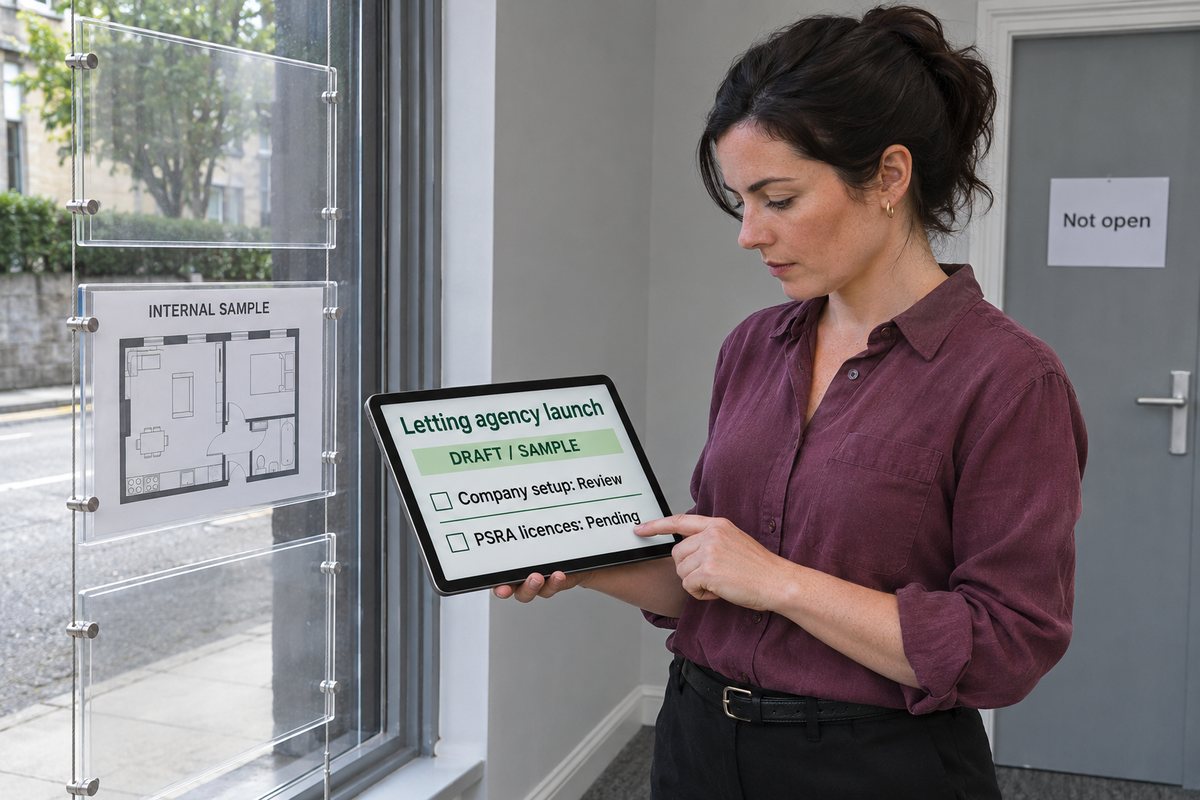
You want to open a small letting agency, perhaps with one experienced founder and a modest online operation. Registering an Irish LTD can create the business entity, but it is not the step that authorises the company or its staff to provide regulated property services.
The useful question is not simply which formation package is cheapest. It is whether the proposed people, activities, premises and financial controls can support the separate licensing application. This guide helps you prepare that decision before committing to incorporation and a launch date. It is a company-setup checklist, not a PSRA application service or an individual eligibility opinion.
1. Define the service before choosing a company package
PSRA distinguishes auctioneering, estate agency, letting and property management as different licence categories. Letting is Category C. Do not assume the everyday phrase property management necessarily means Category D: PSRA explains that managing properties as part of a letting service is covered by Category C, while its Category D description concerns multi-unit-development management on behalf of a management body.
Write the actual proposed activities in plain language: introducing tenants, arranging viewings, negotiating lettings, collecting rent, arranging maintenance or managing an apartment development for an owners' management company. Ask PSRA or a suitably qualified adviser which categories and permissions the real model requires. A label chosen for the website is not a regulatory classification.
This guide concerns a commercial agency providing services for others. It does not determine the position of a landlord letting their own property, an owners' management company self-managing, or a short-term accommodation operator. Those facts can change the analysis. Do not buy an agency setup merely because the word letting appears in your business plan.
2. Check the people before registering the LTD
PSRA's current guide says a company needs at least one appropriately qualified principal officer and at least one principal officer or employee licensed to provide the service on its behalf. One principal officer can fulfil both requirements. A company with a suitable trading name but no qualifying person has not solved the licensing problem.
The Authority assesses qualifications and experience under its published routes; a relevant-looking degree, overseas employment history or membership of a professional association is not automatic acceptance. Collect the actual certificates, transcripts and lawful-experience evidence for review before making a fixed promise to landlords or signing an expensive lease.
Also distinguish a person's previous licence from permission to act for the new employer. Section 4 links a principal officer's or employee's service entitlement to the licensed property-services employer and the relevant capacity. An experienced recruit is valuable, but do not describe their old employer's licence as the new company's authorisation.
Appointing a routine company secretary does not establish PSRA qualifications. The statutory company appointment and the regulator's competence assessment serve different purposes. Agree who will supervise regulated work, what unlicensed administrators may do and what happens if the qualifying person leaves.
3. Form the correct applicant, not a temporary substitute
Once the licensing route is understood, decide which legal person will run the agency. An LTD is a separate legal entity; incorporation does not merely rename the founder's existing sole trade. Agree shareholders, eligible directors, the secretary, share instructions, registered office and genuine Irish activity before the formation documents are prepared.
CRO's Form A1 activity declaration identifies the intended activity, its Irish location and central administration. A NACE code records a classification; it is not a PSRA licence. Describe the business honestly, including any overseas administration, instead of inventing an Irish operating arrangement because a correspondence address is available.
If an existing sole trader is moving into an LTD, ask about the new entity's licensing, contracts, insurance, bank arrangements and client-money handover before transferring activity. Do not assume the personal business's permissions follow the new CRO number. Keep one consistent legal applicant across the separate providers' instructions.
PSRA's current new-licence page asks company applicants for a duplicate Certificate of Incorporation dated and signed within four weeks of the application. Plan that fresh CRO document request near the actual application, rather than assuming the original formation certificate will always satisfy the later evidence requirement.
| Workstream | What it does not replace |
|---|---|
| CRO incorporation | PSRA business or individual licences |
| Registered office | Evidence of the actual operating premises |
| PSRA application | A licence already in force |
| Ordinary company accounts | The specified PSRA accountant's report |
4. Separate the registered office from the operating address
PSRA's June 2026 company-application notes ask for the address from which the company provides property services, which is not necessarily its registered address. They say the principal business address appears on the licence and address additional business locations separately. A mail-handling purchase does not answer those operating-premises questions.
If you intend to work from home or operate largely online, describe that arrangement to PSRA and confirm the evidence and conditions for your case. Do not infer that you must lease a high-street shop, or that any virtual address is sufficient. Check the actual home, lease, insurance and data-security permissions with the appropriate parties.
StartCompany.ie's registered-office service is an address and agreed mail-handling service, not an allocated letting-agency workspace or proof that PSRA accepts an operating model. Confirm any proposed use before ordering. Keep regulatory correspondence and statutory company mail monitored while an application is pending.
5. Budget for financial controls, not just a business bank account
Section 30 requires a specified accountant's report on appropriate systems and controls for protecting client money, evidence of the availability of the required professional indemnity insurance and the application fee. PSRA's new-licence page identifies Form A for Category C business applications. A set of ordinary company accounts is not that report.
Ask an appropriately qualified accountant to define the required client-account arrangements, bank documentation, reconciliations, authority limits and reporting work. Section 46 provides the client-account and recordkeeping framework. Do not treat rent or deposits held for others as free working capital for the agency's launch expenditure.
Obtain separate quotes for licensing-related accounting work and ongoing company accounts. Explain the exact category and whether the agency will handle client money; let the adviser apply the current requirements rather than assuming a no-cash business model removes every control. Check the company and director tax-clearance requirements too. Banks and insurers make their own decisions, and incorporation does not guarantee either approval.
Keep a cash forecast for the period before the first lawful fee is earned. Include company administration, suitable premises, software, insurance, regulatory payments, professional support and contingency for queries. A modest formation bill should not hide the larger cost of maintaining a compliant operating business.
6. An application receipt is not permission to launch
Section 28 prohibits not only providing an unlicensed property service but also holding yourself out or advertising as available to provide it without the relevant licence in force. Do not schedule a public service launch on the assumption that submitting an application or paying a fee is enough.
Keep draft listings, brochures and website service offers internal until the licensing position is settled. Ask for advice before publishing a coming-soon message that could amount to holding the agency out as available. The precise content and circumstances matter; calling a page a draft does not make a publicly accessible offer private.
When licensed, check that the actual employer and people have the appropriate permissions before assigning work. Section 37 addresses displaying licences and registration numbers in the relevant premises, advertising and correspondence. Build those details into the real launch checklist rather than adding an invented licence field to make the website look finished.
A fictional founder may incorporate while preparing the remaining application evidence, but should keep opening conditional on the necessary licences being in force. Do not promise a completion date based only on the incorporation timetable. Regulatory queries, insurance and bank arrangements have separate dependencies.
7. Put company compliance and agency obligations on different calendars
CRO requires an annual return whether the company is trading or not. The first return is due six months after incorporation and does not require financial statements attached; the filing window and later accounts requirements still need tracking. A pending PSRA application does not pause the company's statutory calendar.
The regulator has a separate renewal process. PSRA says to apply six weeks before licence expiry and warns that not receiving its invitation is not an accepted reason for a late application. Use the actual licence dates, not an assumed anniversary of incorporation, when budgeting renewals and professional reports.
For client engagements, Section 43 requires the specified letter of engagement no later than seven working days after starting the service or reaching agreement, whichever is earlier. It also sets a signed-return requirement and consequences if that is not met. Use current PSRA forms and obtain professional guidance on execution; an ordinary sales email is not a complete substitute.
Also assign company tax, payroll where relevant, beneficial-ownership records and accounts to named responsible people. Ask separately about continuing professional development, sector controls and client-money compliance. A company secretary, accountant, insurer and licensing adviser should each know which tasks they have actually accepted.
8. Prepare this brief before committing to formation
Use a one-page summary to make the unresolved decisions visible. It is preparation for discussions, not a self-issued licence assessment. Send private qualification, identity and financial evidence only through the secure channels agreed with the appropriate recipient.
- List the intended letting services and any separate sales or development-management activity.
- Identify the proposed legal applicant and whether an existing sole trade is involved.
- Name the qualifying principal officer and the people who will perform regulated work.
- Record which qualification and experience evidence still needs assessment.
- Distinguish the registered office, real operating address and overseas administration.
- Obtain insurance, accountant, banking and licensing-cost estimates separately.
- Keep public advertising and service delivery conditional on the required licences.
- Assign application follow-up, launch approval, renewals and company filing responsibilities.
9. What StartCompany.ie can help you buy
StartCompany.ie can help register the Irish LTD. Compare the current formation packages for the company-name check, constitution, incorporation documents and CRO fees, then choose according to the actual director, identity-number and other company-setup requirements. Confirm the package inclusions and total payable before ordering.
StartCompany.ie does not provide PSRA licence applications, licensing representation or a professional opinion on a person's property-service qualifications. Those tasks must be arranged separately with PSRA or a suitable independent professional. A formation package is not a letting-agency launch package and does not promise a licence, premises acceptance, bank account or insurance.
If your licensing route is unclear, resolve that question before spending on a structure that depends on an unavailable qualifying person. If the route is clear, give the formation team the agreed company brief and realistic timetable. Keep incorporation, regulatory approval and permission to start providing services as three separate milestones.
StartCompany.ie service
Company Formation
Official information and next steps
Primary sources checked on 16 November 2026, including PSRA's current June 2026 applicant guide. This is a formation-preparation checklist, not a complete licensing manual, legal opinion or decision on an applicant's qualifications, premises or exemptions. Confirm the actual business model and current requirements with PSRA and the appropriate advisers.
- PSRA: licence categories
- PSRA audit guide: letting and property-management scope
- PSRA: licensing FAQs
- PSRA: new applications and accountant's report forms
- PSRA: June 2026 applicant guide
- Property Services (Regulation) Act 2011, section 4: individual capacity
- Property Services (Regulation) Act 2011, section 28: unlicensed services and advertising
- Property Services (Regulation) Act 2011, section 30: application evidence
- Property Services (Regulation) Act 2011, section 37: licence display
- Property Services (Regulation) Act 2011, section 43: engagement letters
- Property Services (Regulation) Act 2011, section 46: client accounts and records
- PSRA: licence renewals
- CRO: incorporation and the activity declaration
- CRO: annual returns for trading and non-trading companies