
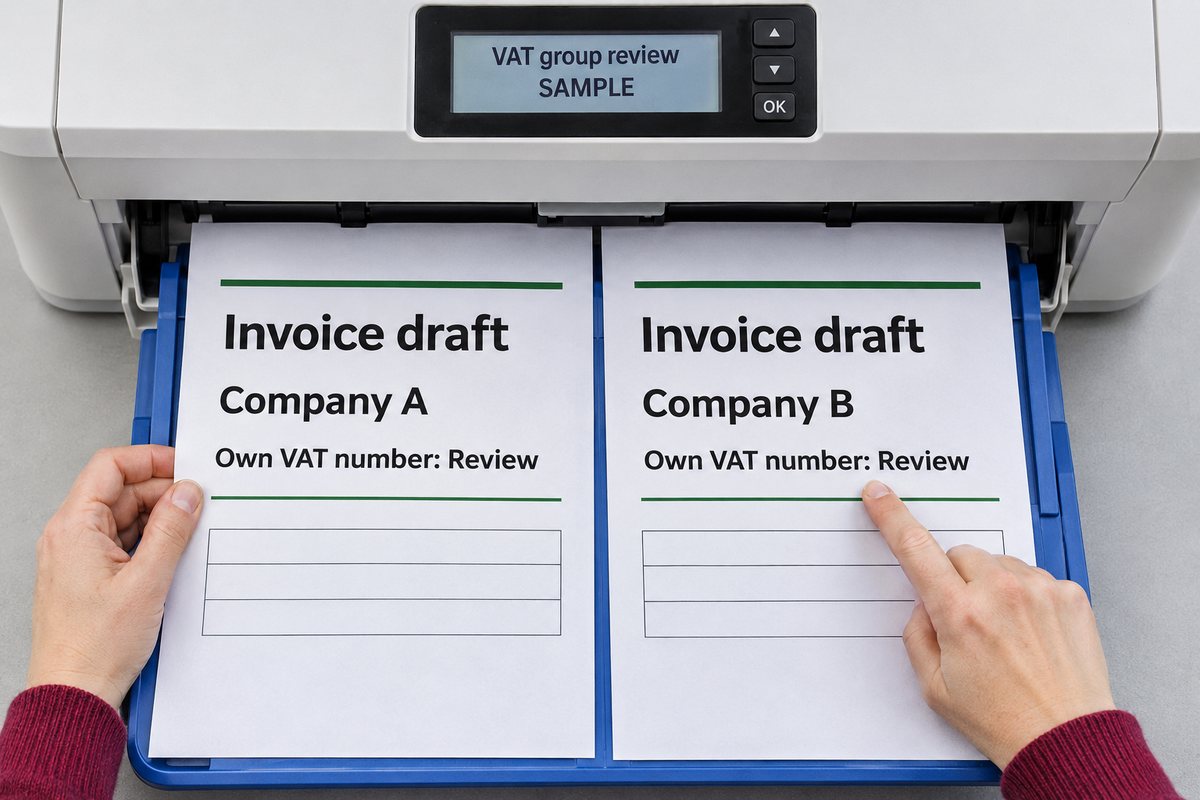
A founder owns two Irish limited companies and wants simpler billing. Perhaps one company already has a VAT number, while the second is preparing its first customer invoice. Can both just use the existing number, or would applying for a VAT group solve the problem? Start by separating ownership, the legal supplier and the VAT reporting arrangement.
This guide is for founders comparing ordinary company registrations with an Irish VAT-group review. Revenue guidance, including its November 2025 territorial-scope changes, and relevant legislation were checked on 13 November 2026. It is a preparation checklist, not an approval of your structure or a substitute for transaction-specific tax advice.
1. First decide whether you have two companies or two brands
One LTD can operate more than one business or trading name, while two incorporated LTDs are separate bodies corporate. Section 25 of the Companies Act describes the corporate identity created by incorporation. A trading label on a website is therefore not enough to identify the supplier or decide whether two VAT registrations need to be considered.
Make a short entity list before contacting an adviser: full company name, CRO number, trading names, existing tax references and who signs the customer contract. Keep the names unambiguous. If the invoice says a different LTD from the accepted quotation, investigate that discrepancy rather than solving it by copying a familiar registration number.
For example, two brands of a single consultancy are not two separate VAT-group applicants merely because they have different websites. Conversely, a parent company and its incorporated subsidiary do not become one legal company because the same director manages both. Explain which arrangement you actually have before discussing a group application.
2. A single VAT return does not mean one number on every invoice
Revenue's current VAT Groups manual distinguishes the remitter's group return from members' external invoices. The remitter makes the single return and related payment using its number. A member supplying an outside customer invoices under its own name and individual VAT number. VIES reporting also uses the relevant members' own numbers; it is not automatically consolidated into the remitter's identity.
Before changing accounting software, map the customer-facing invoice settings separately from the return-preparation settings. Do not overwrite every company's tax-reference field with the remitter's number. Ask the adviser to confirm the approved membership and the exact configuration, including any intra-EU reporting, before a revised invoice template goes live.
Revenue's ordinary invoice requirements also include the supplier's identity and registration details. Keep customer master data, quotation terms, invoice sequences and credit-note references aligned with the actual supplier. A shared billing team should know which entity it is acting for.
| Record | Question to resolve | Do not confuse with |
|---|---|---|
| Company record | Which legal supplier? | A brand name |
| External invoice | Which member's number? | Remitter's return |
| Group return | Which approved remitter? | Every other tax filing |
| Membership record | Who joined, and when? | Common ownership |
3. Common ownership is not the whole eligibility test
Section 15 requires closely connected financial, economic and organisational relationships between persons established in Ireland, with at least one accountable person, and an administration-based decision by Revenue. Those are cumulative requirements, not alternative ways to qualify. A common shareholder alone does not answer every condition.
Prepare evidence of control, what each business does and how the management arrangements operate. Give the adviser an ownership chart, voting and appointment rights, activity descriptions, relevant service agreements and a management chart. Mark any uncertainty, such as an unsigned agreement or a different ultimate owner, rather than drawing a neat chart that conceals it.
Ask for each relationship to be assessed on the actual facts. Two businesses can share staff or premises without that fact alone proving all the grouping conditions. Equally, do not assume a holding company is automatically excluded: Revenue permits holding-company participation, subject to the relevant conditions. The adviser needs the activities and establishment position, not just the word holding in the name.
4. Compare the benefit against the continuing work
Revenue explains that grouping generally removes VAT invoicing for internal group transactions, with exceptions including certain property dealings. That does not make the group exempt from VAT or remove external customer invoicing. List the actual internal flows you want reviewed: staff recharges, management support, equipment, premises or other transactions. Do not assume the same rule resolves every item.
An expected saving needs an input-tax review as well as an output-tax review. Revenue's reclaim guidance ties recovery to eligible taxable or qualifying activity, with restrictions for exempt or non-business use and certain costs. Ask for the proposed position to be compared with the current one; do not treat joining a group as a guarantee of full VAT recovery.
The companies also remain companies. CRO annual-return obligations are not replaced by a VAT-group return. Keep a separate compliance calendar showing company filings and the tax work assigned to each adviser. Administrative simplification in one area is not permission to stop maintaining the underlying company records.
5. Obtain the decision before implementing the change
Revenue identifies VAT52 for the proposed remitter and VAT53 for the other proposed members. Adding a company later also requires permission. Completing an ordinary company tax-registration application is not the same as obtaining group membership, and purchasing a registration service is not Revenue approval.
For a taxpayer application, the current manual says written notifications establish the group and identify the effective date, which cannot precede the start of the application VAT period. Do not pick a convenient historic date yourself. Keep the notifications with the implementation instructions, rather than relying on a sent form or a telephone recollection.
Create a dated implementation list: who checks the approval, who confirms membership, who handles the final pre-group reporting, who configures the new return workflow and who validates the first period. If anything has already been changed, disclose the dates and affected invoices promptly. Do not backdate documents or silently relabel earlier transactions.
6. Understand responsibility before choosing the remitter
Group members have joint and several VAT responsibility. Appointing one remitter does not isolate the other members from that exposure. Section 15 also requires written notice of specified significant changes within 30 days after the relevant taxable period ends. A business sale, establishment change or reorganised control therefore needs timely tax review.
Agree how every member will deliver information to the remitter, who funds the payment and who investigates missing records. The person preparing the return needs more than a bank total. Preserve invoices, credit notes, transaction schedules and supporting evidence that let the reviewer trace each figure back to the relevant business.
Do not choose the remitter only because its existing login is convenient. Review staff cover, adviser authority, bookkeeping quality and payment controls. Set an internal deadline before the statutory filing date, with an escalation contact for late information. Internal responsibility agreements should be reviewed separately and should not be mistaken for a release from Revenue-facing obligations.
7. Overseas branches need a current territorial-scope review
Revenue published new territorial-scope guidance on 19 November 2025. Its position is that only Irish establishments can belong to an Irish VAT group; a non-Irish head office or branch is not included simply because it belongs to the same legal person. Cross-border head-office and branch charges therefore need specific analysis.
The territorial manual says the new guidance applied immediately to groups established after publication. Affected existing groups must implement it by 31 December 2026 and can contact Revenue about suitable transitional arrangements. That is not a general grace period for a new application made in November 2026.
If an overseas establishment supplies services to an Irish group, ask the adviser to check place of supply, reverse charge and recovery. Within the scope of VAT does not automatically mean charge Irish VAT on every invoice. Provide a location-by-location map of actual operations, services and charges; do not describe an overseas office as Irish because it uses the group's branding.
8. Worked preparation example and enquiry checklist
Imagine a fictional owner with separate Irish consulting and support LTDs. The support company wants to start billing an outside client, while finance staff propose using the consulting company's VAT number for convenience. The first task is to confirm the support company's own registration and invoice position, not to copy the number and promise to tidy it up later.
If the owner wants a group assessment, prepare a second workstream: relationship evidence, establishment details, current registrations and the proposed remitter. Neither the shared owner nor a promising adviser discussion proves approval. Keep the existing invoice question moving under proper advice while the grouping proposal is assessed separately.
The following is a practical enquiry pack, not a universal Revenue attachment list. Redact customer banking and personal identity data from an initial quotation request, and agree secure arrangements for any detailed records needed later.
- Legal names, CRO numbers, trading names and current registration status for each entity.
- Ownership, voting and management charts, with unexplained differences marked.
- Activity descriptions and actual services or goods supplied between the businesses.
- Locations of head offices, branches and other establishments, with evidence available.
- Current external invoice samples and the proposed billing changes.
- Taxable, exempt and non-business activities and costs needing recovery review.
- Existing group approvals, outstanding reporting issues and the intended implementation period.
- Proposed remitter, responsible adviser, information deadlines and payment controls.
9. Request the right scope before ordering tax support
Describe the problem as a VAT-group assessment rather than simply a new number application. Ask whether eligibility, invoice identity, input-tax recovery, territorial scope and implementation planning can be reviewed. Explain any approaching deadline or already-issued invoices, and request a written distinction between advice, application preparation and ongoing returns.
StartCompany.ie's tax-services page is the appropriate enquiry route to discuss the support available. A routine formation or tax-registration purchase does not automatically include VAT52/VAT53 work, specialist group advice, cross-border analysis, historic corrections or continuing group returns. Confirm acceptance, the named adviser, responsibilities and total payable before instructing work.
For a useful cost comparison, ask what records you must prepare yourself and how many entities and periods the quote covers. A lower application price may leave reconciliation or implementation outside scope. Revenue decides the application; neither a quotation nor payment guarantees membership, a completion date or a tax saving.
StartCompany.ie service
Tax Services in Ireland
Official information and next steps
Checked on 13 November 2026. The current VAT Groups manual is vat-groups-new.pdf; Revenue also publishes separate territorial and transitional guidance. Follow the applicable current documents and obtain advice on the facts, rather than treating an older manual or common ownership as approval.
- Revenue: current VAT Groups manual
- Revenue: group registration, VAT52 and VAT53
- Revised VAT Consolidation Act, section 15
- Revenue: territorial scope of VAT groups
- Revenue eBrief 216/25: new guidance published on 19 November 2025
- Revenue: information required on VAT invoices
- Revenue: VAT recovery conditions
- Revenue: VAT records to keep
- Companies Act 2014, section 25: effect of incorporation
- CRO: annual returns