
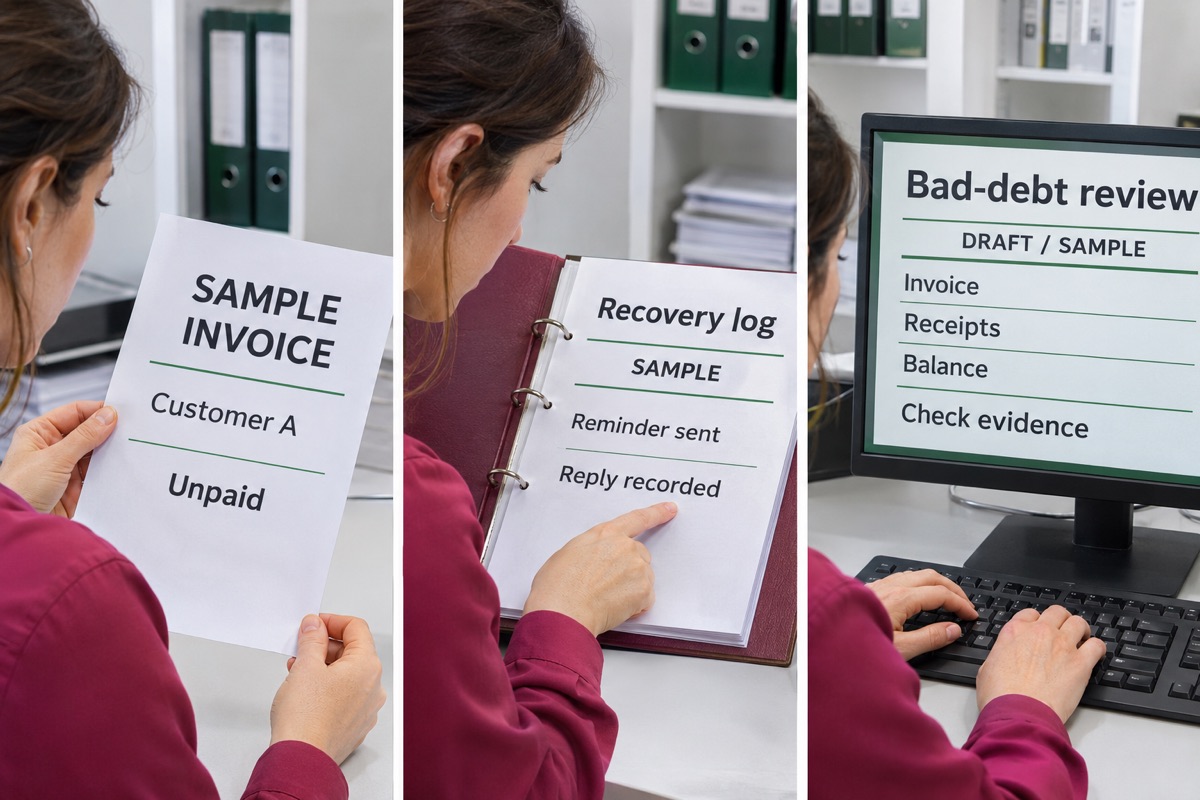
Your LTD has delivered the work, issued an invoice and accounted for sales VAT. The customer has not paid. You want to know whether the company must carry the VAT cost indefinitely, whether to cancel the invoice, and what an accountant needs before making an adjustment. These are different questions: collecting the debt, recording a loss and claiming tax relief should not be collapsed into one software button.
This guide is for Irish companies reviewing ordinary unpaid customer invoices. It is not a debt-collection service, a determination that a particular debt is irrecoverable, or advice on an actual tax claim. Primary sources were checked on 9 November 2026, including Revenue's bad-debt manual last reviewed in July 2025. Hire-purchase, property and other special arrangements require separate advice.
1. Start with the event, not the age of the invoice
Put each balance into a clear working category before asking for a tax adjustment. Is the customer simply late? Are they disputing the work? Have you agreed a lower price? Or has the company concluded, on evidence, that a debt cannot be recovered? The same unpaid balance can look identical in an ageing report while requiring a different next step.
Section 39 provides a statutory route for relief where consideration falls short, subject to regulations and exclusions. It does not make every uncollected sale an automatic refund. Revenue's manual also distinguishes a bad debt from the simple expiry of normal payment terms. Avoid importing a foreign waiting-period rule into the Irish analysis.
Keep commercial language precise. A note saying 'remove this invoice' does not tell the bookkeeper whether to record a discount, investigate a misallocated receipt or prepare a bad-debt review. Describe what happened and retain the original transaction trail.
| Situation | First review | Avoid |
|---|---|---|
| Payment late | Collection status | Automatic claim |
| Price reduced | Credit-note rules | Calling it default |
| Debt irrecoverable | Evidence and write-off | Deleting invoice |
| Receipt after relief | Recovery adjustment | Ignoring receipt |
2. Confirm the company's VAT accounting basis
Revenue permits bad debt relief where VAT has been accounted for and the customer defaults in full or part. Its overview expressly excludes traders accounting on the moneys received basis. Confirm the basis actually applicable to the company, rather than assuming it from the name of a bookkeeping report.
Ask the preparer to locate the invoice, relevant VAT return and liability record. Where the business changed basis, identify the approved transition date and opening-debtor treatment. Revenue requires authorisation to move from invoice accounting to the moneys received basis; changing a software preference is not that authorisation.
A useful instruction is: 'Please confirm which basis applied to this sale, whether its VAT was accounted for, and whether any adjustment already exists.' That is more informative than asking for all old invoices to be refunded. Our cash-receipts guide addresses the separate decision about changing basis.
3. Build the evidence before calling a debt bad
The conditions in regulation 10 include reasonable recovery steps, the relevant tax-deduction condition, an actual financial-accounts write-off with prescribed records, and the debtor not being connected during the specified period. Being a small company or having a cash-flow problem does not replace those tests.
Prepare a dated chronology: invoice delivery, reminders, replies, disputes, repayment proposals and any adviser or insolvency correspondence. Record who assessed the evidence and why the remaining amount is regarded as unrecoverable. This is a practical review file, not a claim that every debtor must be pursued through court.
Do not turn an unanswered reminder into an invented insolvency conclusion. If an instalment arrangement is still being honoured, or a material dispute remains unresolved, tell the accountant. If the customer is connected to a director or shareholder, disclose the relationship instead of leaving the adviser to infer it from a customer name.
4. Separate an actual write-off from an estimate
Revenue's manual distinguishes an actual write-off from a specific or general doubtful-debt provision; the provision alone does not qualify for this VAT relief. Agree the posting and review date with the accountant, and preserve the debtor balance before and after the entry. A management note about likely losses is not necessarily the required accounting event.
Use the software's documented accounting workflow, with a clear explanation and reviewer. Do not delete the original sale to make the ageing report look clean. The reviewer should be able to follow the customer invoice, receipts, remaining balance and adjustment without relying on a verbal explanation months later.
Keep corporation-tax treatment as a separate question in the engagement. Do not assume that a VAT adjustment automatically settles the company's profit computation, or that an accounting estimate produces the same result for every tax. Describe all requested work when asking for support.
5. Do you need a credit note instead?
A genuinely revised price is not the same event as a customer default. Section 39 specifically addresses the credit note required for a reduction or discount. Revenue's credit-note guidance discusses price adjustments and incorrect original VAT rates, including an exception where the agreed VAT-exclusive reduction leaves VAT payable unchanged.
For example, if a customer disputes an incomplete job and both parties agree a lower charge, provide the settlement and original invoice for a credit-note assessment. If the original charge remains valid but the customer cannot pay, do not describe it as a commercial discount merely to clear the ledger.
Ask for one coherent treatment. A credit note and bad-debt adjustment must not both relieve the same amount. Explain any earlier journal, refund, partial settlement or credit already posted before the accountant reviews the balance.
6. Worked example: part of a single-rate invoice is unpaid
Take a fictional ordinary domestic supply invoiced for EUR 2,000 plus EUR 460 VAT, a gross total of EUR 2,460. For this illustration only, assume the supply correctly bears 23%, the invoice-basis VAT was accounted for, EUR 1,230 has been received, the remaining EUR 1,230 is genuinely bad, and every other relief condition is met. This is not a statement that every sale uses that rate.
The VAT fraction of the outstanding gross balance is EUR 1,230 x 23 / 123 = EUR 230. The possible VAT adjustment is therefore EUR 230, not the entire EUR 460 originally invoiced and not 23% of the gross EUR 1,230. The remaining EUR 1,000 is the net component in this simplified example.
Reconcile the numbers back to the original document and receipt allocation. A customer payment covering several invoices needs an allocation first. Mixed rates, offsets, credit notes and unusual arrangements need their own calculation; do not apply this example to a combined customer-account total without checking its components.
7. Agree the return period and monitor later receipts
Revenue directs the claim to the VAT return period of write-off through an increase in Box T2. It also requires a reversal adjustment when a previously relieved debt is later recovered, using the receipt period. The unpaid amount is therefore not something to forget after the initial posting.
Keep a recovery flag against the customer or invoice. Tell whoever performs bank reconciliation that an unexpected later payment needs to be matched to the old adjustment, not automatically treated as a new sale. Include these balances in an accountant handover if the company changes providers.
Before submitting anything, agree the period, calculation, reviewer and whether historic-return correction work is required. An illustrative calculation is not authority to amend an already-filed return without that review. Preserve the final working paper alongside the actual submission evidence.
8. Give the accountant a usable review pack
Revenue requires complete, accurate VAT records that let it verify transactions. Assemble the evidence so another person can reconcile the claim without searching unrelated emails or guessing what a bank receipt settled. Use a secure agreed channel for customer records; do not paste bank credentials or a full debtor file into a public enquiry form.
The bad-debt manual specifies retention for six years from write-off. Revenue's wider retention guidance also addresses claims and unresolved matters. Confirm whether a longer retention requirement applies before removing documents, even if the underlying invoice is much older.
Your handover should identify missing evidence explicitly. A useful cover note is: 'The invoice and bank allocation are attached; the customer's latest reply is still outstanding; no write-off has been posted; please assess the next step.' That prevents a request for review being mistaken for an instruction to file.
- Original invoice, supply details, customer identity and relevant transaction dates.
- Receipts, allocations, credits and reconciliation of the gross outstanding balance.
- Evidence of the applicable VAT basis and VAT already accounted for.
- Recovery chronology, correspondence and the reason a balance is considered bad.
- Any relationship with the debtor and any special arrangement needing advice.
- Write-off decision, date and ledger entries, or confirmation that these remain unposted.
- Proposed calculation, return period, previous adjustments and later-receipt monitoring.
- Named preparer and reviewer, secure records location and unresolved questions.
9. Scope accounting support before relying on a claim
StartCompany.ie connects businesses with qualified Irish accountants for bookkeeping, tax returns, financial statements and related support. Explain that you need an unpaid-debtor and possible VAT bad-debt review, rather than asking only for routine return filing. Confirm whether the accountant can accept the work.
Request a quote distinguishing ledger reconciliation, evidence review, tax assessment, write-off entries, current VAT return preparation and any historic correction. Agree deliverables, information deadlines, responsibility and total payable. Debt recovery, litigation and a commercial dispute are separate from the accounting service and should not be assumed included.
Neither forming a company nor appointing an accountant guarantees relief, a repayment, a banking outcome or a particular tax treatment. The useful result is a supported decision and an accurate filing, which may be to seek more evidence or use a different correction route rather than claim immediately.
StartCompany.ie service
Accountant Services in Ireland
Official information and next steps
StartCompany.ie provides preparation and filing support for the service described above. Final acceptance, registration, tax treatment or court approval remains with the relevant authority. Check the current official guidance before acting, particularly where a deadline, tax position, dispute or unusual transaction is involved.
- Revenue: when VAT bad debt relief is available
- Revenue: VAT treatment of bad debts, reviewed July 2025
- VAT Regulations 2010: regulations 10 and 27
- VAT Consolidation Act 2010, section 39
- Revenue: when to issue a VAT credit note
- Revenue: full and accurate VAT records
- Revenue: record-retention periods and unresolved matters
- Revenue: changing VAT accounting basis requires authorisation