
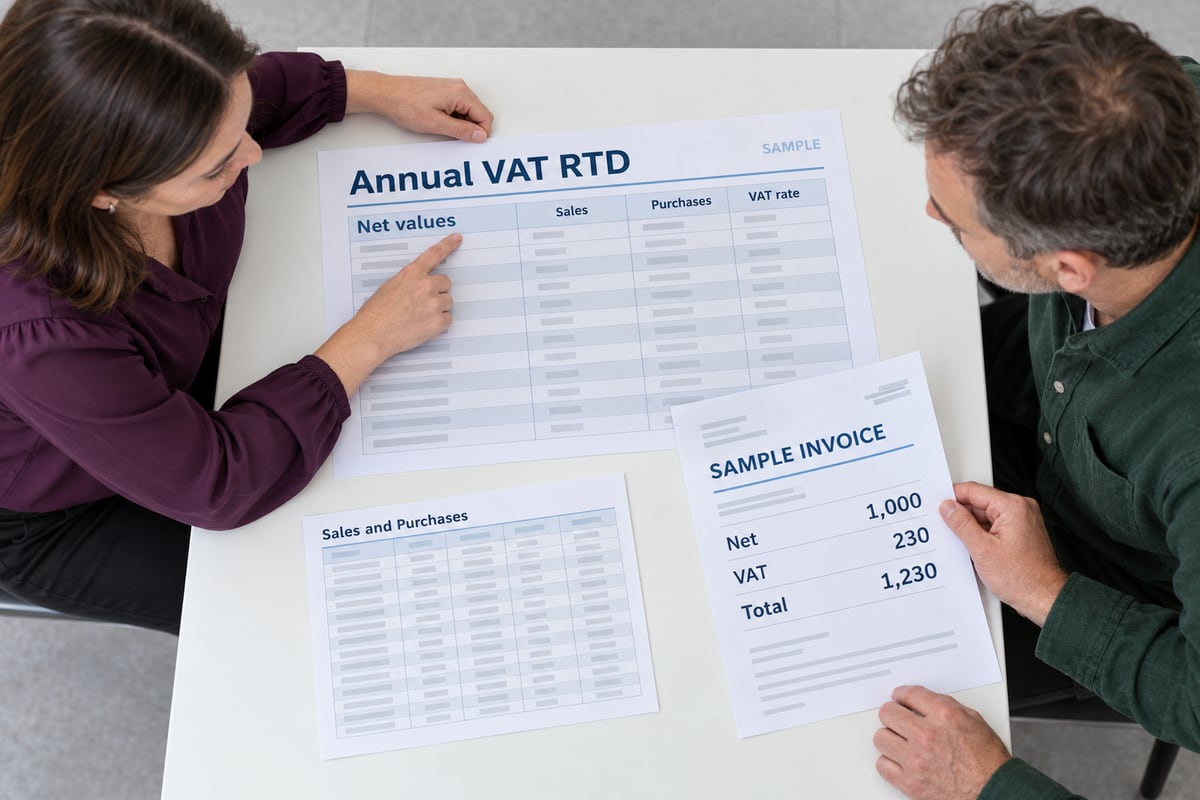
Your Irish company's periodic VAT returns have been filed, but ROS still shows a Return of Trading Details. Is this another payment, a duplicate return or something your company-formation provider should already have completed?
The VAT RTD is a separate annual task. This guide helps directors prepare a useful accounting brief, identify the right source figures and check the work before submission. It is not a box-by-box tax calculation: cross-border transactions, special schemes and uncertain deductions need the company's adviser to apply the current instructions.
1. Identify which annual return is actually outstanding
Revenue's general VAT guidance requires an annual RTD summarising purchases and sales by VAT rate. By contrast, VAT3 records VAT payable or reclaimable for its taxable period. The CRO's Form B1 is the company-law annual return filed through CORE. Completing one does not complete the others.
Read the notice or outstanding-return entry before instructing a provider. Record the company, tax reference, document type and period. An email saying 'please do our annual return' can lead to the wrong work being quoted if nobody distinguishes the Revenue task from the CRO task.
Keep a simple responsibility list. The accountant preparing VAT returns, a company-secretarial presenter filing B1 and the person who registered the business for tax may have different engagements. Ask which provider has actually accepted this RTD, rather than assuming that one of them must be handling it.
| Return | What to distinguish |
|---|---|
| VAT RTD | Annual VAT trading-value breakdown |
| VAT3 | Periodic VAT liability or repayment |
| CRO B1 | Company-law annual return through CORE |
2. Confirm the RTD year and deadline, not just the accounts date
Revenue's February 2026 RTD manual gives the ordinary ROS deadline as the 23rd of the following month. It notes that the VAT year-end may differ from the financial year-end. Exempt non-electronic filers have a different, 19-day rule.
For example, if ROS confirms an RTD period ending on 31 October 2026, the ordinary ROS timetable points to 23 November 2026. This is a conditional illustration, not a deadline for every company. Verify the actual period and any unusual registration history with the adviser or Revenue.
Put the period on the working-paper cover and every export sent to the accountant. Explain any change of year-end, commencement, cessation or missing earlier return. Do not silently rename a January-to-December report to match a different period, or wait for the Corporation Tax or CRO deadline without checking this task.
A useful brief gives the internal records deadline as well as the submission deadline. Leave time for questions about purchases, unusual VAT codes and missing invoices. A last-day handover containing only a bank statement is unlikely to support a reliable review.
3. Build the evidence pack before opening the form
Revenue requires full, accurate VAT-related business records, supported by documents such as invoices, credit notes, receipts and bank statements. Use those records to build a traceable annual working file, rather than trying to reverse-engineer every transaction from the amount paid to Revenue.
Export the sales and purchase ledgers for the confirmed period, with invoice dates, transaction descriptions, net amounts, VAT amounts, VAT codes and references back to the documents. Mark unresolved items clearly. An accountant should be able to see which source produced a number and which decisions still need review.
Include credit notes, overseas transactions, imports and any adjustments already made in the periodic VAT work. If the company uses payment processors, provide the sales and fee reports as well as bank payouts. A single net deposit may combine sales, deductions and timing differences; it is not a complete transaction description.
Keep the original export unchanged and save the reviewed version separately. Record the reason for recoding an item. This makes it easier to explain why the final schedule differs from a report produced earlier, without losing the path back to the original records.
4. Keep net values, VAT amounts and gross payments distinct
The RTD manual requires VAT-exclusive invoice values, not liability or refund figures. That distinction is easy to lose when the only spreadsheet available is a list of payments.
Consider a fictional, correctly issued domestic invoice showing net EUR1,000, VAT EUR230 and gross EUR1,230. The three numbers answer different questions. The EUR1,000 describes the underlying transaction value; EUR230 is the tax component; EUR1,230 is the gross invoice total. Using the bank payment or the VAT component in place of the net value would describe a different amount.
Build those components into separate columns in the working schedule. Do not overwrite the VAT column with a net figure just to make a software export look convenient. Retain enough information for the accountant to review both the trading-value schedule and the periodic VAT calculation.
The example does not establish a right to reclaim the EUR230. Revenue's deduction rules distinguish taxable, exempt and non-business activities and require supporting evidence; some costs are blocked or restricted. Have uncertain purchases reviewed before treating every tax amount on a receipt as deductible.
5. Review transaction types before copying totals
The RTD panels distinguish supplies, acquisitions, resale purchases and other deductible purchases. More than one panel can apply to a transaction; complete each independently under Revenue's instructions.
In the preparation file, describe what was bought or sold, its business purpose, where the other party belongs and the VAT treatment used. A purchase of resale stock and an overhead may share a supplier but need different analysis. A generic 'expenses' total hides that distinction.
Revenue explains that goods and services can have different VAT rates. Check the transaction and relevant date rather than assigning every item to the company's most common rate. Preserve any explanation for an unusual code so the reviewer does not have to make the same investigation twice.
For overseas services, imports, construction reverse charges, margin schemes or mixed activities, request a specific mapping review. Do not remove an entry solely because its value appears elsewhere, or force every field to equal the profit-and-loss account. Document the relationship and any legitimate differences instead of inserting a balancing figure.
An accounting package's RTD report is a starting point, not proof that the underlying tax codes were correct. Ask how uncoded transactions, credit notes and manual journals were treated. The aim is an explainable schedule, not merely a report that adds up.
6. Do not confuse zero tax payable with no activity
VAT3 distinguishes VAT due on supplies from VAT the business is entitled to reclaim. A zero net payment can therefore coexist with sales and purchases. The bank payment alone cannot tell the accountant whether there were trading details.
Suppose a simplified period contains one domestic sale of EUR1,000 plus EUR230 VAT and one fully deductible business purchase of EUR1,000 plus EUR230 VAT. Assume no other transactions or adjustments. The two VAT amounts offset, but there are still two underlying transactions. A zero payment is not evidence that the company did nothing.
For a newly registered company with no sales, give the reviewer the purchase records too. For a genuinely inactive period, let the complete records support that conclusion. Do not choose a no-details response merely to clear a reminder when the transaction file has not been examined.
Likewise, incorporation is not proof of VAT registration, and a CRO dormant-audit assessment is not a VAT-return decision. If the Revenue record appears wrong, ask for that issue to be resolved explicitly rather than ignoring it or using an unrelated filing to justify the answer.
7. Agree submission, evidence and correction responsibility
Before submission, approve the reviewed schedule and the exact period. Agree who sends the return, who keeps its acknowledgement and who monitors feedback. A saved draft, an exported report and an email to the accountant are different stages of the work.
Revenue says an authorised agent uses their own ROS certificate and password. Do not send your personal ROS login or certificate to arrange assistance. Discuss the proper authorisation and secure document channel instead; a quote enquiry should not require surrendering control of the company account.
Same-day RTD amendments are restricted. If an error is discovered, preserve the filed copy and identify the period, field and supported replacement figure. Check the current correction route with the adviser; do not repeatedly submit conflicting versions to make a status message disappear.
Revenue's MyEnquiries service allows business correspondence through ROS to be sent and tracked. Keep the reference and relevant response if the return period or record needs clarification. An enquiry being received is not the same as a completed correction, and it should not be assumed to extend a deadline.
8. Send an accountant a brief they can act on
State whether you need a first RTD, an overdue return, a correction or a review of the accounting setup. Mention missing records immediately. A quote based on clean annual ledgers may not cover reconstructing several years of transactions.
Use this preparation checklist:
- Identify the company and the exact VAT RTD period shown in ROS.
- Confirm the deadline, any outstanding earlier periods and the person responsible for filing.
- Provide sales and purchase ledgers, source documents and credit notes for the full period.
- Keep net values, VAT amounts and gross totals in separate fields.
- Flag uncertain rates, deductions, overseas transactions and special schemes.
- Supply the periodic VAT workings and explain adjustments or unresolved differences.
- Agree review, approval, submission evidence and any correction follow-up.
- Confirm whether RTD work is included, any historic reconstruction and the total payable.
9. Request the accounting support, not the wrong service
StartCompany.ie's Accountant Services page is the route to discuss bookkeeping and tax-return support. Describe the RTD period, transaction volume, existing records and any overdue work, then ask whether the required RTD review and preparation can be provided. Agree the scope and total payable before instruction.
Company formation, an annual secretary appointment, a CRO B1 order and VAT-registration assistance do not automatically include this recurring accounting work. If another provider already handles VAT3, ask whether RTD is expressly included before ordering duplicate support.
Keep historic corrections, account reconstruction and specialist transaction advice visible in the quote. If you only need a review of an existing draft, say so. If you need ongoing bookkeeping as well, explain the current gaps so the proposed service matches the actual task.
The useful outcome is a supported return and a clear completion record, not a promise that every tax issue has been solved. No quotation, appointment or registration guarantees Revenue acceptance, a particular deduction or a refund.
StartCompany.ie service
Accountant Services in Ireland
Official information and next steps
Revenue guidance, including the RTD manual last updated in February 2026, and CRO guidance were checked on 29 October 2026. The worked transactions are simplified fictional illustrations, not completed returns or advice on a company's VAT treatment. Confirm the actual RTD period, deductions, special-scheme and cross-border treatment with the company's adviser or Revenue.
- Revenue: VAT RTD guidance, updated February 2026
- Revenue: annual RTD requirement and periodic VAT
- Revenue: completing VAT3
- Revenue: keeping VAT records
- Revenue: who can reclaim VAT
- Revenue: VAT-rate categories
- Revenue: agents and protected account access
- Revenue: MyEnquiries
- CRO: the separate company-law annual return