
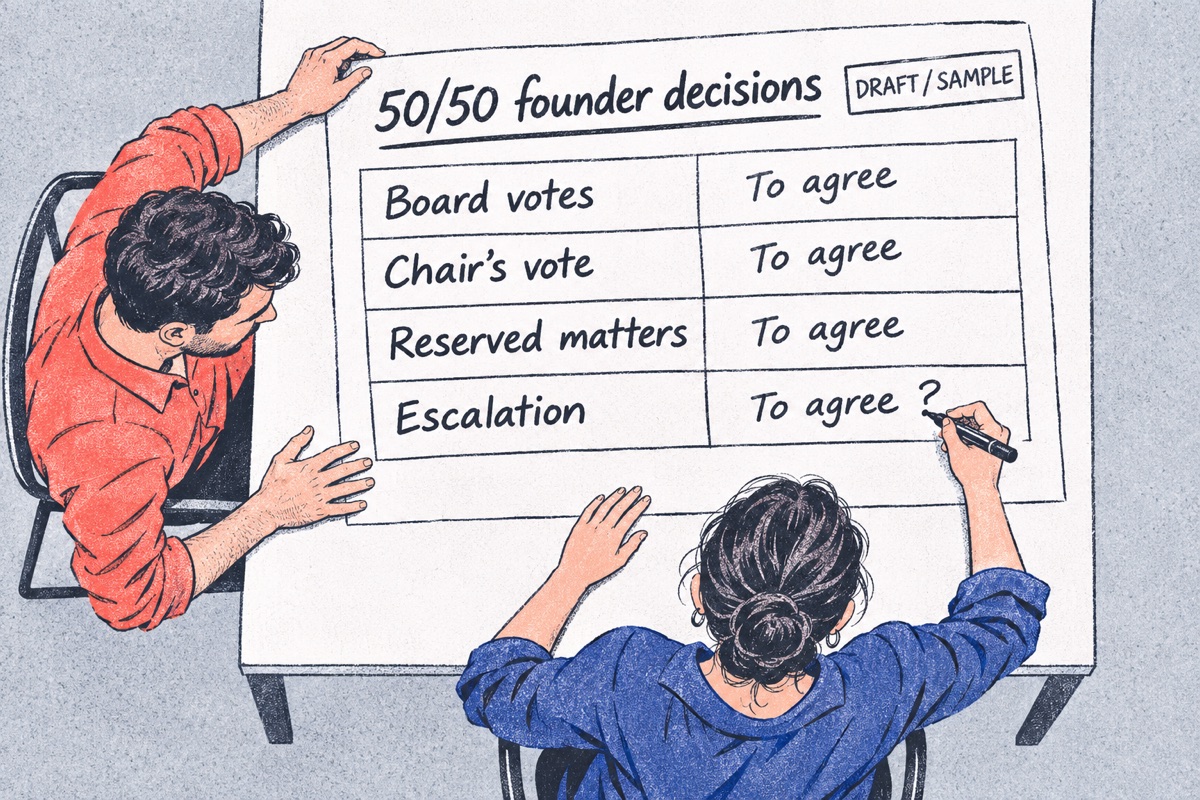
Two founders agree to own an Irish LTD equally. They assume every important decision will need both signatures, and that appointing one founder chair is merely administrative. Those assumptions can produce a very different control arrangement from the one they intended.
This guide focuses on tied votes and decision design before forming an ordinary Irish LTD. Our broader co-founder guide covers the overall setup; this article explains why the share split alone does not settle control. Official sources were checked on 8 November 2026. It is a preparation checklist for professional advice, not a ruling on an existing vote or a substitute for tailored drafting.
1. Separate equal ownership from voting and management
Start by stating what 50/50 means. Two founders taking 50 of 100 identical ordinary shares is a simple equal allocation. Different classes or attached rights can make a percentage misleading. Section 188 distinguishes votes on a show of hands from votes on a poll, subject to share rights and the constitution.
Also identify each person's roles. Both may be members, while only one is a director; alternatively both may sit on the board. Section 158 places management with directors, subject to the Act and constitution. Owning half the shares does not automatically make someone a director or give them authority to sign every company contract.
Prepare a role list before discussing deadlock: shareholder, director, chair, working executive and authorised signatory. Give each role its own proposed authority. A founder's title, bank access and ownership percentage should not be treated as interchangeable evidence of legal decision-making power.
2. Check the board chair's casting vote explicitly
Under section 160, board-meeting questions are decided by a majority, and the chair has a second or casting vote on an equality. Section 157 makes these provisions subject to what the constitution provides otherwise. The default is therefore not a promise that two equally invested directors must always agree.
Ask who can become chair, how long the appointment lasts and whether the proposed constitution retains, removes or limits a casting vote. Section 160 also addresses choosing the chair and board quorum. Do not assume a founder can appoint themselves chair merely because they called the meeting or paid the formation invoice.
Have the drafting adviser explain the practical effect for your two-director board. A casting vote may help avoid paralysis, but it can also give one founder influence the other did not intend. Removing it without any alternative process can create a different problem. The decision should be deliberate, not hidden in documents nobody reviewed.
3. General-meeting ties are a separate check
Do not stop at the board clause. Section 187(8) provides a second or casting vote for the chair of a general meeting where votes are equal, on a show of hands or a poll. That provision is also subject to constitutional variation. Check who chairs the members' meeting and the actual rules rather than importing a board conclusion automatically.
Section 191 defines an ordinary resolution by a simple majority of votes cast and a special resolution by at least 75% of votes cast, alongside the applicable requirements. Those are meeting rules, not a universal percentage test based only on the cap table. A casting vote is not permission to ignore notice, eligibility, required thresholds or additional approvals.
Ask the adviser to walk through one ordinary and one special-resolution scenario using the proposed documents. Include any relevant class rights or contractual consent requirements. Avoid a blanket statement that either '50% blocks everything' or 'the chair can approve everything'; both skip necessary questions.
4. A meeting casting vote is not a written-resolution shortcut
Section 161 starts from a written board resolution signed by all directors entitled to notice, with particular exceptions and conditions. Its rules do not simply transfer a meeting chair's casting vote into an email decision. Have the adviser identify the correct written route and signatories rather than asking one founder to sign twice.
For majority written member resolutions, section 194 uses more than 50% of all relevant members' total voting rights for an ordinary resolution, and at least 75% for a special resolution. Exactly 50% is not more than 50%. The circulation and effectiveness requirements also matter; a shared chat saying 'approved' is not automatically the statutory procedure.
Decide how routine approvals will be documented when founders travel or work remotely. Keep the board decision, member approval and contractual consent distinct. Choosing a convenient communication tool does not change which body must decide or create a majority that does not exist.
5. Review quorum and absence, not just the vote count
Quorum is the attendance needed to transact business, not the number of votes needed to pass a resolution. Section 182 generally starts with two members for a general meeting, subject to the constitution and its other provisions. It also contains rules for an inquorate meeting and an adjourned meeting at which the members present may form the quorum.
That is why refusing to attend should not be treated as a guaranteed permanent veto. Ask what happens if a founder misses the original meeting, an adjournment or a properly arranged remote meeting. Likewise, the board's quorum and chair rules need their own review; a two-member company is not necessarily a two-director board.
Build a reliable notice and availability process. Keep current contact details, agree how papers are circulated and identify what information is needed before a decision. Do not use deliberately poor notice, exclusion from systems or unexplained last-minute documents as a substitute for a lawful and workable control arrangement.
6. Design routine authority and reserved decisions together
Equal founders do not need to debate every ordinary purchase. Prepare an operating budget and discuss what may be delegated within it. Section 158 permits delegation subject to the applicable limits. Distinguish permission to make a decision from the separate authority and signing process needed to implement it.
Then identify the matters for which both founders genuinely want additional protection. A consent list should be precise enough to apply: what transaction, what threshold, whose consent and what happens in an emergency? Do not assume the phrase 'major decisions need both of us' is a usable legal provision.
The following is a discussion worksheet, not a recommended approval policy. Ask the solicitor to align any agreed protections with statutory powers, the constitution, share rights and the shareholders' agreement. Do not adopt the table itself as a contract.
| Scenario to test | Question to settle | Keep separate |
|---|---|---|
| Routine budgeted purchase | Who may approve within agreed limits? | Contract-signing authority |
| Major borrowing or guarantee | Which approvals and protections apply? | Each person's personal exposure |
| New shares or investor | Who authorises the terms and dilution? | The actual issue and record updates |
| Business sale or founder exit | Which consent and valuation process applies? | Funding, tax and completion steps |
7. Give unresolved disagreement a defined next step
Describe the deadlock you are trying to prevent: disagreement on a specified decision, repeated inability to approve a budget, or a longer breakdown in the working relationship. Not every rejected proposal should force a sale of the company. Agree which situations need escalation and what evidence starts the process.
Ask your solicitor to consider staged discussion, a defined information exchange, negotiation or mediation before any exit mechanism. Decide what happens to ordinary trading and essential compliance while discussions continue. A suggested discussion sequence is not authority to bypass a statutory duty or make payments the company cannot afford.
If an independent director or adviser is proposed, define their actual role. Section 228 imposes director duties to the company; a third director is not merely a neutral voting token for the founders. An expert asked to assess a narrow valuation question has a different assignment from a director deciding business strategy.
8. Do not treat 51/49 or a buy-out clause as a universal fix
Changing the economic split also changes what the founders own. It does not, by itself, rewrite a two-director board's voting rules, remove a reserved consent or solve the company's funding needs. Ask which exact problem a proposed unequal split addresses, and what new risk it creates for the minority founder.
For an exit mechanism, discuss valuation, information access, payment terms, finance, guarantees and what happens if neither person can fund a purchase. A forced buy-or-sell process can have very different effects on founders with unequal financial resources. Get legal and tax advice before agreeing binding mechanics rather than copying a dramatic clause from another business.
Keep departure from employment, resignation as director and ownership of shares separate. A founder stopping work does not itself explain how their shares will be dealt with. Our exit guide covers that handover; this article does not recommend changing an existing company's ownership to win a current dispute.
9. Example: equal shares, three different decision routes
Imagine a fictional consultancy with two founders, each holding half of identical voting shares and both serving as directors. Before filing, they test a disputed equipment purchase at a board meeting, a proposed ordinary resolution at a general meeting and a majority written member resolution. They do not assume all three have the same result.
Their solicitor checks the constitution and explains the chair, casting-vote, quorum and approval provisions for each route. For the written ordinary resolution, one founder's 50% alone does not meet the more-than-50% statutory test. The founders then decide whether the proposed controls match their commercial expectations and ask for any drafting changes before signing.
They also test a missed meeting and a founder who cannot fund an exit. This exposes practical gaps that a cap-table percentage would not show. The example is a review exercise, not a declaration that a particular vote would pass or that one set of clauses is suitable for every equal-share company.
10. Align the documents before ordering the formation
Section 31 gives the registered constitution binding significance for the company and members, subject to the Act. Treat it as an operating document, not a formality behind the certificate. Have the solicitor check that any separate shareholders' agreement, consent rights and founder service arrangements work with it rather than assuming one private promise overrides every company-law action.
CRO's formation requirements include Form A1 and a constitution, with subscriber, share and officer details. Give the presenter one agreed set of instructions after the control questions are resolved. If bespoke documents are needed, confirm whether the proposed formation process can accommodate them before signing standard versions.
StartCompany.ie offers formation packages with a company constitution and core incorporation documents. Compare the current inclusions and total payable, explain the equal-share arrangement and ask about the accepted document scope. Do not assume a package includes a tailored shareholders' agreement, deadlock drafting, investment advice or representation in a founder dispute.
- Agreed share quantities, classes and voting rights, not just 'half each'.
- Separate board and member approval rules, including chair and casting votes.
- Quorum, notice, absence and written-resolution routes checked.
- Routine delegation, reserved decisions and signing authority distinguished.
- Escalation, exit funding and valuation questions reviewed with advisers.
- Constitution, private agreements and final formation instructions aligned.
StartCompany.ie service
Irish Company Formation Packages
Official information and next steps
Official CRO guidance and the linked revised Companies Act provisions checked on 8 November 2026. This is a pre-formation decision checklist, not bespoke governance clauses or a conclusion about a real meeting, disputed vote, minority remedy or exit transaction. The Act, actual constitution, share rights, agreements and facts must be assessed together by a suitable adviser.
- Companies Act 2014, section 157: constitutional variation
- Companies Act 2014, section 158: management and delegation
- Companies Act 2014, section 160: board meetings and casting vote
- Companies Act 2014, section 161: written board decisions
- Companies Act 2014, section 182: member quorum
- Companies Act 2014, section 187: general-meeting casting vote
- Companies Act 2014, section 188: votes of members
- Companies Act 2014, section 191: resolution thresholds
- Companies Act 2014, section 194: majority written resolutions
- Companies Act 2014, section 228: director duties
- Companies Act 2014, section 31: constitutional effect
- CRO: required steps for incorporation