
You download an annual return already registered by the Companies Registration Office and notice a misspelt member name, an unexplained share figure or an officer entry that does not match your records. The filing status says accepted, so can you edit it, upload another copy or leave the correction until next year? First establish exactly which document and historical fact are wrong.
This guide concerns factual company-information errors discovered after a B1 has been registered. It is different from correcting a return that CRO has sent back or revising the attached financial statements. Official guidance and legislation were checked on 14 November 2026. It is a preparation checklist, not a decision that a particular filing can be replaced or a substitute for legal advice on disputed ownership.
1. Verify registration and isolate the affected document
Check the company number, the return's made-up date, submission reference and current status. Save the actual registered B1 and any separate shareholder attachment, not only a draft from your accountant's folder. CRO's filing guidance explains how submissions can be monitored on CORE and how a separately associated shareholder list can be requested when a B1 is purchased.
Next identify the location of the problem. Is it in the B1's company particulars, an attached financial statement, the current officer record or the company's own register of members? Those records can raise connected questions without sharing one correction process. A screenshot of the current company profile does not show every fact contained in an older return.
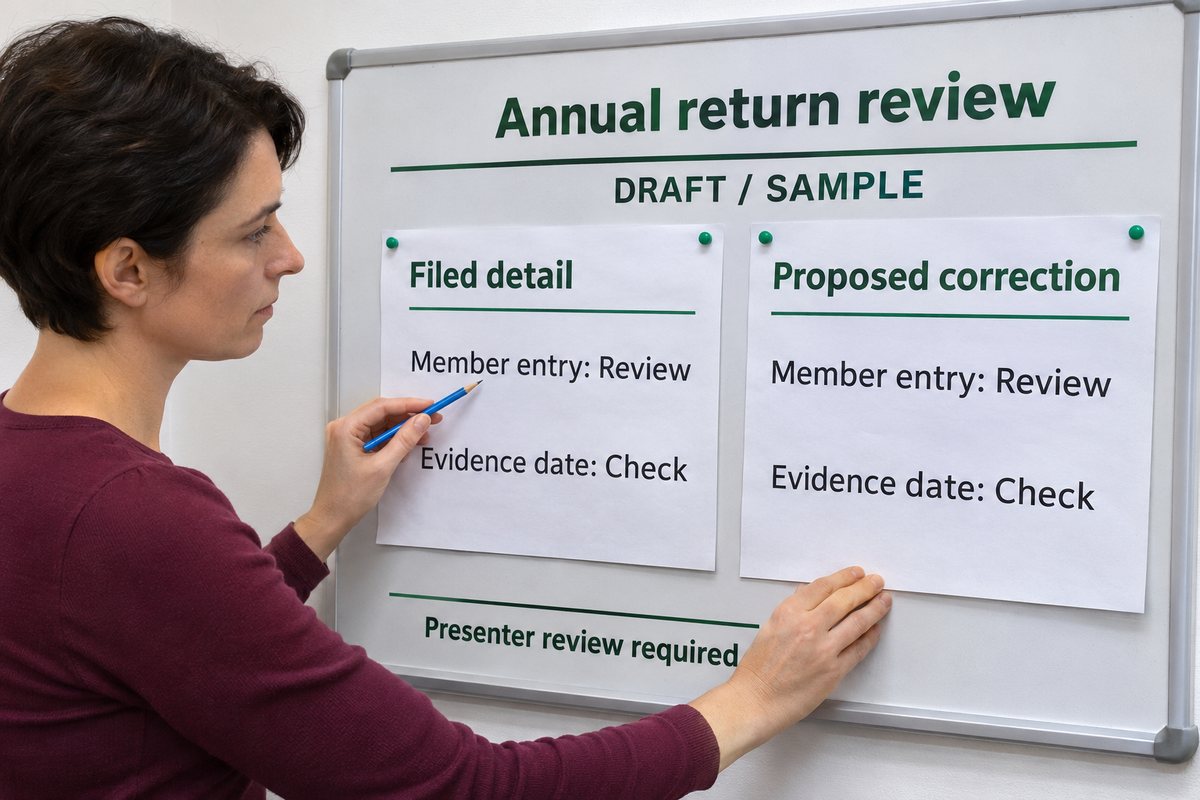
Write one issue per line: document, page or field, filed wording, proposed wording and why the change is needed. Keep the original copy intact. This gives the presenter something precise to assess and avoids an instruction such as fix the CRO file, which does not identify the document or intended outcome.
2. Distinguish adding a correction from erasing history
CRO's rectification guidance says it has no general administrative power to rewrite or remove registered submissions. Its practice of accepting an amended factual return is not a promise that the original disappears. The guidance identifies High Court-directed rectification in appropriate cases and a limited statutory member-register route; these should not be confused with an ordinary amendment.
Tell the adviser what you actually need. Adding a supported correction, removing an existing document and determining a contested ownership position are different requests. If a bank or investor has queried the old filing, ask what explanatory evidence they need as well; do not promise them a clean register before the route is assessed.
The comparison below is a triage tool, not a menu of guaranteed remedies. Provide the full facts before deciding which process applies.
| Problem | Review route | Not the same as |
|---|---|---|
| Factual B1 error | Amended return enquiry | Deleting the original |
| Wrong accounts | B1X revision review | Editing B1 particulars |
| Member register error | Section 173 assessment | A new share transfer |
| Later officer change | B10 notification | Rewriting the past |
3. Rebuild the facts at the return date
Section 343 distinguishes the date to which an annual return is made up from its delivery deadline. A later event is not automatically evidence that the earlier return was wrong. Prepare a timeline with the return date, relevant appointments or share events, the original delivery and registration, and the date the discrepancy was discovered.
Compare the entry with contemporaneous records rather than today's contact list or cap table. Useful evidence may include signed appointment consents, resolutions, the dated members register, share documentation and earlier filings. Label unresolved gaps. An email saying someone intended to become a shareholder is not a substitute for establishing what was actually implemented.
Officer changes have their own notification obligation. Section 149 provides a 14-day period for relevant changes, and CRO identifies B10 for post-incorporation officer appointments, cessations and particulars. Investigate any missing event filing separately; do not assume that repeating the desired name in an annual return completes that task.
4. Check whether the company's members register is also wrong
A transcription error in a CRO attachment and an incorrect statutory register are not identical. Under section 173(5), a company can rectify an error or omission in its register of members without a court application, but cannot adversely affect someone unless that person agrees. Where the error also appears in a document sent to CRO, subsection (6) requires notice in the prescribed form within 21 days after that rectification.
The section also addresses issued-capital errors and court applications concerning membership. Have the adviser establish whether this route is relevant before sending a generic amended B1. The 21-day rule is tied to that particular register rectification; it is not a universal deadline for every mistake discovered in an annual return.
If people disagree over who owns the shares, stop treating it as a routine typing correction. Preserve the competing records and obtain legal advice. Do not create a transfer, invent a new allotment or obtain a signature on a document with a false historical date just to make the public figures appear consistent.
5. Keep financial-statement revisions in their own workstream
If the error is in the attached accounts or directors' report, CRO identifies Form B1X for revised financial statements. Its guidance points to sections 366-379, proper approval and signing, and delivery within 28 days after revision. That is not simply a B1 company-particulars correction or an informal replacement PDF.
Tell the accountant exactly which financial statement, note or report is affected, and whether correcting it changes other figures or disclosures. There may be an accounting review, director approval and auditor involvement to assess before a revised pack can be filed. Do not change a share figure in the B1 and assume an inconsistent accounts note has been repaired too.
Our separate B1X guide covers the distinction between supplementary notes and replacement statements. Use it for the accounting workstream while the presenter assesses any company-information amendment. Agree who keeps the two issue lists aligned so one provider does not assume the other has dealt with everything.
6. Two examples: an old error and a later event
Consider a fictional consultancy whose signed, dated member records consistently identify one shareholder, but the registered B1 attachment misspells that person's surname. The review starts with the saved attachment, correct source record and a narrowly described proposed spelling correction. The presenter checks the current amendment instructions. Nobody creates a new share transfer merely to fix the spelling.
Now consider a director who genuinely joined after the B1's made-up date. The founder notices their name is absent from that historical return and assumes it needs replacement. The relevant question is the appointment date and any required B10 notification, not how to make an earlier snapshot show a person who had not yet joined.
Both examples are deliberately limited. If the underlying appointment or membership is contested, documents are missing or several years disagree, the work is broader than either simple scenario. Explain the whole timeline. Selecting the most convenient document and ignoring conflicting evidence can make a proposed correction misleading.
7. Prepare an evidence pack before requesting a quote
Send an initial summary through the normal enquiry route and agree secure delivery of supporting material. Do not put passports, personal tax identifiers, customer records or banking credentials in an open contact form. The following list is a practical briefing pack, not a mandatory CRO attachment list.
- Company name and CRO number, checked against the affected filing.
- Return made-up date, submission reference and confirmed registration status.
- Unaltered registered B1 and any separate attachment containing the error.
- A field-by-field list of filed wording, proposed wording and the reason.
- Dated source records supporting each change, with gaps or conflicts disclosed.
- A timeline separating historical facts from events after the return date.
- Details of related officer, member-register, capital or accounts issues requiring review.
- Any CRO correspondence, live deadline, third-party query and the person authorised to coordinate.
8. Confirm the filing method, authority and completion evidence
Ask the presenter or CRO to confirm the current channel, form, supporting explanation, signatures and charges for the actual case. This guide does not prescribe a universal upload button or amendment form code. A draft created in filing software is not proof that an amendment has been delivered or registered.
CRO's annual-return guidance distinguishes Electronic Filing Agent signing from director-and-secretary certification of required accounts copies. Section 134 also prevents a required director-and-secretary act from being performed by the same person in both capacities. Confirm the signing requirements for the proposed submission rather than reusing a signature page from an unrelated document.
Keep the final approved version, instructions, submission acknowledgement and registration outcome together. After processing, check the actual document available on the register, not only the status email. Record unresolved questions separately. Where a bank or adviser needs an explanation of the history, supply an accurate document trail rather than claiming the earlier copy no longer exists.
9. Do not borrow a deadline from another correction process
Section 898 provides a specific notice-based process for non-complying documents, with a 14-day replacement window after service of the notice. It is not a fresh 14-day allowance automatically triggered whenever a director discovers an error in a registered return. If CRO has actually issued a notice, preserve it and obtain advice on its requirements promptly.
Keep ordinary annual-return deadlines under section 343 on the calendar while an older filing is reviewed. A correction enquiry, provider payment or proposed amendment should not be treated as a waiver of another outstanding obligation. Different clocks may be running for an officer change, a member-register correction or an accounts revision.
Section 223 leaves each director responsible for ensuring company-law compliance. Assign one person to coordinate the presenter, secretary, accountant and any solicitor, with clear next actions and evidence of completion. Do not leave the matter marked done merely because the first enquiry was sent.
10. Ask about the amendment before ordering routine B1 support
StartCompany.ie's Annual Returns service describes B1 preparation and filing, checking company particulars and attaching required financial statements. An already-registered factual amendment may need a different review from the next ordinary annual return. Contact us with the affected return date and a concise issue summary before purchasing support for this problem.
Ask whether amendment assessment, presenter correspondence and submission can be provided, what documents you must supply and how completion will be confirmed. Historic record reconstruction, disputed ownership, court rectification, accounting revisions and legal representation are not automatic inclusions in a routine B1 order.
Confirm acceptance, scope, responsibility for linked work and the total payable in advance. Payment is not an accepted amendment and cannot guarantee removal of a public document or a legal outcome. The aim is a supported, accurately described next step, not another filing made before the underlying facts are understood.
StartCompany.ie service
Annual Returns
Official information and next steps
Checked on 14 November 2026. This guide separates CRO's amended-return practice, statutory member-register rectification, non-compliance notices and accounts revisions. Their conditions and clocks are different. Confirm the current submission instructions and obtain legal advice on disputed facts, removal requests or court proceedings.
- CRO: register rectification and amended annual returns
- CRO: filing an annual return and submission evidence
- CRO: revised financial statements and B1X
- Companies Act 2014, section 173: member-register rectification
- Companies Act 2014, section 149: officer changes
- CRO: officer-change notifications and B10
- Companies Act 2014, section 898: non-complying documents
- Companies Act 2014, section 343: return date and filing obligation
- Companies Act 2014, section 134: director and secretary capacities
- Companies Act 2014, section 223: director responsibility