
Your only employee has left. The payslip is ready, the business is staying open and your payroll software still shows an active employer registration. Do you need to keep it? The answer turns on what will still go through payroll, not simply how many staff are on the rota today.
This is a closeout guide for an Irish LTD that already has an employer registration. It is not a procedure for making someone redundant, determining a settlement's tax treatment or shutting down the company. Where final pay is disputed, the company is insolvent or a business is being transferred, get advice on that situation before treating it as a routine leaver. Official sources were checked on 22 November 2026.
Start with three dates, not a cancellation button
Pull the actual date the employment ended, the date the company made the last payment and the proposed date for ceasing the employer tax registration. The first is about a person and their employment record. The second tells you when to report the payment and is the reference point for the employer notification where required. The third is a company registration detail to confirm with Revenue or the payroll adviser. Do not overwrite one date with another to make the records match.
Regulation 17 requires the employer to notify Revenue of the employee's cessation no later than the date of cessation. Revenue's practical guidance describes including the leaving date on the final payroll submission. If payment is due after the person leaves, arrange the cessation reporting on time and use the appropriate later-payment procedure. The employer's 30-day notification is not extra time to report the individual's departure.
Check who will still be paid
Ask whoever operates payroll for the open employments and a list of expected payments. Include an owner-director's salary, fees and any continuing benefits that might belong in payroll. Revenue specifically says a company must operate PAYE on directors' income even if there are no other employees. A director is not taken off payroll by cancelling a staff member's employment record, and an existing director appointment is not itself proof of taxable pay.
If you expect to rehire soon or only employ people for part of the year, ask whether this is an ordinary period without payments rather than an employer cessation. Revenue expressly describes nil months for seasonal employers. It does not give a universal number of weeks that makes a gap permanent; explain your actual hiring plan if the answer is unclear.
For example, a shop whose only assistant leaves in November may still have a December board fee scheduled for the owner-director. Before switching off payroll, ask the adviser to check the fee and any continuing benefits. The staff leaver is still reported, but the shop should not mark its employer account as finished while there is relevant director pay to process.
| Situation | What to do |
|---|---|
| Nobody left to pay and no near-term hire | Report the leavers, settle final payroll and notify Revenue within 30 days of the last payment. |
| Director still on salary | Keep payroll in place for the director; report the staff leaver separately. |
| Genuine seasonal gap | Confirm the registration should remain active and review the nil months. |
| Bonus or other payment still expected | Agree the later-payment reporting and registration timing before closing access. |
Final pay and money paid after leaving
List the amounts actually due: ordinary wages, agreed commission or overtime and outstanding annual leave, for example. The Workplace Relations Commission explains that leaving employees are entitled to payment for outstanding annual leave. Get specialist input on notice pay, a redundancy lump sum or a settlement instead of using the same tax treatment for every line. Make sure the payroll record, payslip and bank payment can be reconciled.
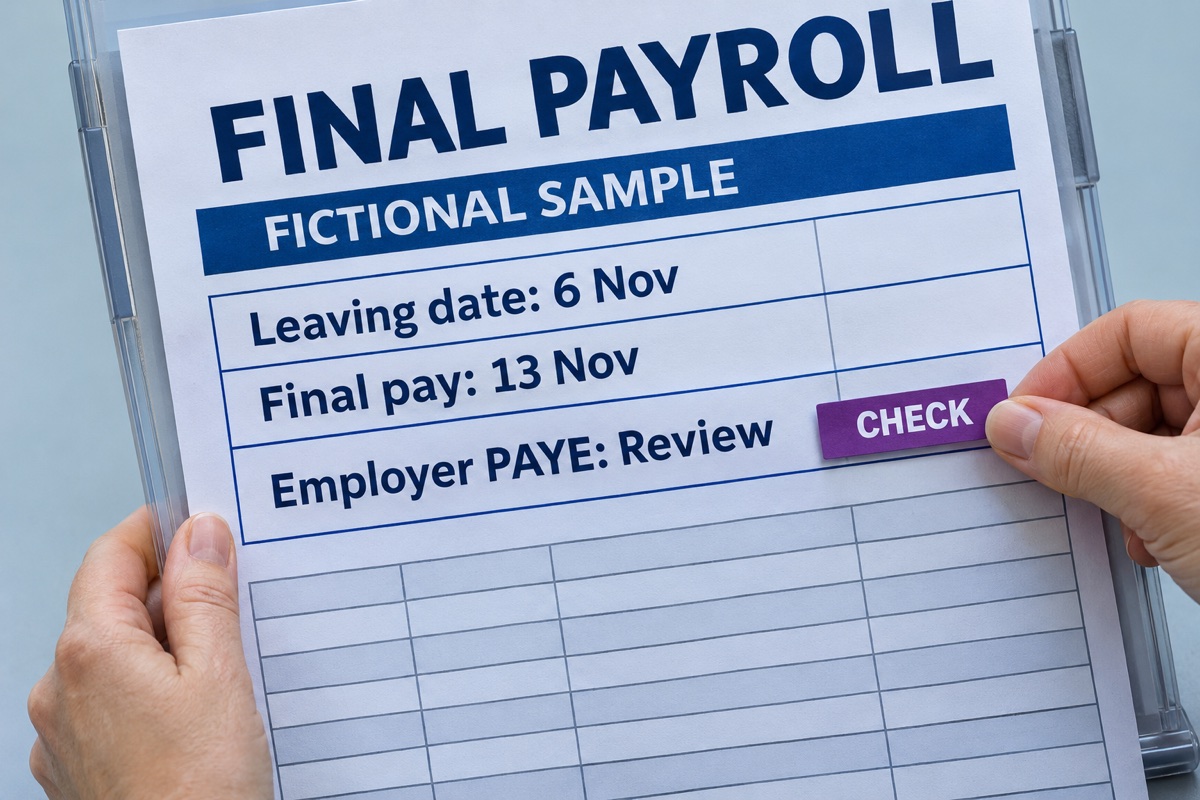
Take a fictional design studio. Its last employee leaves on 6 November 2026 and the studio reports the cessation on time. A final amount is actually paid on 13 November. The payment date for that submission is 13 November, not 6 November. For a payment after cessation in the same tax year, Revenue says to look up the available Revenue Payroll Notification (RPN) and use the original employment ID and cessation date. If the studio continues with an unpaid director, expects no hires soon and has no other payroll items, its 30-day employer notification is measured from the last payment, not the day the employee left.
If a further payment is due in the following tax year, Revenue calls for a new RPN request, no employment commencement date, and reporting the payment against the original employment ID and cessation date. If the registration has already ceased, ask Revenue or your adviser how to handle that payment under the correct employer record. Do not create a fictional new employment or assume that bank payment alone completes the correction.
Notify Revenue and check the correct tax head in ROS
Where the notification rule applies, don't wait for the next monthly statement to tell Revenue. Keep dated evidence of the notification and the last payment. Revenue's employer manual links the notification to section 988(6) of the Taxes Consolidation Act 1997. If you've already missed it or are unsure which pathway records it, contact Revenue promptly, give the true dates and ask what is still needed. Do not guess an effective date or assume the final payslip served as the notification.
For eligible users, the Revenue Online Service (ROS) provides Manage Tax Registrations on the My Services screen. Find the company's specific Employer (PAYE/PRSI) entry, confirm the number and choose Cease Registration where appropriate. Check the requested date and keep the confirmation or subsequent registration status. If the option is unavailable, a date is disputed or you have more than one employer registration, ask your Revenue office or authorised agent which route applies. Revenue's cancellation manual explains the alternative TRCN1 route for cases that cannot use eRegistration.
Ceasing this tax head does not close the LTD, clear unpaid payroll liabilities or stop Corporation Tax and CRO obligations. If the company is continuing to trade, leave unrelated tax registrations alone. If it is ceasing the trade altogether, make a separate closure plan covering its remaining filings and liabilities.
Reconcile the last month before ending your payroll subscription
Compare Revenue's final monthly statement and return against the payroll report and payments. The normal monthly review point is the 14th of the following month, but the payment date depends on remitter status and how you pay and file. A quarterly or annual remitter still receives monthly statements. Correct any omitted pay or wrong leaving date, confirm the actual outstanding balance and assign someone to check that the remittance has cleared. A closed payroll account in your software is not a nil balance in ROS.
If the company stays registered without payments in a month, Revenue says it normally generates a nil statement by the 5th where there were no submissions. The statement can become the statutory return by default by the 14th if no submissions or acceptance intervene. That is different from an employee-level zero submission or correction. If the nil statement doesn't match what the company actually paid, check for a missing pay run.
Before withdrawing agent access or cancelling software, download payroll submissions, payslips, monthly returns, proof of payment and the correspondence for any correction or cessation request. Revenue's employer guide generally requires retention of pay and deduction records for six years after the end of the tax year concerned. Keep them securely and check that another authorised person can recover them.
What to send the payroll adviser
Start the enquiry with dates, the current employer status and the work you need. Use a secure channel for employee names, PPSNs, payslips and records once one has been agreed. If you later hire or start paying the director again, check re-registration and the first payroll submission before payday rather than reusing an assumption from the previous payroll.
- The leaver's actual cessation date, payment dates and latest accepted payroll submissions.
- Salary, director fees or reportable benefits that will continue, and any planned rehire.
- Amounts still to pay and any earlier errors, arrears or unsettled remittances.
- ROS employer registration status, outstanding statements and dated cessation evidence.
- Who should handle the corrections, Revenue notification, registration change and final balance.
- Where records will be retained and who will check for later Revenue correspondence.
StartCompany.ie service
Accountant Services in Ireland
Official information and next steps
Sources checked on 22 November 2026. This guide explains the ordinary employer workflow and does not determine employment-law rights, the treatment of a settlement or the correct effective date for a particular registration.
- Revenue: if you no longer have employees
- Revenue: payments after an employee leaves
- Revenue: Employer's Guide to PAYE
- Revenue: cancellation of a tax registration
- Revenue: paying tax to Revenue
- Revenue: nil pay months
- Irish Statute Book: Income Tax (Employments) Regulations 2018
- Workplace Relations Commission: annual leave