
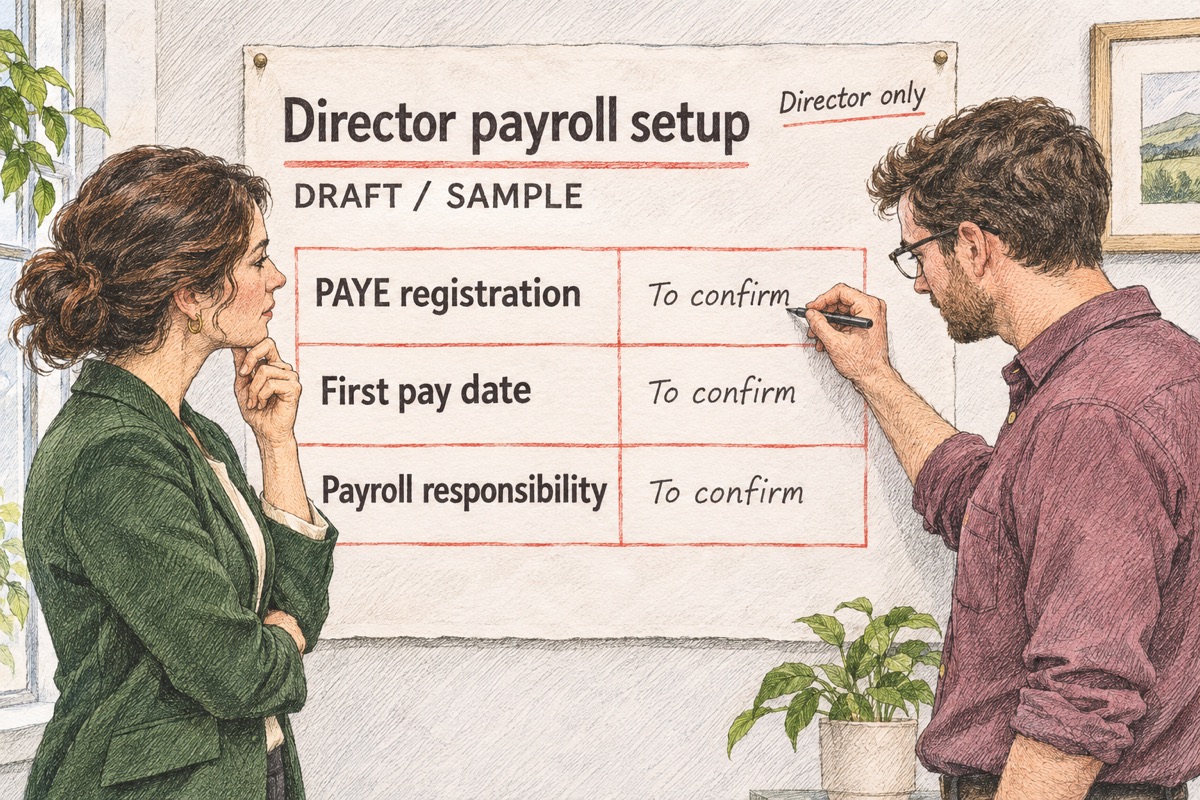
You run an Irish LTD alone. There are no staff contracts, no recruitment plans and perhaps no regular salary yet. When a tax-registration form asks whether the company will be an employer, answering 'no employees' can feel natural. But the question is not just whether you intend to hire someone else: it also concerns what the company pays or provides to its director.
This guide addresses that narrow registration decision and the handover before a first director payment. It does not calculate take-home pay or replace a review of benefits, cross-border duties or overdue payroll. Official Revenue guidance was checked on 10 November 2026. Examples are fictional. Tell your adviser about the actual arrangements, including payments already made, rather than relying on the label 'owner-managed' or 'unpaid director'.
1. Count director income, not just other staff
Revenue's employer-registration guidance expressly includes companies whose only relevant income recipient is a director. You cannot exclude the director merely because they own the shares, work alone or describe themselves as self-employed. A small salary or occasional director fee should therefore prompt the registration discussion before payment, not after the first outside employee joins.
Start with a simple question for your accountant: 'Will this company pay or provide anything to a director that needs payroll treatment?' Give the proposed payment date and explain whether remuneration has already been approved, accrued or transferred. Deferred or accrued remuneration needs its own timing review; this article does not determine when such an amount becomes reportable.
Keep the company decision separate from your personal budget. Deciding how much cash you need each month is useful planning, but it does not establish the correct legal character, gross pay or payroll treatment of a bank transfer.
2. No salary is not the same as no taxable benefit
Review what the company provides as well as what reaches your personal bank account. Revenue treats non-cash benefits as part of pay for tax purposes. Its guidance also addresses advance or on-account payments to employees and directors. Do not assume an advance escapes payroll because the final salary calculation will happen later.
Ask the adviser to examine private use of company assets, company-paid personal costs and any benefit offered instead of salary. Describe the item and its use accurately; do not decide from this checklist that every company cost is taxable, or that an exemption automatically applies. Supporting facts and the relevant benefit rules matter.
Where you genuinely intend no remuneration, no benefits and no other employees, request a documented assessment of that position and a trigger for reviewing it. This guide does not offer a blanket exemption for every unpaid director. Revisit the decision before changing the arrangement, rather than discovering after year-end that the company has been providing something different from the original plan.
3. Classify transfers before calling them drawings
Make a list of proposed or historic director-related transactions. For each, record the date, recipient, purpose, supporting agreement or receipt, and how it was entered in the books. 'Drawings' is not a complete instruction for an LTD's payroll or accounts. Ask the adviser to distinguish remuneration from a properly supported repayment, distribution or other transaction.
Expense reimbursements deserve particular care. Revenue requires taxable expense reimbursements to be reported through payroll on or before reimbursement. Notional pay for benefits also has reporting requirements. A receipt is useful evidence, but does not by itself answer whether an expense is deductible, tax-free or reportable through a different process.
The comparison below is a triage tool, not a list of exemptions or authority to pay a dividend or loan. Use the separate owner-pay and expense guides linked below for the supporting records. If a payment is disputed or unclear, flag it before sending a registration application based on an assumed 'no pay' position.
| Arrangement | First check | Next step |
|---|---|---|
| Director salary | Pay and date | Plan PAYE setup |
| Non-cash benefit | Private use | Review payroll |
| Expense repayment | Purpose and proof | Check treatment |
| No remuneration | All benefits too | Record assessment |
4. Keep company registration and personal tax separate
Employer registration belongs to the company; the director's personal tax record is a separate matter. Revenue says PAYE applies to proprietary and non-proprietary directors, with an RPN, or Revenue Payroll Notification, requested and applied to director pay. Payments must be reported on or before the pay date. Registration alone is not that payroll submission.
A proprietary director can also have a personal Form 11 obligation under self-assessment. Do not assume the company's payroll or Corporation Tax return replaces that return. Equally, submitting a personal return later is not a substitute for operating company payroll correctly when required.
In your handover, identify the person responsible for company registration, the person running payroll and the person advising on personal returns. They may be the same adviser, but confirm each task expressly. If the director lacks a PPSN, use the dedicated payroll-without-PPSN guide rather than substituting a CRO identifier.
5. Choose the route for the company's existing position
Check which tax registrations already exist before preparing a fresh application. Revenue provides an online employer-registration route and paper alternatives where eRegistration cannot be used. Its employer guidance lists PREM Reg for a taxpayer already registered for Income Tax or Corporation Tax, alongside TR2 for registering a company. Ask which route fits this particular company rather than submitting duplicate applications.
There is a separate access issue for overseas-led companies: Revenue currently lists companies with no Irish-resident directors as ineligible for eRegistration. That restriction is not itself a test of company tax residence. The resident-company TR2 and non-resident-company TR2 (FT) distinction must not be decided simply from a director's nationality.
Supply previous Revenue correspondence and ask the adviser to confirm the applicable route, effective date and any authority needed to act. Do not send a ROS certificate, password or identity document in an ordinary enquiry email. Agree a secure collection process for information that is actually needed.
6. Two director-only examples
Example A: a fictional design LTD has one working owner-director and no other staff. The director wants the first monthly salary next month. The useful instruction is not 'register when we hire'. It is 'review and arrange employer PAYE for the first director salary, then confirm who will run payroll before the transfer'. Company tax-registration correspondence and the intended pay date should travel together to the adviser.
Example B: another fictional LTD says its director is unpaid, but the company is considering paying for private medical cover. The absence of a salary transfer does not settle the PAYE question. Ask for a benefit assessment before the cover starts, including any payroll implications. Do not use the word 'unpaid' on an application while leaving the proposed benefit out of the information supplied.
Neither example provides a tax calculation. The first illustrates why outside headcount is the wrong deciding factor; the second shows why the registration brief needs more than a yes-or-no salary answer. Actual benefit treatment, exemptions and any cross-border facts require individual advice.
7. Use a first-payment handover checklist
Build the handover backwards from the intended payment date. Leave room for questions about the company, director and application route; do not promise a salary date on the assumption that registration approval is immediate. Ask for evidence of the registration outcome and a clear payroll-start instruction, not merely confirmation that an application was sent.
Before authorising the first payment, resolve the following practical checks. These are suggested controls for an orderly handover, not a claim that one checklist covers every employment or tax obligation.
- List every director payment and benefit, including anything already provided; disclose overseas work or residence for separate review.
- Confirm which company tax heads are active and the employer registration route and effective date being requested.
- Nominate the payroll operator and agree how director details, RPN handling and benefit information will be collected securely.
- Confirm registration status and payroll readiness before the intended first transfer; identify unresolved items instead of guessing.
- Agree who will submit payroll, arrange tax payments, review Revenue correspondence and correct any earlier omissions.
- Retain the assessment, application evidence, outcome and engagement scope with the company's records.
8. Already registered, but no pay this month?
A quiet month is not a reason to ignore an active employer account. Ask the payroll operator to check the company's reporting and payment position for that period, including any benefits or earlier corrections. Revenue can issue an assessment where an employer is registered but does not make payroll submissions; do not assume silence closes the account.
Where employment genuinely ends and there is no immediate prospect of employees, or the business ceases, Revenue requires notification within 30 days of the final employee payment and completion of employment-cessation procedures. Apply that guidance to the real facts: losing the last outside employee does not settle the position if director remuneration continues.
If you find historic payments that should have been reviewed, prepare a dated schedule and seek correction advice promptly. Do not invent a future start date to conceal earlier remuneration, or cancel a tax head merely to stop reminders. Agree responsibility for the old periods separately from any new registration work.
9. Agree registration support and ongoing work separately
StartCompany.ie's Tax Registration service includes support for relevant company tax heads, including employer PAYE/PRSI, alongside the published ROS and registration support. Before ordering, describe the director-only arrangement and ask which application route and effective date will be handled. Confirm the scope and total payable against the current service page.
Registration support is not automatically ongoing payroll. Confirm separately whether benefit advice, recurring payroll submissions, tax-payment administration, historic corrections and the director's personal Form 11 are included or need a separate engagement. Revenue processing and acceptance are not guaranteed by a service purchase.
The best initial enquiry is short and factual: the company is formed, whether it already has a tax registration, the intended first director payment or benefit, whether anything has already been provided, and whether all directors live abroad. Leave sensitive identifiers out of the initial message and ask how to supply them securely if required.
StartCompany.ie service
Tax Registration
Official information and next steps
StartCompany.ie provides preparation and filing support for the service described above. Final acceptance, registration, tax treatment or court approval remains with the relevant authority. Check the current official guidance before acting, particularly where a deadline, tax position, dispute or unusual transaction is involved.