
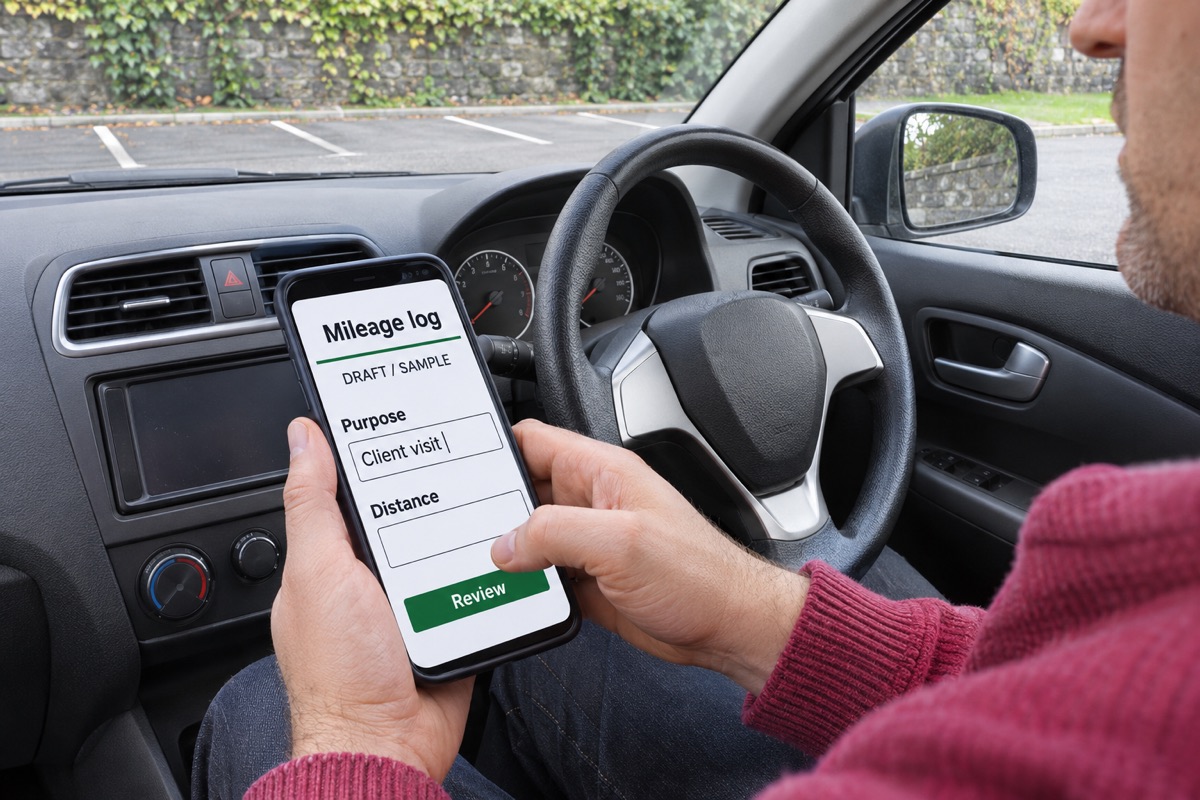
You need a car for customer visits, but it will also be used outside work. Should your Irish LTD buy or lease it, or should you keep a personally owned car and claim eligible business journeys? The company having cash does not settle which arrangement costs less overall.
This is a pre-purchase checklist for directors of an ordinary Irish LTD, not a universal tax-saving recommendation or vehicle-finance comparison. Revenue guidance was checked on 12 November 2026. The worked example is specifically for 2026; get advice for the actual vehicle, contract dates, working pattern and relevant tax year before committing.
1. Define the arrangement before asking which is cheaper
Start with ownership, not the bank account used for a deposit. Who signs the purchase or lease, who owes the finance payments and who will have the car? Give the accountant the actual draft agreement. A personal purchase later paid from the company account is not a clear substitute for deciding those matters first.
Revenue's employer-vehicle rules cover directors as well as other employees and can apply to a leased vehicle, not just one owned outright. A later transfer of the vehicle to the individual is a different transaction. Do not assume that a lease removes the benefit question or that company payments quietly make a personal vehicle company property.
Use a short comparison brief rather than asking whether all cars are deductible. Include the expected holding period and what happens if the director leaves, the company stops trading or the car is sold. An attractive monthly payment can hide a large deposit, final payment or difficult early exit.
| Route | Main review | Records to prepare |
|---|---|---|
| Personal car | Eligible journey claims | Mileage and reimbursement |
| Company purchase | Funding, benefit and asset | Invoice and use evidence |
| Company lease | Contract, benefit and costs | Lease and use evidence |
| Later transfer | Separate sale or benefit | Value and disposal review |
2. Keeping your own car: reimburse journeys, not ownership
Revenue allows qualifying private-vehicle business-travel expenses to be repaid using actual vouched costs or permitted mileage rates, including the current Civil Service schedule. Company directors are included in its employee-expense guidance. This is not an entitlement to have the company pay every cost of owning a personal car.
Describe your normal workplace accurately. Revenue says home is not normally the workplace merely because you choose to do some duties there; an objective requirement is relevant. Ordinary commuting is generally private travel. The registered office on your CRO record is not a shortcut for deciding where every journey starts.
Before choosing this route, ask the adviser to review a realistic sample week. Identify customer visits, normal commuting and private trips separately. Agree the reimbursement method and approval process, avoid duplicate recovery of costs, and keep the private-car comparison separate from the company-car costing. Use our detailed expense guide for the claim workflow.
3. Company provision: plan the payroll from the start
Private use of an employer-provided car is generally a benefit in kind, or BIK, subject to Income Tax, USC and the applicable PRSI treatment through payroll. Travel between home and work is generally private use. Explain actual availability and use rather than relying on a business-only label.
The calculation uses Original Market Value, annual business kilometres and the relevant emissions category. Original Market Value is not simply today's second-hand purchase price. Obtain the supporting valuation and emissions information before comparing quotes; a cheap used purchase can have a much higher original value.
Revenue's general benefit guidance requires notional pay in the relevant pay period. Arrange the payroll owner before the car is provided, including where the director takes little or no cash salary. Ask how deductions and any funding shortfall will be handled. Waiting until annual accounts are prepared is not a payroll plan.
4. Electric cars: use the correct year's figures
A fully electric car and a hybrid do not receive the same electric-car relief. Revenue's published 2026 guidance provides a EUR20,000 electric-car OMV reduction plus the additional EUR10,000 reduction. Its schedule changes for later years. Recheck the applicable rules when delivery or availability moves into a different year.
Here is a fictional full-year 2026 illustration: a fully electric car has OMV of EUR48,000, zero emissions and 18,000 business kilometres, with no director contribution or other adjustment. The category A1 percentage is 15%. The calculation is (EUR48,000 - EUR20,000 - EUR10,000) x 15% = EUR2,700 annual notional pay, or EUR225 per month.
EUR2,700 is not the director's tax bill. The actual deductions depend on their circumstances. Nor is EUR225 the lease cost or the company's total monthly cash requirement. Ask for separate lines for benefit value, personal deductions, company payments and company tax treatment. Do not copy this full-year example into a part-year arrangement.
5. A company deduction is not an immediate purchase refund
Revenue distinguishes capital expenditure from ordinary deductible expenses. Buying a company asset is not automatically a full expense deduction in the purchase year. Its car-specific Part 11C guidance applies emissions-based limits to capital allowances and leasing deductions, and identifies changes for expenditure from 1 January 2027.
Ask the accountant to explain the proposed accounting entry and tax computation separately. A finance instalment can contain components that need different treatment; do not post every bank payment to motor expenses simply because that description appears in the payment reference. Send the complete finance schedule, not just the dealer's headline payment.
For each option, request an after-tax cash projection across the intended holding period. Include deposits, repayments, running costs and likely disposal proceeds, showing assumptions separately. If a relief depends on conditions, ask what evidence is needed and what happens if they are not met. A deduction reduces taxable profit; it is not reimbursement of the car's price.
6. Do not budget for a full passenger-car VAT refund
The ordinary director's passenger car needs its own VAT review. Revenue's partial-recovery guidance allows up to 20% of VAT on qualifying vehicles, subject to normal deduction rules, at least 60% business use for two years or more and the relevant emissions conditions. For vehicles first VRT-registered from 2021, the stated emissions limit is less than 140g/km.
Wholly exempt activities do not establish deduction entitlement. A used-car price also does not prove there is deductible VAT. Give the adviser the actual supplier invoice and proposed use before assuming a refund. Classification as a car, a van or dealer stock cannot be chosen simply to obtain the preferred result.
The partial-recovery rules also address use changes and early disposals. Ask who will monitor the conditions and any adjustment, rather than treating an initial claim as the end of the review. Keep this assessment separate from both payroll BIK and Corporation Tax allowances: passing one test does not establish the others.
7. Build records that support the route you choose
For employer-provided vehicles, Revenue's manual calls for a robust process that records verifiable business mileage. Plan evidence capture from the first day. A calendar of meetings helps explain the work, but an unexplained year-end mileage estimate is a weak handover.
For qualifying travel reimbursements, Enhanced Reporting Requirements need separate attention. Relevant details must be reported through ROS on or before the payment date. Agree whether the provider only records claims or also submits the report. Capturing a receipt in an app does not itself prove submission.
A practical file should connect the contract, vehicle details, use record and accounting entries. Keep permissions and access controlled, while allowing the company to retrieve its own records. Review changes promptly: a different driver, longer commute or delayed delivery may mean the original comparison needs updating.
- Purchase or lease draft, invoice and payment schedule.
- Vehicle specification, registration history, emissions and OMV evidence.
- Date provided, date withdrawn and who had access.
- Journey dates, destinations, purpose, distances and odometer evidence.
- Director contributions and evidence of payments to the company.
- Payroll calculations or approved claims and reporting acknowledgements.
8. Compare two scenarios without forcing a tax-saving answer
Fictional director A already owns a reliable personal car and makes occasional customer visits. Start the review with actual eligible journeys and the cost of keeping that car, not a new company purchase selected first and justified afterwards. The existing car's future replacement and private running costs still belong in the personal comparison.
Fictional director B needs a replacement car and travels regularly for work. Obtain purchase and lease proposals, then have the adviser model the company and personal routes over the same period. Use the same mileage assumptions and identify which party pays each cost. Do not compare a whole company-car budget with mileage receipts alone.
Neither scenario proves one route wins. Test a lower-business-travel case, a change in tax year and an early sale. Ask which result changes most when an assumption moves. A decision that only works at an optimistic mileage figure deserves another look before a non-refundable deposit is paid.
9. Avoid three shortcuts that obscure the real cost
First, calling a vehicle a pool car is not enough. Revenue lists conditions including actual use by more than one employee, incidental private use and the car not normally being kept overnight at or near the employee's home. A car mainly kept for one director needs an honest assessment against those conditions.
Second, putting a car allowance into expenses does not make it a mileage reimbursement. Revenue distinguishes an allowance to buy a car, which is taxable salary, from qualifying own-car expense repayments. Describe what is being paid and why, rather than choosing a convenient bank label.
Third, do not plan a later personal takeover as if the company asset disappears without a transaction. Have the proposed sale or transfer reviewed before agreeing it. Preserve the valuation, approvals, payment trail and asset disposal record. This is particularly important when the same person negotiates on both sides.
10. Request the right accounting support before committing
StartCompany.ie's Accountant Services page offers an introduction to accounting support including bookkeeping, tax returns, payroll and advisory work. Explain that you want a pre-purchase company-car versus own-car review, not just year-end accounts. Ask whether the adviser can accept that specific assignment and confirm the scope and total payable.
Send the vehicle and finance proposals, intended business and private use, current remuneration arrangements and the company's tax position securely. Request a written comparison with dated assumptions, the reporting responsibilities and any follow-up needed when the car is delivered. Identify whether ongoing payroll and reimbursements are included or separately quoted.
This is not automatically vehicle selection, credit approval, insurance advice, legal review of a finance agreement or a guaranteed tax saving. Where work or residence crosses borders, flag that before relying on an Irish-only calculation. Incorporation itself does not guarantee tax treatment, residence, banking or immigration permission.
StartCompany.ie service
Accountant Services in Ireland
Official information and next steps
Official Revenue guidance checked on 12 November 2026. The numerical illustration concerns full-year 2026 only. Confirm current legislation, the applicable year and the facts with an adviser; this checklist is not a personal tax computation.
- Revenue: private use of employer-provided cars and payroll
- Revenue: company-car OMV, emissions and business-kilometre calculations
- Revenue: electric-car reductions and pool-car conditions
- Revenue Manual 05-01-01b: directors, leases and mileage records
- Revenue: private-vehicle reimbursement methods
- Revenue: normal workplace and home-working conditions
- Revenue: director expenses and commuting
- Revenue: Enhanced Reporting Requirements and payment-date deadline
- Revenue: company deductions and capital expenditure
- Revenue Part 11C: car capital allowances, leasing and 2027 changes
- Revenue: partial VAT recovery on qualifying passenger motor vehicles
- Revenue: benefit valuation and pay-period treatment