
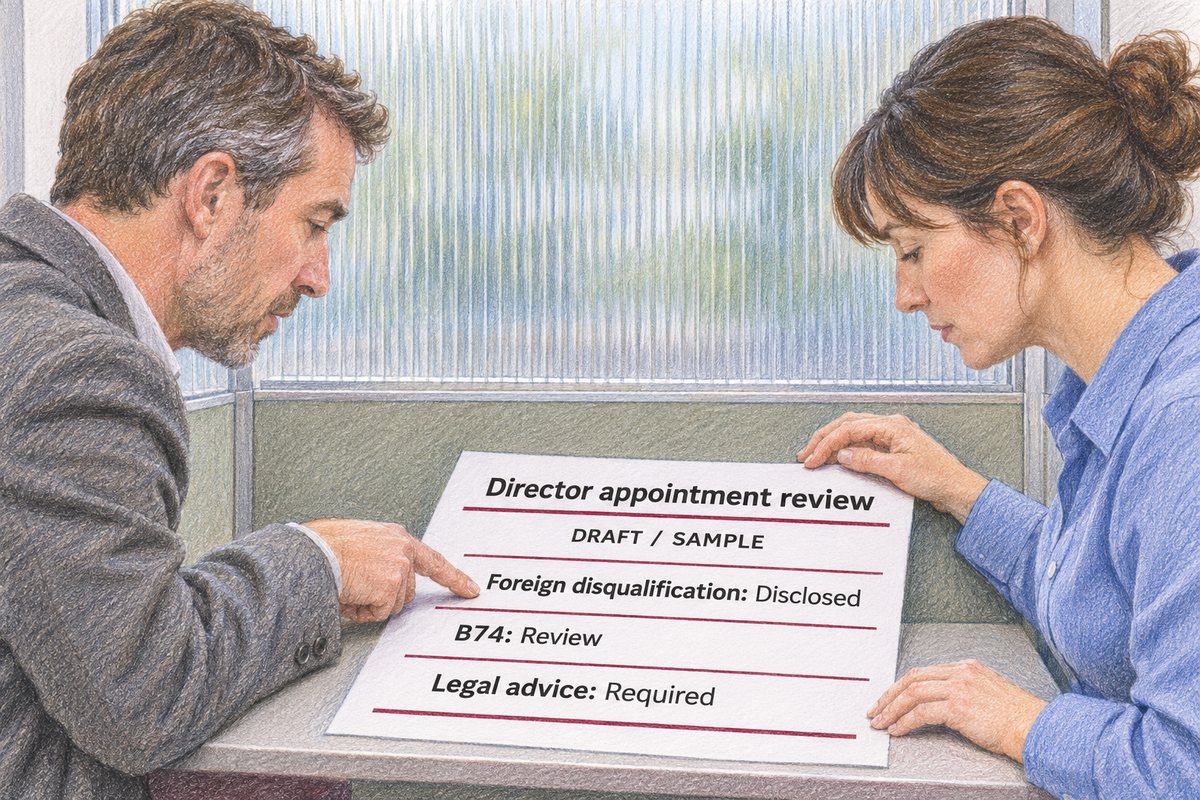
An overseas director disqualification needs attention before an Irish company application or appointment is submitted. It is not the same question as nationality, director residence, identity verification or buying a non-resident package.
This guide separates the disclosure needed at appointment from a foreign disqualification arising later. It is general information checked on 15 November 2026, not an assessment of your eligibility. Obtain independent Irish legal advice, and foreign-law advice where necessary, before acting on an unresolved ban.
1. Establish the actual restriction before choosing a package
The Corporate Enforcement Authority's Information Note 2024/1 explains that foreign disqualification does not ordinarily, by itself, automatically disqualify a person in Ireland. That is a starting distinction, not a clearance to incorporate or manage a business. Other grounds for Irish disqualification can apply independently.
Section 842(i) also allows an Irish court to disqualify where the foreign disqualification and its underlying conduct or circumstances meet the statutory test. Filing a disclosure does not remove that possibility. An adviser needs the full facts, not only a search result showing the person's name.
Give the solicitor the complete order, undertaking or other relevant instrument and any later variation, expiry, appeal or stay documents. Ask what is currently effective, which activities are prohibited and whether proposed Irish involvement is lawful. Do not infer that an appeal suspends the restriction, or that changing country makes it irrelevant.
2. Match the disclosure to the appointment timeline
Write down two different dates: the Irish appointment and the start of the foreign disqualification. For a new company, identify whether the person is proposed as a first director. Do not choose between B74 and B74a just because one form looks easier to complete.
The CRO forms distinguish an existing disqualification at appointment from one arising afterwards. Use the following as a briefing aid, not a substitute for reviewing the legal instrument and any previous Irish filings. An expired foreign order with no current restriction is not the same situation as a live order; have its status confirmed rather than silently marking every question 'none'.
| Situation | Review route | Timing |
|---|---|---|
| First director; already affected | A1 with B74 | Together |
| Existing company; already affected | B10 with B74 | With appointment notice |
| Foreign ban starts after appointment | B74a | 14 days from event |
| Missing or incorrect disclosure | Urgent legal review | Do not assume a cure |
3. A first director: prepare B74 with the A1
Section 23 covers a proposed first director who is currently disqualified under another state's law from appointment or action as a director or secretary of a corporate body or undertaking. It is not confined to a judge's order: the legislation also covers a tribunal or other basis of disqualification.
The person must ensure that the incorporation statement is accompanied by a separate prescribed disclosure, signed or authenticated as the section permits. It identifies the jurisdiction, the date disqualification began and its duration. There is no 14-day period after incorporation in which to supply this missing accompaniment.
The B74 form has an A1/B10 selection and identifies the affected director as its signatory. Its company-number field is not applicable for an A1 incorporation, whereas an existing company's B10 needs the correct number. Do not invent a number to make a draft look complete.
Before submission, ask the presenter to confirm that the right signed disclosure accompanies the actual application, not merely that a scan sits in an email thread. Keep the submitted version and delivery evidence. Check the current submission arrangements with the presenter or CRO rather than relying on old postal instructions printed on a downloaded form.
4. An existing company: do not separate B74 from the appointment notice
For appointment to an existing company, section 150(2) requires the affected appointee's separate signed statement to accompany the appointment notification. CRO identifies B74 as the disclosure accompanying B10. It is additional to the appointment consent, not a replacement for it.
Section 149(8) normally requires the company's change notification within 14 days of the change. That window does not mean B10 can be delivered alone and B74 added whenever convenient. Prepare the connected documents before the presenter sends the notification.
Section 150(8) requires reasonable company enquiries on appointment about whether the disclosure requirement applies. A failure to enquire does not relieve the appointee of their own obligation.
A practical handover should identify who is obtaining the appointee's information, who checks the appointment date, who secures the required signatures and who verifies the delivered package. Forwarding the task to a secretary or agent should not leave everyone assuming somebody else checked the disqualification.
5. A later foreign ban: B74a and prompt written notice
If the foreign disqualification starts after the Irish appointment, CRO's B74a is the subsequent-event form. It asks for the company and affected director, jurisdiction, commencement date and period, with certification by a company officer in the stated director or secretary capacity. Do not assume that every disclosure form has the same signatory.
The current event deadline is 14 days. CRO's delivery-times page also mentions three months after commencement of section 150 for historical transitional cases. That is not a fresh three-month allowance for a disqualification arising now.
The affected officer should provide the necessary information in writing to the company promptly. Section 150(3) requires information as soon as may be, not at the end of the filing window. Send it to the people responsible for every affected Irish company's records; do not assume that telling one presenter updates other companies.
Keep a dated chronology of the event, written notification, advice, filing and any return or rejection. A later annual return is not a reason to leave this event unresolved until the next routine compliance cycle.
6. Understand the consequences of omission or misleading information
Section 841 addresses failure under section 23 or 150(2), including specified materially false or misleading signed disclosures. The resulting deemed Irish disqualification starts when the relevant first-director statement or appointment notification is delivered to the Registrar. It runs for the remaining foreign period, or the longest remaining period where several states' periods differ.
Section 840 concerns the later-event case. Its trigger requires the company's failure to notify, or materially misleading particulars, to be by reason of the relevant director's default. For failure, the deemed period starts on expiry of 14 days after the foreign disqualification; for misleading particulars, on delivery. Again, the remaining foreign period applies, with the longest where different foreign periods overlap.
These are different from a discretionary court order under section 842(i). Do not treat the lack of an Irish court hearing as proof that there can be no Irish disqualification. If a disclosure was missed or wrong, get advice urgently on the actual statutory position and appropriate CRO steps. A late filing is not an automatic cure.
Section 847 provides for discretionary court relief where its test is met. It is not a routine exemption a formation provider can promise. Preserve genuine dates and earlier submissions; never backdate a document or rewrite the record to suggest a missing disclosure accompanied the original filing.
7. Two example timelines, not eligibility decisions
Example one: a founder has a current overseas disqualification before an Irish LTD is formed. The team has not submitted A1. The useful next step is legal review of the founder's position and a properly prepared application if proceeding is lawful. Treating this as an ordinary non-resident bond purchase, followed by disclosure after incorporation, confuses two separate requirements.
Example two: a director was appointed to an Irish company before an overseas disqualification arose. The company needs the later-event review and timely notification, not a new A1. If another Irish company now proposes to appoint that same person, its appointment requires a separate assessment of the already-existing disqualification. The fact that one company uses B74a does not determine another company's route.
In either example, ask the adviser to state what can and cannot happen while review is outstanding. An Irish disqualification can affect involvement in promotion, formation or management, not merely the name entered as director. Do not put another person on paper while assuming the affected person can run the company unseen.
8. Prepare a secure legal and filing handover
Use this practical briefing checklist for the adviser. It is not an official attachment list or a request to upload sensitive court papers to a general contact form. Agree a secure document-sharing method first and keep access limited to those who need it.
- Identify the affected person accurately, including any different names used in the relevant records.
- Provide the complete foreign instrument, jurisdiction, issuing body and legal basis, not a cropped screenshot.
- Record the effective date, duration and evidence of any variation, appeal, stay or expiry.
- List all relevant Irish companies, company numbers and actual or proposed appointment dates.
- Distinguish unsubmitted drafts from delivered A1, B10, B74 or B74a documents, with submission references.
- Supply written notifications to the company and any CRO correspondence, returns or rejection messages.
- Ask the solicitor to confirm current eligibility, permitted involvement and the filing or remedial steps needed.
- Agree the presenter, signatories, deadline, evidence of delivery and separate written scope and costs.
9. Separate ordinary formation from specialist eligibility work
Section 137 addresses the EEA-resident director requirement and its bond alternative. A Section 137 bond does not cure disqualification. Nor does an identity number, registered office or company-secretary service establish that someone may lawfully act as a director.
StartCompany.ie can discuss ordinary formation scope once the eligibility questions have been resolved. A published formation package does not automatically include a foreign-law opinion, specialist B74/B74a remediation, an Irish eligibility opinion or court representation. Obtain written agreement before assuming extra work is included.
For a straightforward, legally cleared formation, compare the current packages and total payable on the pricing page. For an unresolved situation, send a short non-sensitive enquiry about formation scope first, while instructing an independent Irish solicitor on eligibility. Incorporation itself guarantees neither banking nor tax treatment, residence or immigration permission.
StartCompany.ie service
Irish Company Formation Packages
Official information and next steps
Primary sources checked on 15 November 2026. CEA Information Note 2024/1 is dated April 2024; it is guidance, not a personal eligibility decision. Use the current legislation and obtain advice on the actual foreign instrument and Irish position.
- Companies Act 2014, section 23: incorporation disclosure
- Companies Act 2014, section 149: company notifications
- Companies Act 2014, section 150: disclosure and information duties
- Companies Act 2014, section 841: appointment defaults
- Companies Act 2014, section 840: subsequent-event defaults
- Companies Act 2014, section 842: court disqualification
- Companies Act 2014, section 847: court relief
- Companies Act 2014, section 137: residence and bond
- CRO B74 form and notes
- CRO B74a form and notes
- CRO statutory delivery times
- CRO Requirements for Directors, Leaflet 36
- CEA Information Note 2024/1: disqualification