
Your Irish company has paid a designer, consultant or outside support provider. The invoices are in the bookkeeping system and the bank is reconciled. Is that enough, or does Revenue also need a supplier-payment return?
Form 46G is easy to miss when the year-end conversation centres on accounts and Corporation Tax. This guide concerns an ordinary Irish LTD preparing its own supplier-payment information. It explains the review to commission, not how to classify every specialist transaction or submit a return without suitable records.
1. Identify the return: information about suppliers you paid
Revenue distinguishes the company version of Form 46G from the version used by individuals and other businesses. This is information about relevant outgoing payments, not a second calculation of tax on your company's sales. Being small, making a loss or having no employees does not answer the supplier-reporting question.
Sections 889 and 894 of the Taxes Consolidation Act 1997 underpin the reporting framework. Revenue's notes explain that section 894 places the filing responsibility on the relevant person without waiting for an inspector's notice. Do not postpone the review simply because no letter arrived.
A director should ask a precise completion question: which company, accounting period and supplier-payment return have been reviewed, approved and submitted? A message saying annual returns are done can refer to entirely different work. Keep distinct evidence rather than assuming one acknowledgement covers every obligation.
| Record or return | Main question |
|---|---|
| Supplier ledger | What did the company buy, owe and pay? |
| Form 46G (Company) | Which relevant supplier payments must be reported? |
| CT1 | What is the company's Corporation Tax position? |
| CRO B1 | Has the separate company-law annual return been filed? |
2. Start with the real service and the actual payee
Build the review from supplier contracts, invoices and payment records. Identify the legal recipient behind each trading name. A payment reference saying design, project costs or contractor does not establish who received it or the reporting treatment.
The statutory framework includes services connected with forming, acquiring, developing or disposing of a business, not just its recurring overheads. It also addresses copyright payments and non-cash consideration. Do not automatically leave out a payment because the accountant capitalised it, the business had not launched, or value was exchanged without an ordinary bank transfer.
Use Revenue's service categories and exclusions for the actual transaction. A software-development engagement, recruitment assignment and purchase of a laptop are not interchangeable merely because the same expense code was used. Mixed contracts need the underlying breakdown, not a guessed label.
3. Aggregate payments: four smaller entries can cross the limit
Use the current operational guidance, not an old form or an amount remembered from another return. The EUR6,000 exclusion is per entity for the return period. It is not a per-invoice test, a tax-free allowance for the supplier or a reason to report only the excess.
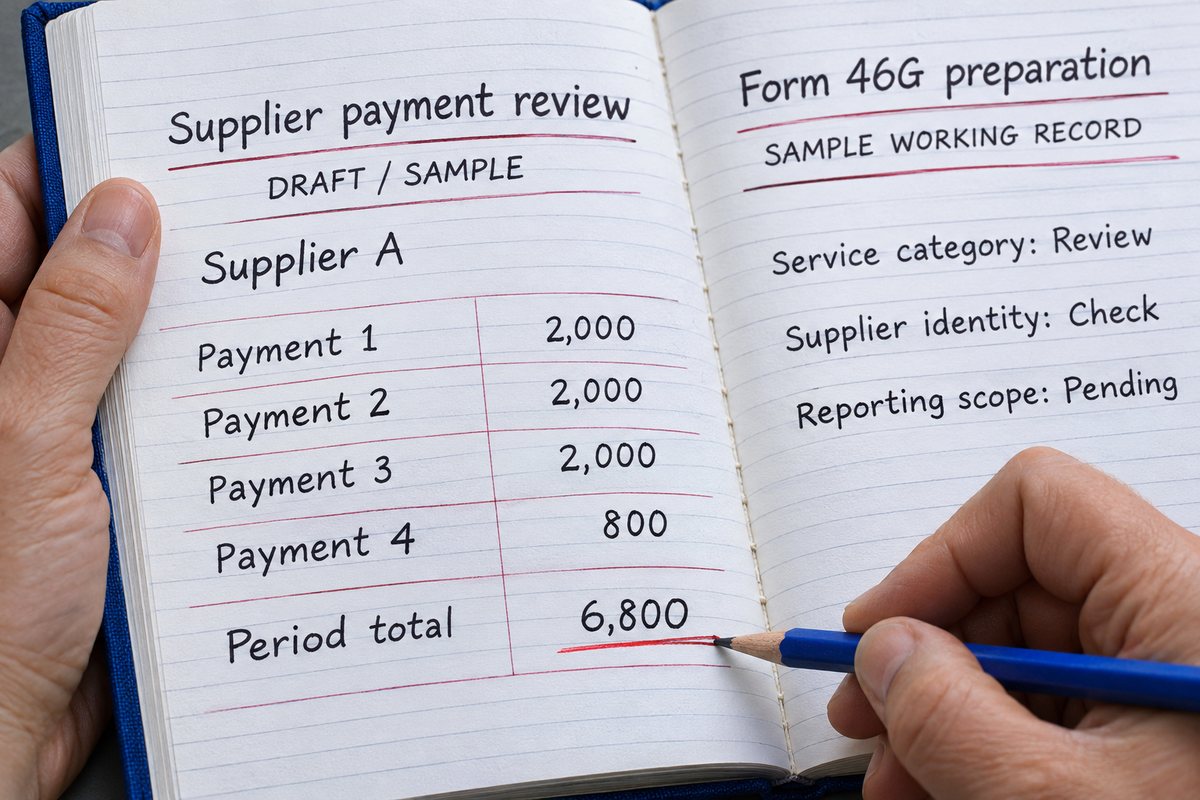
Consider a fictional company paying one Irish-resident design supplier EUR2,000 three times, then EUR800. Assume all figures use a consistent VAT-exclusive basis, the service is reportable and no other exclusion applies. The payments total EUR6,800. The review concerns that total, not just the final EUR800 or the EUR800 above the limit.
Compare another fictional supplier paid EUR3,000 twice. That aggregate is EUR6,000, so it does not exceed the stated exclusion limit. Keep the analysis and evidence; do not generalise from this example to an unexamined transaction with different facts.
Export payments by supplier and match them to invoices and bank or payment-platform records. Merge duplicate supplier accounts only after checking identity. Conversely, do not combine genuinely different legal suppliers just because their bank references look similar. Reconcile refunds, reversals, non-cash items and amounts paid through intermediaries with the accountant before approving the schedule.
4. Review exclusions without relabelling the transaction
Revenue's manual excludes specified withholding-tax payments, essential utilities and non-resident payees. For this purpose, a payee operating from an Irish business or private address is treated as resident. It also excludes unlisted activities and mixed services where goods exceed two-thirds of the charge. Assess the actual facts; an overseas bank account alone does not establish non-residence.
Keep employment status separate. Calling someone a freelancer, receiving an invoice or adding their details to 46G does not establish self-employment. Revenue requires businesses to assess the real arrangement using its five-step framework. If payroll treatment is required, an information return is not a replacement for operating PAYE.
RCT is also a separate regime for relevant principal-contractor payments in construction, forestry and meat processing. Do not treat RCT registration or a zero-rate payment as automatic proof of a 46G exclusion. Have the actual payment and reporting treatment reviewed, including evidence of any withholding, rather than assuming every contractor belongs in one bucket.
An overseas-services purchase may need a separate VAT review even if excluded from this information schedule. Each return serves its own purpose. Ask for the reason behind each excluded row so that another bookkeeper can reproduce the decision at the next handover.
5. Collect identity details and reconcile the amount basis
The reporting framework calls for the recipient's identity, address, tax reference, payment amount and service details. A bank nickname is not a supplier master record. Request missing information from the real supplier through an agreed secure process; never invent a tax reference or borrow another person's number to make a row validate.
The manual normally uses VAT-exclusive payment figures, allowing specified alternatives if clearly indicated. Do not mix gross bank debits with net ledger totals without explaining the basis. Agree one consistent basis for the schedule and retain the reconciliation to bank amounts.
A practical handover separates source data from decisions. Keep one unaltered export, one reconciled working schedule and a short list of unresolved identities, transaction types or differences. Restrict access to tax references and send them only through the route agreed with the appointed adviser, not in a general website enquiry.
6. Match the company tax period, not an assumed calendar year
Revenue requires Form 46G (Company) to use exactly the same accounting period as the corresponding CT1. Its Period of Account manual notes that the returns may be filed by different people. Give both presenters the confirmed dates instead of assuming their software defaults agree.
Long first accounts can contain more than one tax accounting period because a CT1 cannot cover more than 12 months. Ask the accountant to map each required 46G to its corresponding CT1 and allocate relevant payments accordingly. A single long accounts pack is not permission to file one mismatched supplier schedule.
Revenue's ordinary company pay-and-file timetable is nine months after the accounting-period end, with electronic filing and payment by the 23rd of the ninth month. For an illustrative period ending 31 December 2026, that points to 23 September 2027 under the current rules. Have the actual deadline checked, including any specific Revenue notice; do not substitute the CRO B1 date or a sole trader's October deadline.
If the period was changed or a return is already filed, reconcile the position with the adviser before submitting another version. Correcting the CT1 dates does not justify leaving 46G inconsistent. Retain the original and corrected acknowledgements so the completion history remains understandable.
7. File through ROS and keep separate completion evidence
Revenue provides online filing and its 46G Return Tool. Its newer return-preparation guidance says the Return Preparation Facility has replaced the retired ROS offline application. Follow the current supported route rather than downloading an old desktop installer because an older page still mentions offline forms.
Preparing a spreadsheet is not filing it. Allocate who checks the company and period, reviews the rows, obtains director approval, submits through ROS and saves the acknowledgement. Do not share someone else's digital certificate or presume an accountant has accepted this task merely because they prepare the statutory accounts.
Where the review finds no reportable payments, record why and confirm the appropriate nil-return or filing position with the adviser or Revenue. Do not submit fabricated supplier rows, and do not silently abandon a return already requested. If something was missed, ask how to correct it promptly rather than concealing the difference in the following period.
8. Give the accountant a reviewable supplier-payment pack
The most useful starting point is a complete population of payments, with exclusions explained afterwards. A hand-picked list of large invoices can omit repeated smaller payments, duplicate accounts or payments made outside the main bank account.
Revenue's general record-keeping guidance requires original tax records to be retained for six years and leaves responsibility with the business even where an accountant holds them. Preserve the linking evidence, not just the final return. Check whether another obligation, ongoing enquiry or dispute requires longer retention.
- Company details, confirmed CT1 periods and filing deadline.
- Complete supplier and payment exports, including other payment channels.
- Invoices, contracts and evidence linking entries to actual recipients.
- Verified supplier identities, addresses and securely provided tax references.
- Reconciled per-supplier totals and an explained VAT-inclusive or exclusive basis.
- Proposed exclusions with supporting facts, not just expense-code labels.
- Prior returns, acknowledgements and any Revenue request or unresolved correction.
- Named responsibility for review, approval, submission and confirmation.
9. Agree whether Form 46G work is actually included
StartCompany.ie's accountant service connects companies with an accountant for bookkeeping, accounts and tax support. Explain that you need a supplier-payment and Form 46G review, state the periods and approximate supplier volume, and ask whether the work can be accepted. Do not send supplier tax references in the first general enquiry.
An accounting referral is not an automatic Form 46G engagement. Confirm reconciliation, supplier-detail recovery, classification review, preparation, filing, any correction work and total payable before instructing support. Employment-status advice, disputed transactions and historic reconstruction may need separately agreed work.
Keep company formation, CRO annual-return presentation and Revenue supplier reporting separate in the quote. The useful outcome is an agreed responsibility and evidence of completion, not simply buying a package whose name sounds like annual compliance.
StartCompany.ie service
Accountant Services in Ireland
Official information and next steps
Primary Revenue and CRO sources checked on 17 November 2026. The EUR6,000 operational exclusion and payment exclusions follow Revenue's January 2026 Part 38-03-13 manual; this is not a statement that every transaction above the amount is reportable. The guide does not determine employment status, specialist exclusions or an individual company's filing position.
- Revenue: Form 46G and company version
- Revenue: Part 38-03-13, January 2026 third-party return guidance
- Revenue: Part 38 notes, sections 889 and 894 framework
- Revenue: CT1 and 46G accounting-period alignment
- Revenue: Corporation Tax payment and filing
- Revenue: supported ROS preparation facilities
- Revenue: determining employment status
- Revenue: Relevant Contracts Tax overview
- Revenue: VAT on services received from abroad
- Revenue: keeping business records
- CRO: separate annual-return filing