
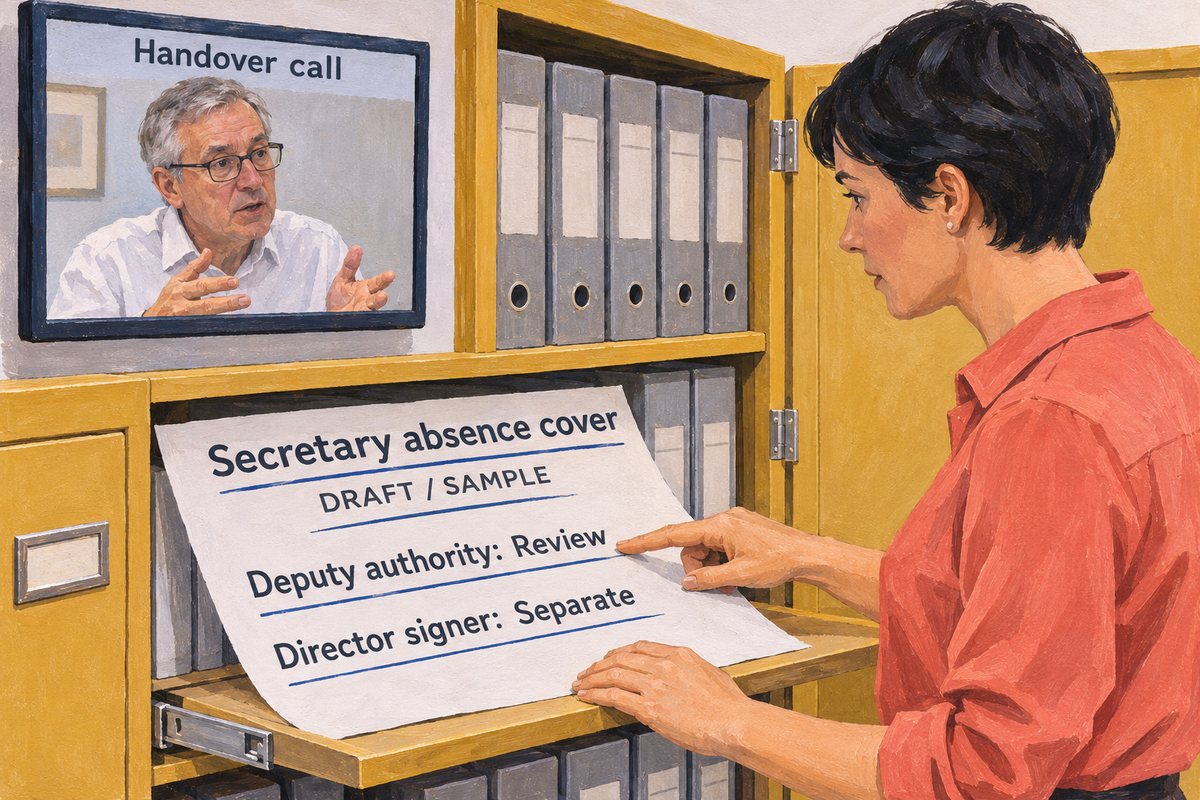
Your company secretary will be unavailable when an annual return or another company document needs attention. Do you need a replacement, can a colleague cover, or can the director simply sign twice? Those are different questions, and the answer should be settled before the document reaches its filing deadline.
This checklist concerns temporary cover for an ordinary Irish LTD, rather than a permanent resignation or a guide to electronic-signature technology. Primary sources were checked on 16 November 2026. It is general preparation information: obtain advice on disputed authority or incapacity, and confirm the proposed filing execution with the presenter and, where necessary, CRO.
1. Establish whether the office-holder or only a working contact is absent
Start with the actual appointee. Is the secretary an individual, two joint appointees or a company that provides staff contacts? An out-of-office reply from a firm's employee does not itself establish that the appointed secretary has ceased office or that nobody can act for it.
Ask what work will fall due, when the person can respond and whether the engagement already provides an authorised alternative contact. Keep this factual: operational availability is normally what the handover needs, not private medical details or speculation about someone's capacity.
Leave is not a resignation. Do not invent a cessation date or remove a continuing secretary simply because a submission needs attention. If the appointment really has ended, use the separate replacement and resignation process. CRO's officer-change guidance requires the actual event to be notified; a filing should not manufacture a different history.
| Situation | Check first | Avoid assuming |
|---|---|---|
| Staff contact away | Actual appointee | Office is vacant |
| No secretary can act | Cover authority | Any colleague can sign |
| New deputy proposed | Consent and records | Job title is enough |
| Appointment ended | Replacement route | Leave plan fixes it |
2. Apply the statutory cover hierarchy, not an informal office rota
Section 129(2) first looks to an assistant or deputy secretary when the office is vacant or no secretary is capable of acting. If no assistant or deputy is capable, it permits a company officer authorised generally or specifically by the directors. The conditions and order matter; it is not a blanket delegation to any available employee.
An administrative assistant is not necessarily an assistant secretary. A person with access to the filing folder is not automatically a company officer authorised for this purpose. Have the adviser establish the person's actual position and the authority needed for the particular act before relying on a cover schedule.
Record the decision and scope accurately: the work concerned, person acting, period or trigger, directors' authorisation where relevant and any limits. This is a practical evidence file, not a universal resolution template. Do not backdate authority to make a signature already applied appear properly authorised.
The continuing requirement to have a secretary remains. A vacancy arrangement is not a reason to leave a permanent appointment unresolved. Equally, do not buy a new annual appointment if the genuine problem can be resolved within the existing secretary's agreed cover arrangements.
3. A formal assistant or deputy appointment has a records trail
Section 149 expressly includes assistant and deputy secretaries in the company's officer register. It requires their prescribed particulars, notification of relevant changes within 14 days and signed consent accompanying an appointment notification. A handwritten name on an internal leave calendar does not complete those requirements.
Distinguish appointing an assistant or deputy from authorising an existing officer for a particular contingent function. They are not automatically the same company event. Tell the adviser exactly what is proposed, who remains appointed and whether this is an additional role or a genuine replacement.
CRO identifies B10 through CORE for post-incorporation officer changes. Ask the presenter or CRO to confirm how the actual assistant/deputy appointment and any supporting material should be submitted under the current process. The statutory duty does not establish a universal CORE button or permission to select a different role because it is easier.
Keep the consent, company decision, register entry and delivered notification together. Check names, capacity and genuine effective dates against the current record. An upload receipt is not proof that every related entry has been accepted or that a later signature will pass validation.
4. Temporary cover does not permit one person to sign twice
Section 134 prevents one individual satisfying a requirement for both a director and the secretary, including where that individual acts in place of the secretary. Relabelling the second signature 'acting secretary' does not solve the same-person problem.
CRO's dual-capacity guidance identifies A1 and B1 as notable examples and says the rule also applies to companies with more than one director. A two-director company should still identify different people for the relevant director and secretary acts, with the correct authority for each role.
A sole director cannot also hold the secretary office. Nor is there a workaround where that same founder signs the director portion personally and the secretary portion for a corporate secretary. CRO specifically warns about that corporate-secretary situation. The legal entity's separate name does not make one human into two signatories.
For a cover plan, write the actual proposed signers beside each required capacity before circulating the document. If one name appears in both places, stop and resolve the arrangement. Do not ask somebody to copy an absent person's signature or use their certificate or account to disguise who actually acted.
5. Check the B1 and accounts certification as separate tasks
For an annual return, identify the B1 signing route and the certification of any accounts attached. Section 347 addresses certification of the copies by a director and secretary. A plan to deliver a return is incomplete if nobody has resolved the supporting-document certification.
An Electronic Filing Agent is a different role. CRO explains that an authorised EFA can sign B1 through that route, but cannot certify the financial statements as EFA; the separate director-and-secretary certification remains necessary. B77 authority is not an assistant or deputy secretary appointment.
CRO's B1 error guidance also flags signatories whose director/secretary details do not match its records. If relying on a contingent acting capacity, establish the legal basis and ask the presenter and CRO how it should be evidenced and executed before submission. Do not assume that an unrecorded substitute will pass the ordinary signature-page checks.
Ask for one document list identifying each act, signer, capacity, version and delivery route. Separate accounts preparation and board approval from certifying the filing copy. Our linked B1 signature guide covers the wet-ink, ROS and EFA workflows; absence cover does not create an unrestricted new electronic-signing method.
6. The filing clock does not pause for leave or an unanswered email
Section 343 generally requires delivery within 56 days after the annual return date, or an earlier date to which the return is made up. Where accounts are required, their year-end can produce an earlier filing deadline. Have the presenter calculate the actual completion date rather than assuming the ARD itself is the final day.
An absence notice, an order for support or a request for CRO advice is not an automatic extension. CRO's guidance warns that certain missing-signature or missing-accounts submissions are rejected without a 14-day correction opportunity. Do not send an incomplete placeholder and assume it reserves the original date.
If time is already short, state the deadline, what has actually been delivered and exactly what remains unsigned or unprepared. Ask for an urgent assessment of lawful completion and any available formal remedy. Court relief, where appropriate, is a separate process, not something a deputy appointment or service payment guarantees.
Keep monitoring the presenter's messages after delivery. A cover plan should name who receives feedback while the normal contact is away and who can authorise a response. A reminder in a personal inbox is not a substitute for an actively managed company filing task.
7. Two handovers that need different solutions
In the first fictional example, an individually appointed secretary plans to be unavailable for several weeks. The company has no deputy, a single director and a B1 approaching. The founder should not plan to sign both capacities. Establish who can lawfully perform the required acts, what genuine appointment or authority is needed, and how the presenter will execute the return and accounts certification.
In the second example, the appointed secretary is a corporate provider whose usual account manager is on leave. The provider offers another working contact. Check whether that person can act for the appointed entity, which documents they can handle and what remains for the director and accountant. A staff-contact change is not, by itself, a change of the company secretary.
Neither example requires an automatic purchase of a second secretary service. The useful question is what gap remains after checking the existing appointment, capacity and engagement. Put the agreed answer in the handover file so the directors, accountant and presenter are working from the same plan.
8. Prepare a usable absence-cover pack
Section 226 concerns board-delegated duties and skills for maintaining the company's non-accounting statutory records. A workable cover arrangement needs access to the right records, not just a willing signature. Use this practical checklist with the adviser; it is not an official CRO attachment list.
- Confirm the actual legal appointee and the existing engagement's authorised cover contacts.
- List the absence period, trigger for cover and contact for genuinely urgent questions.
- Record the relevant appointment, consent or directors' authorisation and its scope accurately.
- Check statutory-register entries, any required notifications and unresolved CRO feedback.
- Identify each document, final version, required capacity and separate human signatories.
- Confirm the actual B1 deadline, accounts readiness, presenter and certification route.
- Arrange role-appropriate record access without sharing personal passwords, signing certificates or unnecessary private data.
- Name the person monitoring submission status and close or review temporary access when the handover ends.
9. Agree service scope before buying an appointment
StartCompany.ie's published company secretary service is a 12-month nominee engagement with compliance reminders, officer-filing guidance and statutory-record guidance. It is not advertised as an on-demand deputy-signature service. Explain the existing appointment and intended absence before ordering, and ask whether the required cover can be accepted.
Annual-return preparation, registered office, share transactions and other filings are separate unless expressly included. Changing an existing secretary is also a distinct service. Agree the actual appointee, any separate notification work, urgent availability and total payable in writing rather than assuming one purchase covers every unfinished task.
Renewal is arranged separately, not as an automatic subscription through the published checkout. Payment is not an appointment, signature, CRO acceptance or extension. Where authority or capacity is disputed, obtain independent Irish legal advice; urgent legal opinions and court work are not automatic inclusions in the annual service.
StartCompany.ie service
Company Secretary Service Ireland
Official information and next steps
Primary sources checked on 16 November 2026. Section 129 provides the conditional legal framework; it does not promise acceptance of a particular CORE submission or replace document-specific execution advice. Confirm exceptional signing arrangements with the adviser, presenter and CRO as appropriate.
- Companies Act 2014, section 129: secretary and conditional cover
- Companies Act 2014, section 134: dual-capacity restriction
- Companies Act 2014, section 149: officer register, consent and notification
- Companies Act 2014, section 226: secretary duties
- Companies Act 2014, section 343: annual-return delivery
- Companies Act 2014, section 347: accounts-copy certification
- CRO: dual capacity
- CRO: officer changes and enquiries
- CRO: complete annual-return delivery and signing
- CRO: common B1 errors
- CRO: Electronic Filing Agents and B77