
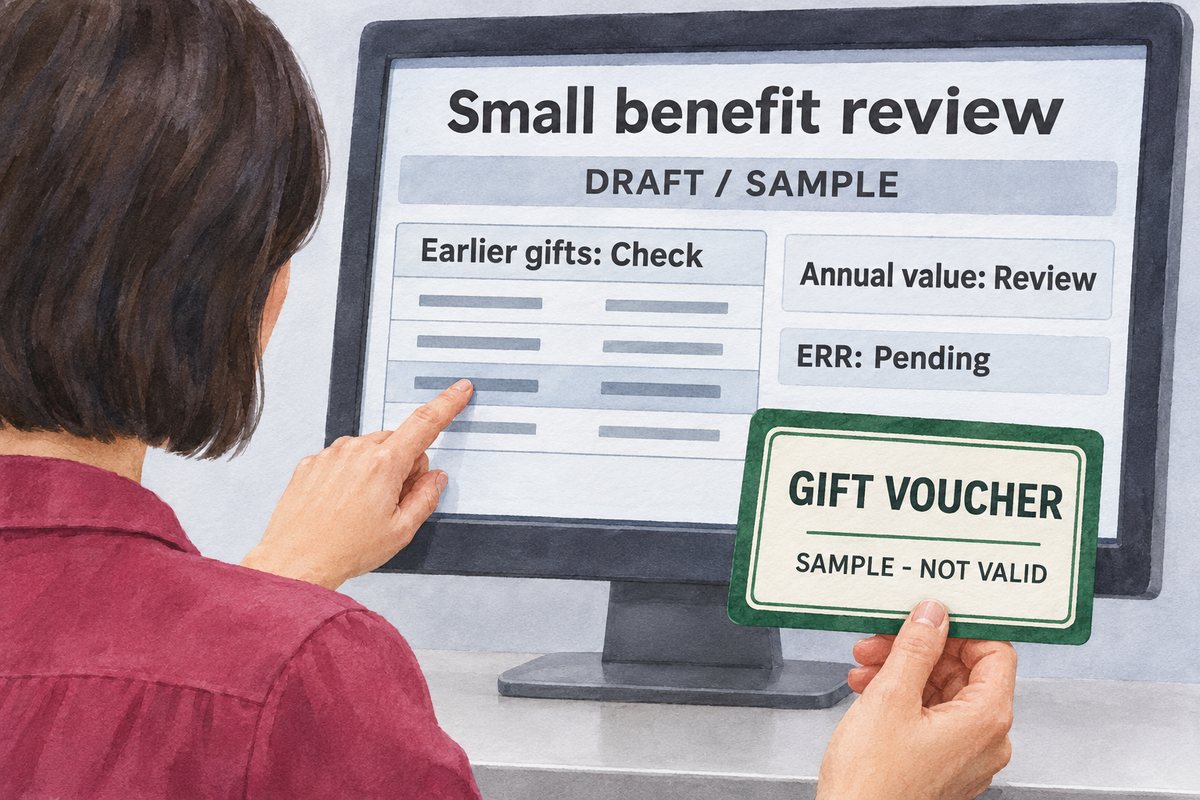
A gift voucher can look like a straightforward year-end purchase. For an owner-managed company, the awkward part is often not choosing the retailer. It is finding out whether an earlier birthday gift or reward has already used some of the recipient's benefit allowance, and getting the reporting done before the voucher changes hands.
This guide is for Irish LTD directors arranging a genuine company-provided benefit, including a company whose director is its only recipient. It separates the exemption decision, voucher purchase, recipient record and Revenue submission. It does not recommend a particular card supplier or calculate anyone's personal tax saving. Official guidance was checked on 19 November 2026.
Check the recipient, not just the company card
Start with who receives the benefit and why. A shareholder receiving value solely as an investor is not the same situation as a director receiving an employment or office-related benefit. Give the accountant the actual role and remuneration arrangement rather than describing every transfer as a director perk.
Revenue's benefit-in-kind guidance specifically addresses directors and warns that their taxable benefits are not covered by the ordinary low-income BIK threshold. Do not conclude that an unpaid or lightly paid director can ignore benefit taxation. The small benefit exemption has its own conditions.
For a sole-director company, keep an explicit company decision and recipient record even if you are organising everything yourself. State the proposed benefit, intended handover date and person responsible for reporting. A separate Irish company secretary appointment is not a payroll or ERR engagement.
There are two limits, and both matter
Revenue's current rules allow up to five qualifying benefits in a tax year, with a combined value no greater than EUR1,500. One qualifying benefit can use the full amount; there is no requirement to divide it into five equal vouchers. Unused allowance cannot be moved into the following year.
The increased limits took effect from 1 January 2025. Section 8 of Finance Act 2024 amended the qualifying-incentive definition and includes a sunset from the 2030 year of assessment. This article addresses 2026, not a promise that the same rules will remain available indefinitely.
Use the recipient's tax-year history, not the company's accounting year-end. A June accounts date does not restart the gift count in July. Before a November or December award, bring together benefits arranged by the director, payroll team and anyone else authorised to purchase gifts.
Read the voucher terms before buying
A voucher must be usable for goods or services and must not be redeemable, even partly, for cash. Read the actual product terms, not just a checkout badge describing it as a business reward. A cash transfer with a gift-voucher reference is still cash.
Record the face value, product restrictions and evidence of what the company bought. Revenue generally uses face value for a voucher. Its small-benefit guidance disregards nominal purchasing fees or postage when testing the exemption limit, but says those costs enter the taxable valuation where the exemption conditions are not met.
Do not assume that refunding your own shopping receipt has the same treatment as the company providing a qualifying voucher. Explain any personal purchase or reimbursement to the adviser before processing it. Keep a voucher's validity period and the supplier's commercial terms separate from the tax decision.
A voucher cannot replace salary you are owed
The exemption excludes salary sacrifice: an arrangement in which someone gives up remuneration they are entitled to receive in return for the benefit. Reducing an agreed director payment and substituting a voucher is not made acceptable merely by staying below the annual limit.
Revenue's general salary-sacrifice guidance lists specific qualifying arrangements, such as certain travel passes and cycle-to-work benefits. Do not import those separate rules into a gift-voucher plan. A non-cash format does not cure a pay substitution.
Give the accountant any remuneration agreement, bonus decision or relevant correspondence. Ask before changing the amount due, not after the pay run. Keep an ordinary company-funded award distinct from a settlement of unpaid salary, a personal expense refund or repayment of money previously lent to the company.
Reconstruct earlier gifts before deciding the next amount
The small-benefit rules do not let the employer pick the most valuable gifts at year-end and discard the smaller earlier ones. Revenue's manual explains that the first relevant incentives must be considered in sequence; taxing an early award is not a way to reserve its place for a later, larger voucher.
Prepare one chronological list per recipient. Include gifts arranged outside payroll and identify anything that needs classification. A non-cash gift may matter even when nobody called it a voucher. Do not assume every company-provided item belongs in this exemption: other benefits can have separate rules.
A practical register needs the date provided, description, value, supplier evidence, cumulative relevant-benefit count and value, treatment decision, and reporting reference. Keep purchase date and provision date in separate fields. Buying several cards in advance is not, on its own, evidence of when a named person received each benefit.
A worked history: the next voucher is not tested alone
Consider a fictional director who has received four relevant benefits from the same company during 2026: EUR200, EUR250, EUR320 and EUR380, in that order. Assume each earlier award meets the conditions. The cumulative value is EUR1,150 and four places have been used.
A proposed fifth benefit of EUR350 would bring the total to EUR1,500. It could fit the count and value tests if the other conditions and reporting are satisfied. A proposed fifth benefit of EUR500 instead would bring the total to EUR1,650. Do not treat that alternative as EUR350 exempt plus EUR150 taxable.
Revenue's current ERR examples show the later benefit that breaches the cumulative limit being taxed in full, while the earlier qualifying benefits remain exempt. On that approach, the whole EUR500 benefit in the second alternative requires payroll treatment, with the appropriate taxable valuation.
Count can also stop the exemption before value does. Five qualifying EUR100 gifts use all five places, although their total is only EUR500. A sixth EUR100 voucher does not become exempt because there appears to be EUR1,000 of unused value. These are alternative planning examples, not a personal tax calculation.
Arrange ERR before handing over the benefit
Enhanced Reporting Requirements have applied since 1 January 2024 to specified untaxed benefits and expenses for employees and directors. Revenue requires reporting on or before provision of the reportable benefit. A small-benefit report includes its date and value.
Treat handover as a scheduled event. Tell the responsible person when the card or digital voucher will be provided, allow time for review, and retain submission evidence. Do not buy it on Friday, email it that evening and assume the accountant can deal with the reporting when the bank statements arrive next month.
The supplier purchase receipt, bookkeeping entry and ERR submission are different records. Paying from the company account does not submit the report. Equally, a successful submission is not Revenue approval of the benefit's exemption.
Revenue offers ROS manual-entry and file-upload routes, alongside software integration. Confirm the actual access and reporting process with the appointed adviser or software provider; do not share your ROS password or certificate as a shortcut.
No director salary yet? Resolve the reporting setup first
Do not invent a token salary solely to make a voucher appear reportable. Revenue's ERR manual addresses a director who is not on payroll: the employer can report using a unique Employer Reference. That reporting mechanism does not establish that a proposed benefit qualifies for exemption.
Ask the accountant to check the director's circumstances, the employer record and identifiers, and the correct route before provision. PAYE registration, employment records, benefit treatment and an ERR submission are related questions, not interchangeable confirmations.
If the director lives or works abroad, disclose that too. This domestic checklist does not decide foreign tax, treaty treatment or the effect of a particular exclusion order. Do not assume an Irish company's voucher is automatically untaxed wherever the recipient lives.
If it is taxable or has already been given, keep the real history
Revenue's ordinary voucher guidance treats a taxable voucher as notional pay. Give payroll the full facts so the appropriate Income Tax, USC and PRSI treatment can be assessed. Do not simply put the excess in a miscellaneous expense account or create an unsupported tax-free entry.
If a voucher has already been provided without the required report, record the actual date, value, earlier gifts and reporting status. Ask the adviser to assess late reporting and any payroll corrections promptly. Never backdate a submission or invent a later handover date.
Revenue's ERR manual describes amendment or deletion of incorrect line items. A correction facility is not permission to erase a genuine earlier benefit to create another exempt slot. Keep an audit trail explaining what was wrong, the correction made and the evidence supporting it.
A short handover pack saves a long December email chain
Before authorising the purchase or release, give the adviser enough information to answer the actual question. A message saying 'Can I take the allowance?' leaves out the recipient history, product terms and reporting timetable.
The following is a practical preparation checklist, not an official Revenue attachment list. Send sensitive recipient identifiers only through the secure channel agreed with the adviser.
- Identify the company, intended recipient, role and relevant tax year.
- List earlier non-cash gifts chronologically, including those bought outside payroll.
- Provide voucher terms, face value, supplier invoice and any charges.
- Explain any salary, bonus or other payment the voucher might replace.
- State the planned provision date and who will make the ERR submission.
- Resolve employer access and recipient-reference questions before handover.
- Keep the approval, treatment decision, provision evidence and reporting receipt.
- Flag gifts already provided, uncertain classifications or any correction work.
| Task | Evidence to keep |
|---|---|
| Exemption review | Recipient history and written treatment decision. |
| Purchase and provision | Invoice, voucher terms and actual handover date. |
| Revenue reporting | ERR receipt or applicable payroll record. |
| Accounting handover | Reconciled cost, recipient record and any correction note. |
Confirm the accounting work, not just the referral
StartCompany.ie connects companies with accounting support. Use the existing accountant-services page to describe the benefit plan, recipient numbers, proposed dates and any earlier gifts. Ask whether benefit review, employer setup, ERR reporting or payroll corrections can be provided, and agree the accepted scope and total payable.
An accounting referral is not an automatic ERR filing engagement. Nor does a formation package or secretary appointment complete a payroll review. Confirm the person responsible and the delivery timetable before relying on help.
The EUR1,500 figure is an exemption ceiling, not a grant, cash refund or a budget the company must spend. It does not settle the company's deduction or every associated tax question. Have the accountant classify the actual cost and any taxable benefit in the records.
A useful first enquiry gives the tax year, intended voucher value, earlier benefit history and planned handover date. Do not include voucher redemption codes, personal identifiers or ROS credentials in a general contact form.
StartCompany.ie service
Accountant Services in Ireland
Official information and next steps
Official Revenue guidance and Finance Act 2024 checked on 19 November 2026. The current ERR manual is marked reviewed September 2026; search-result extracts can show older limits or examples. This is general preparation guidance, not confirmation of any recipient's exemption, foreign tax position or company deduction.
- Revenue: current Small Benefit Exemption limits and voucher conditions
- Revenue: Small Benefit Exemption manual, Part 05-01-01e
- Finance Act 2024, section 8: amendment of the qualifying-incentive rules
- Revenue: benefits in kind and company directors
- Revenue: vouchers and taxable notional pay
- Revenue: Enhanced Reporting Requirements overview and timing
- Revenue: the small-benefit information to report
- Revenue: submitting ERR details through ROS and software
- Revenue: ERR manual, September 2026 review, examples and director reporting
- Revenue: salary sacrifice arrangements