
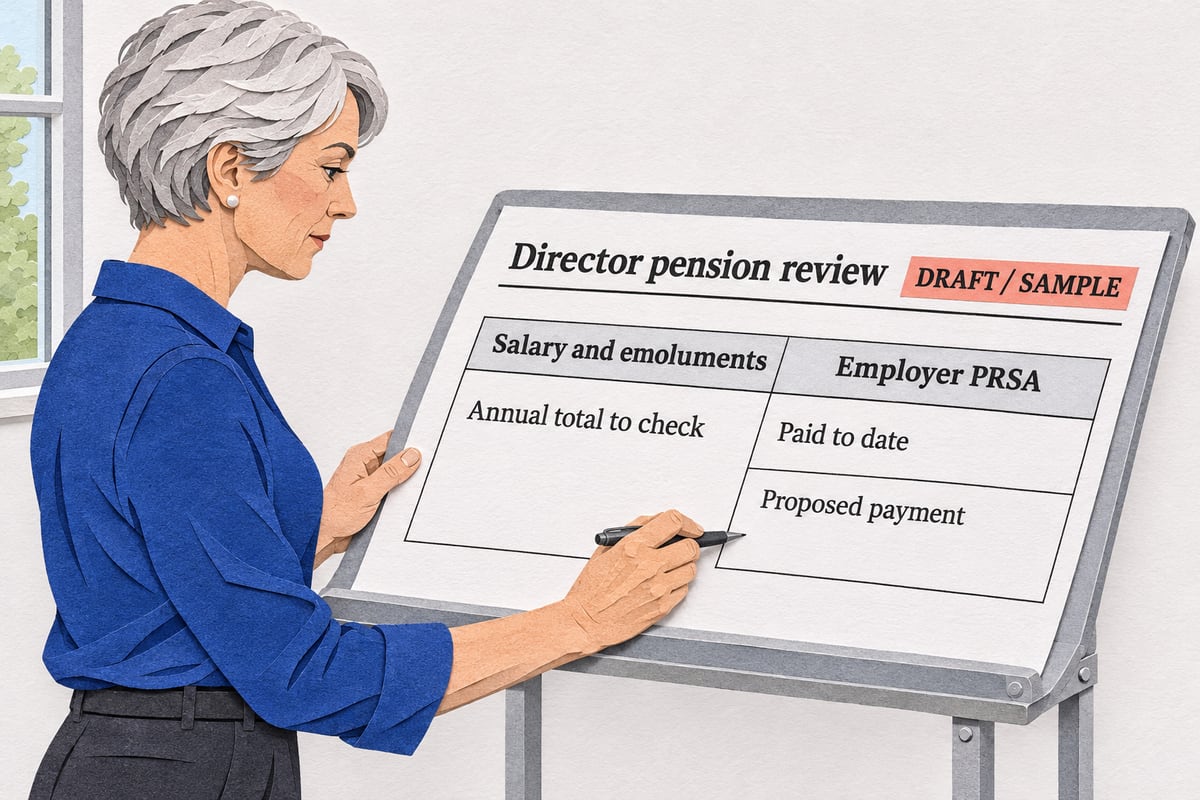
Your Irish company has cash available and you want it to help fund your retirement. Can the LTD pay a pension provider directly, and is that different from taking salary and contributing personally? Those are sensible questions to settle before moving company money, especially in a first year with changing remuneration.
This guide helps an owner-director prepare an accounting and payroll review. It focuses on employer PRSA contributions while distinguishing personal contributions and occupational schemes. It does not recommend a product, investment fund or contribution amount. Company tax advice and regulated pension advice are separate workstreams, and both may be needed.
1. Identify the arrangement before calculating relief
Start with the provider documents, not a bank-transfer description. A PRSA, an occupational pension scheme and a personal contribution deducted through payroll are not interchangeable arrangements. Ask the provider and advisers to identify exactly what is proposed and whose contribution will be recorded.
Revenue treats qualifying employer contributions differently from employee contributions. The Pensions Authority describes a PRSA as an individual retirement account; employer funding does not turn it into ordinary company working capital. Keep the company, the director and the pension arrangement distinct in the records.
The comparison below is a preparation tool. It is not a recommendation to choose one route or an assurance that an existing personal plan accepts a particular employer payment. Obtain the provider's instructions and an assessment of the actual arrangement.
| Proposed route | Question to settle |
|---|---|
| Employer payment to a director's PRSA | What annual employer limit, deduction and payroll treatment apply? |
| Director's own contribution | What personal earnings, age-related relief and payroll rules apply? |
| Occupational pension scheme | What scheme funding, benefit and employer-deduction rules apply? |
| Transfer of an existing pension | What separate transfer assessment and provider documents are required? |
2. Apply the current employer PRSA limit, not an old headline
From 1 January 2025, Revenue's guidance limits the PRSA employer-contribution exemption by reference to 100% of the employee's emoluments. Its detailed manual applies the provision to directors as well as employees. The limit concerns tax treatment; it is not advice to contribute that amount or a promise that every payment below it is suitable.
Revenue defines emoluments by reference to employment or office remuneration. Company turnover, retained profits and the bank balance are not alternative measures of that remuneration. Do not assume that dividends or a founder's loan create employer PRSA headroom. Have the accountant reconcile what actually counts from the relevant employer.
This is especially important where the director takes little or no remuneration. Provide details of unpaid leave, changing employment or a departure during the year rather than applying a headline percentage mechanically. Ask for the applicable calculation and any exception to be documented before the provider receives a lump sum.
3. Worked example: check the total, not just the next payment
Take a fictional director with confirmed annual emoluments of EUR48,000 and an ordinary employer PRSA limit of EUR48,000. The company has already contributed EUR19,000 and proposes another EUR34,000. The total would be EUR53,000, exceeding that assumed limit by EUR5,000. This is an original simplified illustration, not a recommended funding level or a StartCompany.ie service price.
Revenue's manual explains that excess employer PRSA contributions create a taxable benefit and are not deductible by the employer for tax purposes. The accountant must assess the relevant payroll reporting and company tax position. Splitting the proposed payment into several transfers does not change the aggregate arithmetic.
The useful preparation is a schedule of payments already made, the intended payment and the remuneration basis. Ask what changes if actual pay is lower than forecast or employment ends early. Do not treat a contractual annual salary or a hoped-for year-end bonus as an unquestioned final figure.
4. Personal contribution relief is a different calculation
The employee's own pension contribution is subject to personal relief rules, including age-related percentages and an earnings cap. Revenue also links relief to the source of income in respect of which the contribution is made. Do not apply the personal percentage table as though it were the employer PRSA limit, or assume income from another job automatically solves the company's calculation.
For personal PRSA payments through payroll, Revenue permits the relevant Income Tax deduction under the net pay arrangement. It says those employee contributions are not deducted from gross pay when calculating USC or PRSI. The gross contribution, Income Tax relief and actual reduction in take-home pay are therefore different amounts.
Tell the adviser about contributions to other arrangements and relief already obtained. If a personal payment is being claimed through a return rather than payroll, agree who makes that claim and how duplicate relief will be avoided. A company payment should not simply be relabelled as a personal contribution after the event.
5. Separate the calendar-year test from the company year-end
Revenue's PRSA manual compares employer contributions and the relevant emoluments for the year of assessment, with a year-end review. The company's Corporation Tax accounting period may end on a different date. Do not restart the personal-year calculation merely because the company closes its books in June or September.
Keep payment dates and provider acknowledgements, and have the accountant allocate any allowable deduction to the correct company period. A note that the company intends to contribute is not the same evidence as an actual payment. Review the planned transaction before a tax deadline rather than trying to recreate its facts afterwards.
Occupational-scheme contributions have their own rules. Revenue's Chapter 4 distinguishes ordinary contributions, payment-based deductions and special contributions that may require relief to be spread. Do not import a PRSA rule into an occupational funding calculation, or assume a large back-service contribution automatically receives an immediate full deduction.
6. Do not convert salary already due into a supposedly exempt payment
A genuine employer contribution is not the same as surrendering salary in exchange for a benefit. Revenue's salary-sacrifice guidance identifies only specific qualifying exemptions; a pension contribution is not a general salary-sacrifice exemption in that list. Obtain advice before altering remuneration already agreed or earned.
For example, an owner should not tell the bookkeeper to erase a salary liability and send the same money to a pension provider on the assumption that this removes payroll tax. Establish the employment terms, approval, timing and correct tax treatment first. Do not backdate board records, payroll or provider instructions to make an arrangement appear different.
Record whether the company is making an additional employer contribution or processing an employee contribution. Give the payroll preparer the same agreed instructions as the pension provider. Inconsistent labels across the bank reference, payslip and contribution statement make later reconciliation unnecessarily difficult.
7. Check business cash needs and retirement access separately
A potential deduction does not make a contribution free. The company still pays the cash, and the amount available for creditors, payroll, tax and operations changes. Ask the accountant to compare the proposed payment with the company's liabilities and cash forecast, not merely the current balance.
The Pensions Authority says PRSA benefits can normally be taken from age 60, with earlier access possible in particular circumstances. It also warns that a PRSA is not risk-free or backed by a government guarantee. Do not treat pension funds as a temporary business reserve or assume the contribution can be withdrawn whenever the company needs money.
The pension adviser should assess access, investment risk, charges, existing benefits and suitability. A tax calculation alone does not settle those matters. Ask for the effects of the actual product and proposed payment to be explained, including what remains uncertain and which decisions are irreversible or restricted.
8. Use the right adviser for each part of the decision
Ask the accountant to review remuneration records, company deductibility, contribution reconciliation and payroll or return work. Ask an appropriately authorised pension adviser about product suitability, provider choice and investments. One firm may have more than one capability, but do not assume an accountancy qualification alone authorises every regulated financial service.
The CCPC recommends checking the adviser on the Central Bank registers and understanding fees, commission and provider ties. Verify the authorisation and the specific service before sharing sensitive financial documents or agreeing an instruction. A familiar company name or an online testimonial is not the authorisation check.
Also flag other employees and existing pension arrangements. Revenue's PRSA guidance addresses employer access obligations, while its current employer-contribution manual discusses automatic-enrolment interaction. This article does not assess your staff's MyFutureFund eligibility. Have those responsibilities checked separately rather than assuming an owner-director contribution completes every employer duty.
9. Prepare a short contribution-review pack
Give both advisers a consistent set of facts and agree who resolves outstanding questions. The following is a practical preparation list, not a universal provider application form or an instruction to upload sensitive documents to an unverified contact.
- Identify the company, director, product and proposed employer or employee contribution route.
- Provide the relevant remuneration records and explain changes, leave or an expected departure.
- Reconcile employer contributions already paid in the tax year with provider acknowledgements.
- State the proposed amount and actual intended payment date, without assuming approval.
- Provide the company accounting period and a cash forecast covering existing commitments.
- List other pension arrangements and personal contributions relevant to the advisers' review.
- Agree responsibility for payroll, company deductions, personal claims and year-end reconciliation.
- Confirm advice scope, authorisation, charges and required records before authorising a transfer.
10. Request accounting support without assuming pension advice is included
StartCompany.ie connects businesses with qualified Irish accountants for agreed accounting, payroll and tax work. Describe the director's contribution question before requesting a quote, then confirm whether a review can be provided, what it covers and the total payable. A general bookkeeping engagement should not be assumed to include a pension-contribution assessment.
Accountant matching is not an offer to arrange a pension, recommend a provider or select investments. Regulated pension advice must be separately confirmed with an appropriately authorised adviser. Neither incorporation nor an accounting enquiry guarantees eligibility, a deduction, a particular net saving or a provider's acceptance of the payment.
Use the linked owner-payment guide for salary, dividends and expense distinctions, and the director-return guide for personal Form 11 responsibilities. Agree the contribution review and any resulting payroll or tax-return work explicitly. The aim is a supported decision and consistent records, not a transfer made first and explained later.
StartCompany.ie service
Accountant Services in Ireland
Official information and next steps
Checked against primary sources on 5 November 2026. Revenue's PRSA manual is dated May 2025 and its employer-contribution manual April 2026; current personal-relief guidance is dated October 2026. The Pensions Authority's general PRSA guide predates the 2025 tax change and is used here for product operation and access, not current contribution-tax limits. This is general information, not personal tax, pension or investment advice. Examples are fictional and assume ordinary circumstances.
- Revenue: employer pension contributions and the PRSA limit
- Revenue: taxable employer benefits and emoluments
- Revenue Pensions Manual Chapter 24: PRSAs
- Revenue Pensions Manual Chapter 4: employer contributions
- Revenue: personal pension tax-relief limits
- Revenue: employee PRSA contributions and payroll
- Revenue: salary-sacrifice arrangements
- Pensions Authority: general PRSA operation, risk and access
- CCPC: regulated financial advisers and authorisation checks