
Your Irish LTD has been incorporated, a director has an Identified Person Number for company filings, and the business is ready to make its first salary payment. The payroll provider now asks for a PPSN. Can you supply the IPN instead, or must everything stop until the personal number arrives?
This guide deals with that particular handover from formation to director payroll, rather than choosing between salary and dividends. Official CRO and Revenue guidance was checked on 26 October 2026. It is general preparation, not an individual tax calculation, a decision on social insurance or permission to work in Ireland.
An IPN solves a company-filing problem, not every identity requirement
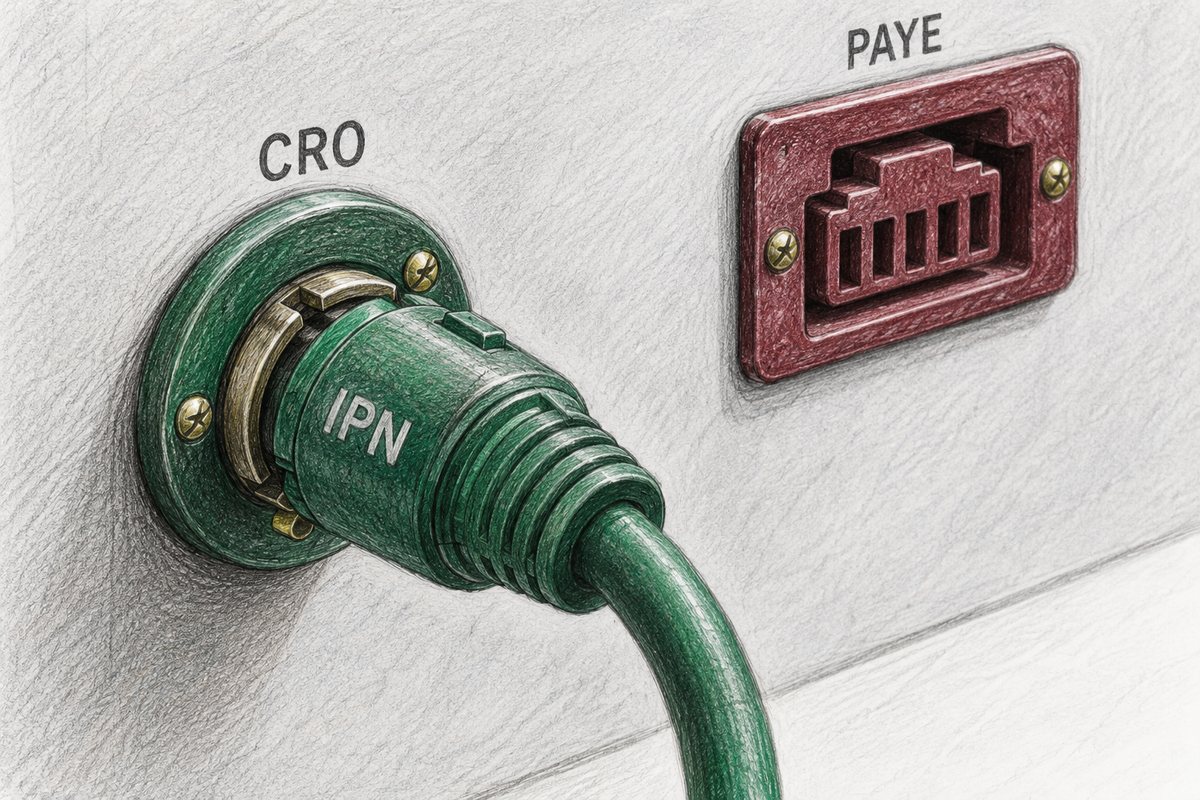
The CRO describes an IPN as a number issued after the VIF process for relevant CRO and RBO documents. Revenue's payroll instructions ask for the individual's PPSN or specified reporting details where it is unavailable. These are separate systems: an IPN is not a PPSN to enter on payroll.
Do not copy a number into a field simply because its length looks plausible, use the company's CRO number as a personal identifier or borrow another director's number. Give the payroll provider an accurate list of what already exists and what is still being obtained.
A successful incorporation confirms neither the director's final payroll treatment nor an entitlement to work. Resolve any employment or immigration question separately before treating a reporting facility as permission to begin an activity.
Register the employer before arranging the first payment
Revenue says a company must register as an employer and operate PAYE on directors' income even if it has no other employees. Being the only person paid does not make an owner-director's salary an informal transfer outside the employer process.
Put the employer registration, proposed pay date and responsibility for submissions on one task list. Identify whether you need a registration application, continuing payroll or help with both. A company tax reference or access to ROS is not, by itself, proof that every necessary registration and payroll setting is ready.
Agree the gross amount and payment frequency before promising yourself a net amount for household bills. Also decide who approves the pay run and who actually releases the bank transfer. That small separation of tasks can prevent a payment happening before the reporting work has been completed.
Understand the five different payroll identifiers
A payroll system may display several similar-looking reference fields. Ask what each field means rather than treating every reference as interchangeable. In particular, the Employer Reference used to identify a person without a PPSN is not the company's employer registration number.
Revenue describes that reference as an internal staff identifier. The Employment Identifier has another function: it distinguishes separate employments for a person and is required when the PPSN is available. A payroll provider should configure the correct fields, not ask a founder to invent a substitute personal number.
| Item | What it identifies |
|---|---|
| IPN | Relevant CRO/RBO filing identity |
| PPSN | The individual's personal number |
| Employer Reference | The person in no-PPSN reporting |
| Employment ID | A particular employment |
| RPN | Revenue's current payroll instructions |
What goes on a submission when the PPSN is missing?
Revenue requires the person's name, address and date of birth where the PPSN is unavailable, together with an Employer Reference that remains consistent. Directors are expressly included among the people covered by payroll submissions.
Collect the required information securely before the pay run. Check spelling and dates against the person's records and ask the provider to confirm the reference it will use. Do not paste identity documents, dates of birth or personal numbers into an ordinary public enquiry form merely to request a price.
Keep the original submission confirmation with the payroll record. If the software reports an error, record the exact message without repeatedly changing identifiers to make it disappear. A technically accepted file is useful evidence of reporting, not an opinion that the payment classification or deductions are correct.
Budget for emergency deductions, not the expected normal payslip
The employer must request the latest Revenue Payroll Notification before running payroll. An RPN supplies the relevant credits, cut-off points and other deduction instructions. If an RPN cannot be retrieved, Revenue requires the emergency basis rather than an employer's estimate of the director's eventual credits.
Under the published 2026 rules, someone who has not supplied a PPSN is taxed at the higher Income Tax rate of 40% on all pay; emergency USC is 8%. As a limited illustration with no pension adjustment, EUR 1,000 gross would produce EUR 400 Income Tax and EUR 80 USC, leaving EUR 520 before any PRSI or other deductions. This is not a personal net-pay quote or the company's full employment cost.
Having a PPSN but no available RPN is a different scenario with its own emergency rules. Do not copy the illustration into every first payslip. Ask the provider to assess the actual facts, current rates and PRSI position, and set aside the company's tax-payment funding rather than spending everything remaining in the bank.
Deal with the personal PPSN and job registration in parallel
Revenue directs someone without a PPSN to the Department of Social Protection. Its emergency-tax guidance distinguishes a first job in the State, which the individual registers through myAccount, from a later employment that the employer registers. Explain your history instead of assuming an existing IPN or earlier overseas employment settles the process.
Make the pending steps visible to the payroll provider: whether the personal number has been requested, whether it has arrived and whether the relevant employment is registered. Keep personal myAccount access separate from company ROS or agent access; sharing a director's login is not a substitute for agreeing the proper authorisation route.
Do not promise a PPSN issuance date or an RPN by the next pay day without confirmation. A realistic first-payment plan allows for outstanding identity and registration work. Someone who previously lived or worked in Ireland should check whether a PPSN already exists rather than requesting a new identity unnecessarily.
Link the earlier pay correctly when the PPSN arrives
Revenue specifically requires the same Employer Reference in the first payroll submission that includes the PPSN. That lets it link the earlier pay and deductions to the personal record. Do not create a second person in payroll and abandon the original no-PPSN entries.
For a fictional monthly-paid director called Alex, the provider might have used its own reference DIR-ALEX for the first pay run. When Alex supplies the PPSN, the handover instruction should identify that existing record and reference, not just say 'add a new employee'. No personal number needs to appear in a general email subject line.
Ask the provider to check the submission response and the subsequent RPN. Separately, Revenue says the Employment Identifier must stay the same for a continuous employment, including across tax years. An ordinary January rollover is not a reason to create a fresh employment history.
An RPN does not guarantee an immediate full refund
Revenue distinguishes cumulative RPNs from Week 1, non-cumulative instructions. A cumulative RPN can enable the employer to reconcile the year-to-date position and refund overpaid Income Tax and USC through payroll. With a Week 1 RPN, the employer cannot make those refunds until cumulative instructions become available.
That distinction matters if you have budgeted a personal expense around receiving all emergency deductions back next month. The amount and timing depend on the actual record and instructions; higher initial deductions are not proof that every euro will eventually be refundable.
If an earlier year is involved, or several jobs or residence issues complicate the record, agree the appropriate review with an adviser. Proprietary directors also have personal self-assessment obligations. Do not assume that operating company payroll automatically completes the director's Form 11 or that every director follows the ordinary employee's refund workflow.
An overseas director needs a separate cross-border review
Do not infer 'no Irish tax' from having no PPSN or living abroad. Revenue states that Irish-company directors are chargeable to Irish Income Tax and USC regardless of residence or where director duties are exercised, subject to possible modification by a double tax agreement. Social-insurance treatment is a separate assessment.
Give the adviser the person's actual residence, duties, work locations and proposed remuneration. Distinguish directorship duties from any additional employment role. Ask about the relevant treaty, any required Revenue authorisation and foreign reporting before changing how deductions are operated.
A bank account abroad, an overseas payroll provider or an Irish registered-office service does not determine those answers. Nor does the ability to report without a PPSN establish a treaty exemption. This guide does not decide a residence position or promise that only one country's payroll will be relevant.
Use a first-payment checklist with a named owner for each task
Before approving the transfer, send the adviser a short status list rather than an unstructured bundle of incorporation documents. The useful question is which items are ready and who will resolve the outstanding ones. Keep the sensitive supporting material within the agreed secure process.
- Confirm the company paying the director and the status of its employer registration.
- Agree the payment classification, gross amount, pay frequency and actual payment date.
- State whether a PPSN exists; keep CRO/RBO identifiers separate from payroll fields.
- Confirm the required no-PPSN details and the consistent Employer Reference where applicable.
- Ask the provider to obtain the latest available RPN or apply the correct emergency basis.
- Review PRSI and any cross-border or proprietary-director issues separately.
- Assign responsibility for approval, reporting on or before payment, payslips and tax-payment funding.
- Set a follow-up for the PPSN, employment registration, record linking and any later refund review.
Buy the support that is actually missing
StartCompany.ie's tax-services page includes employer-registration and payroll-related support within its published service areas. Explain whether you need PAYE registration, the first director pay run, ongoing payroll, a correction or an overseas-director review. Ask what can be provided and agree the responsibilities and total payable before instructing work.
Formation with listed IPN support is not automatically employer registration or ongoing payroll. Likewise, applying for a CRO IPN does not obtain a PPSN from the Department of Social Protection. Keep formation, personal identity, company registration and recurring payroll as distinct items in the quote.
For an initial enquiry, describe the company, payment plans and missing steps without including a full PPSN, passport or bank credentials. Request the secure document process once the appropriate provider and scope are agreed. A clear handover is more useful than buying several services that leave the same payroll task unassigned.
StartCompany.ie service
Tax Services in Ireland
Official information and next steps
Official guidance was checked on 26 October 2026. The calculation above uses the stated 2026 emergency rates only and excludes PRSI and other deductions. This is general preparation, not a personal payroll calculation, treaty opinion or confirmation of work permission. Check current instructions and agree the service scope before acting.
- CRO: IPN purpose and eligibility
- Revenue: employer registration, including directors
- Revenue: payroll reporting without a PPSN
- Revenue: Employer Reference and payroll fields
- Revenue: Employment Identifier
- Revenue: Revenue Payroll Notifications
- Revenue: Emergency Tax and first-job registration
- Revenue: 2026 Emergency Tax rules
- Revenue: refund treatment after Emergency Tax
- Revenue: directors and personal self-assessment
- Revenue: overseas duties and Irish-company directors