
An overseas founder is funding an Irish company from a dollar account. Another founder expects to invoice customers in sterling. Must the new LTD's shares be denominated in euro, or should the share capital follow those other currencies? Those are separate decisions, and choosing a currency because it appears on a bank app can create unnecessary drafting work.
This guide concerns the nominal currency of shares in an ordinary Irish private company limited by shares, not a PLC, regulated capital requirement or an investment offer. CRO guidance, the revised Companies Act and relevant accounting guidance were checked on 13 November 2026. Obtain advice on the proposed documents, settlement and any existing shares before relying on a particular arrangement.
1. What the law allows, and what it does not decide
Section 66 requires shares to have a nominal value and permits different nominal values, currencies and amounts payable. The relevant question is therefore not whether Ireland uses euro, but what shares the company proposes to issue and how that proposal will be documented.
Nominal value is the fixed face amount of a share, not the company's commercial valuation. A proposed USD 1 ordinary share is not a statement that the business is worth one dollar. Equally, a funding target expressed in dollars does not, by itself, determine the nominal currency of the shares offered for that funding.
Start with the intended ownership and commercial reason for the currency. An investor may have a genuine denomination requirement, while another founder may only want to avoid a bank conversion. Tell the adviser which problem you are solving. Do not introduce a second nominal currency just because two founders keep their savings in different countries.
2. Separate four currency decisions in the formation brief
Write the four decisions separately. A single instruction saying that this will be a dollar company leaves the presenter unable to tell whether you mean the shares, an incoming transfer, trading receipts or the accounts. It also invites different people to interpret the same number differently.
The table is a preparation tool, not permission for any particular conversion or settlement method. For each currency, name the relevant document and person who will confirm it. Record unresolved matters explicitly rather than copying one currency across every field for consistency.
| Decision | What it describes | Confirm with |
|---|---|---|
| Nominal currency | Face amount of shares | Formation adviser |
| Payment currency | Funds sent for shares | Subscription reviewer |
| Account currency | Balance held by provider | Account provider |
| Accounting currency | Measurement and reporting | Company accountant |
3. Align the constitution and Form A1 before signing
Section 19 requires the constitution to state the division into shares of a fixed amount, with or without an authorised-capital ceiling, and the number each subscriber takes. CRO's formation process uses Form A1 and the constitution, including subscriber and share details. Have the proposed currency checked across the complete draft, not just the application summary.
For a foreign-currency proposal, ask the presenter to confirm the current filing workflow and the documents they can prepare. Do not select EUR in an online field as a temporary substitute while expecting USD wording to be added later. If a standard form does not accommodate the proposal, pause and obtain instructions before signing or submitting.
Use unambiguous currency descriptions. USD, CAD and AUD are not interchangeable just because each can be written with a dollar symbol. Likewise, specify GBP rather than an unexplained pound sign. Check share count, nominal amount per share, class and subscriber allocation together, and retain the final version that each subscriber was asked to sign.
4. Euro shares and a dollar transfer are not the same thing
Consider a fictional proposal for 100 ordinary shares of EUR1 each. The nominal total is EUR100. A founder wants to send dollars. That proposal needs an agreed settlement treatment; it does not automatically become an issue of USD1 shares merely because the incoming transfer is in dollars.
For illustration only, suppose the reviewed settlement arrangement uses an assumed rate of USD1.25 for EUR1. EUR100 x 1.25 = USD125 before charges. This is invented arithmetic, not a current market rate, Revenue rate or approved legal settlement method. A USD100 transfer would not equal EUR100 under that assumption.
Ask who bears charges, which amount is credited and how any shortfall or excess is treated. Section 71 prohibits allotting shares at a discount to nominal value. Do not mark the shares fully paid solely from the sender's transfer screenshot; the reviewer needs the subscription terms and evidence of what was received and credited.
5. Dollar-denominated shares need their own consistent record
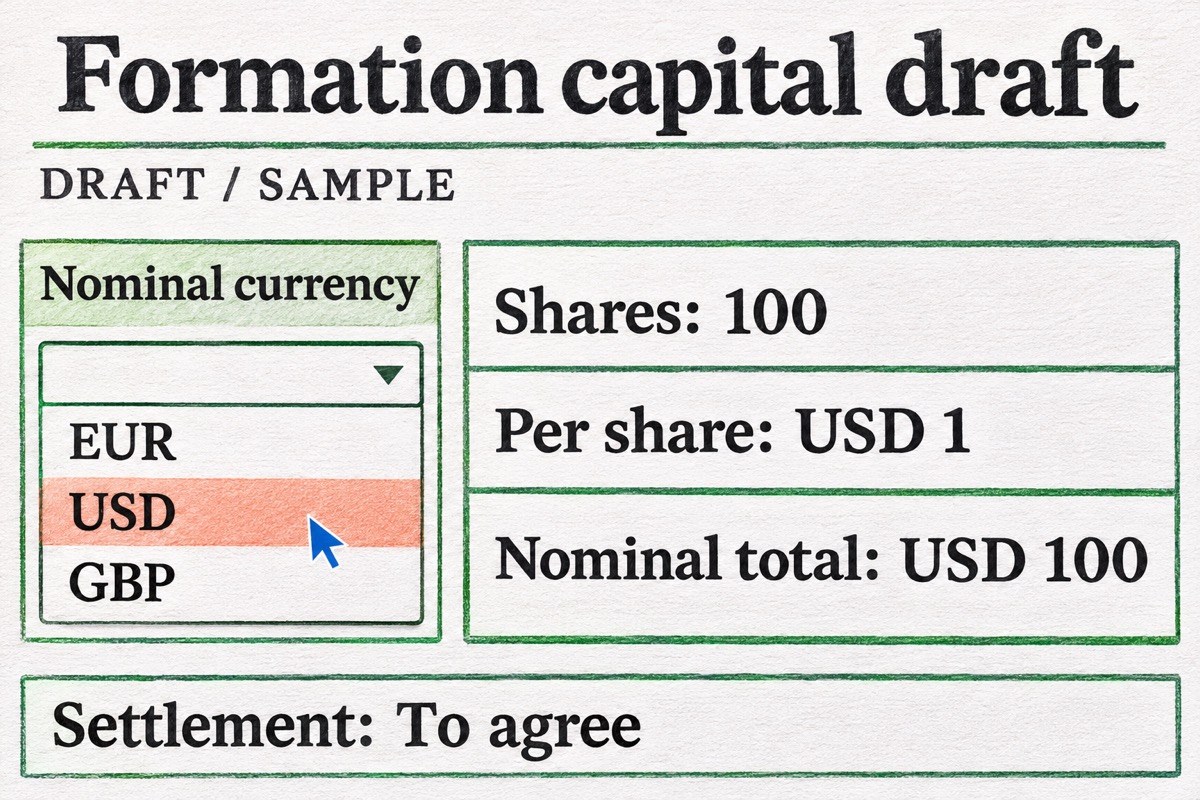
Now consider a different fictional proposal: 100 ordinary shares of USD1 each. Its nominal total is USD100. This is a different denomination from the EUR100 proposal above, even though both have a share count of 100. A later accounting translation should not be used to silently rewrite the nominal amount in the constitutional record.
Under an expressly assumed arrangement of one vote for each identical ordinary share, allocating 60 shares to one founder and 40 to another gives 60 and 40 of those 100 votes. That arithmetic does not depend on the founders' home currencies. Actual rights must still be checked; this example is not a rule for every class or constitution.
If you genuinely need shares of more than one currency, obtain a rights and capital-structure review. Do not add EUR100 and USD100 and describe the result as 200 of a single currency. Keep denomination, class, rights and amounts distinct. A tidy spreadsheet total is not a substitute for clear legal terms.
6. Distinguish nominal capital, premium and other founder funding
The amount needed to launch the business is another question. A company might have a small nominal share amount while receiving substantially more funding, but that does not mean the extra money should be posted to share capital without explanation. Ask what the funding agreement actually provides.
Section 71 addresses value received above nominal value through the share premium account, subject to its provisions. Separate a proposed subscription price from nominal value and from any genuinely separate loan. Do not decide which it is by choosing the label that produces the neatest balance in bookkeeping.
Prepare a funding schedule showing the payer, purpose, legal amount due, payment currency, dates, fees and supporting agreement. If several transfers fund one subscription, connect them to one reviewed schedule. If one transfer covers several obligations, ask for an allocation rather than describing all of it as paid-up share capital.
7. Share currency does not choose the company's functional currency
Where FRS 102 applies, section 30 identifies functional currency by the company's primary economic environment, including the currencies influencing sales and costs. It distinguishes that assessment from presentation currency. Choosing USD shares is therefore not a standalone election to measure the accounts in dollars.
The applicable reporting framework and period matter. Ask the accountant which standard applies and which currency decisions need documenting. Use our GBP and USD accounting guide for transaction and reconciliation issues; this article is not a replacement foreign-exchange policy or a year-end equity calculation.
Section 282 requires records that explain transactions. Preserve original subscription amounts and currencies alongside the relevant translations and bank movements, with the accountant's treatment identifiable. Do not overwrite historic share records whenever a bank conversion or year-end exchange rate changes. Accounting translation and a legal capital change are different tasks.
8. Plan the member register and later investment
Section 169 requires the register of members to record the shares held and amounts paid or treated as paid, as well as membership dates. Build an evidence trail from the signed formation documents to the register, certificates and payment records. The bank's currency balance alone cannot supply those membership particulars.
For a later investment round, section 69 governs allotment authority and relevant existing-holder protections. Section 70 requires particulars of an allotment to be delivered within 30 days. CRO identifies Form B5 for the return. Have the presenter confirm the relevant filing, effective date and currency particulars rather than assuming the next annual return creates the shares.
Before promising an investor a different currency, provide the existing constitution, register and prior issue terms to the reviewer. Explain whether the proposal is new shares, a purchase of an existing holding or a change to existing capital. Those are not interchangeable ways of achieving a desired number on a cap table.
9. Do not fix an existing currency mismatch by editing a certificate
If the company is already incorporated, distinguish a factual error from a proposed change. Collect the filed constitution, A1, register, certificates, subscription documents and payments. Show the adviser exactly where the currencies differ and when each document was created. Do not backdate replacement paperwork to make the history appear consistent.
CRO guidance on constitution alterations requires an up-to-date amended text with relevant resolutions, while its capital guidance warns about limits on changing B5 particulars where issued capital would be reduced. These are reasons for a reviewed correction or change process, not a universal instruction to file one particular form.
Do not assume changing a dollar sign to a euro sign preserves the same capital, payment position or rights. Ask which legal mechanism, approvals, filings, tax review and accounting entries are needed for the actual case. A currency translation in software does not prove a legal redenomination has occurred.
10. What to send before choosing a formation package
StartCompany.ie's published formation packages include a constitution and share certificates. A foreign-currency or multi-currency proposal needs confirmation before ordering: ask whether the presenter can accept it, whether bespoke legal or accounting work is needed, and the scope and total payable. Do not assume that a standard package includes investor-document drafting, currency conversion or a later capital reorganisation.
Use the package comparison for the ordinary formation services, and raise the currency brief before proceeding with an unusual structure. For overseas founders, director-residence compliance, identity checks, banking and tax registrations remain separate matters. A USD denomination does not guarantee an account, tax result, residence or immigration permission.
- Proposed nominal currency, share class and amount per share.
- Each subscriber's share count and intended rights.
- Commercial reason for a non-euro denomination.
- Subscription price and any separate loan or other funding.
- Proposed payment currency, conversion treatment and charges.
- Any investor documents or existing company records.
- Named reviewer for formation, settlement and accounting questions.
StartCompany.ie service
Compare Irish company formation packages
Official information and next steps
Primary CRO, Companies Act and FRC sources checked on 13 November 2026. The conversion example uses a deliberately invented rate, not a live quote or approved settlement rule. This guide does not validate a particular subscription, capital change or tax treatment.
- Companies Act 2014, section 66: nominal values and different currencies
- Companies Act 2014, section 19: constitution and subscriber shares
- Companies Act 2014, section 71: payment, nominal value and share premium
- Companies Act 2014, section 69: allotment authority and existing holders
- Companies Act 2014, section 70: allotment date and 30-day return
- Companies Act 2014, section 169: member and paid-up records
- Companies Act 2014, section 282: explaining company transactions
- CRO: Form A1, constitution and subscriber details
- CRO: share-capital changes, Form B5 and correction limits
- CRO: constitution alterations and up-to-date amended text
- FRC: FRS 102, section 30, functional and presentation currencies
- FRC: current FRS 102 edition, scope and amendments