
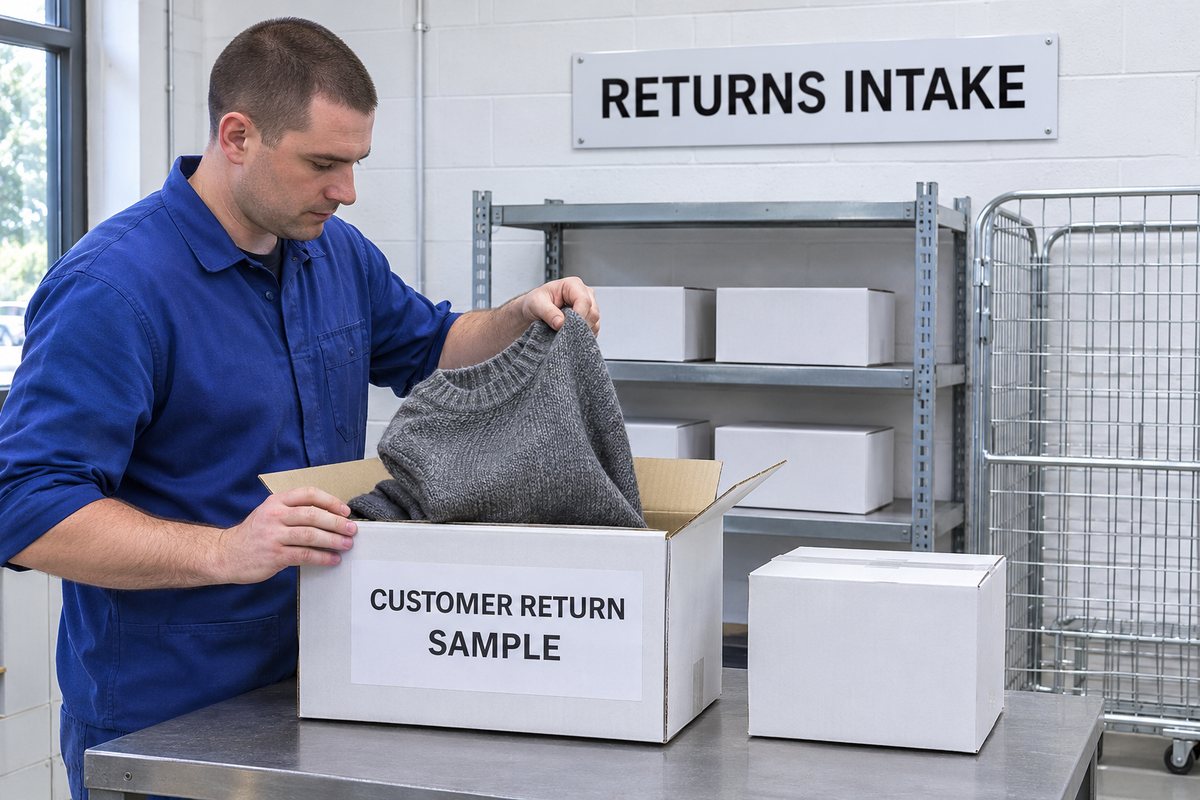
You have chosen an Irish company name, arranged a registered office and started building the online shop. The website builder asks for a returns address. It is tempting to copy the new company address into that field and move on.
Pause there. Receiving official letters and receiving a box of returned clothing are different services. A parcel sent to an unsuitable address can leave the customer chasing delivery, the shop unable to locate the item and the refund process relying on somebody who never agreed to handle stock.
This guide helps an Irish LTD selling ordinary physical goods to consumers separate those arrangements before launch. It is not a full consumer-law audit or advice on every product, country or marketplace. Sources and service scope were checked on 18 November 2026.
A registered office is not automatically a returns depot
CRO describes the registered office as the address for official documents, notices and court papers. It must be a physical location in Ireland, not simply a PO box. That company-law function does not establish that the provider will accept, store, inspect or forward merchandise.
A returns operation needs practical answers that an official-mail arrangement may never address: parcel sizes, carrier deliveries, safe storage, damaged packaging, product inspection and the point at which the seller is notified. A receptionist accepting an envelope is not evidence of agreement to do all of that.
Get permission for the specific company and use. Do not take the address from a supplier's website or another company's CRO record. StartCompany.ie confirms the allocated address after reviewing the order and completing the required checks; an order receipt is not permission to start printing labels.
Keep four address functions clear
One location may legitimately perform several functions, but each needs a sound basis. Build a small address register before copying information into the footer, contact page, checkout settings and shipping software.
For each field, record the correct legal entity, purpose, recipient and supporting agreement. Consistency means accurately explaining those functions, not forcing every system to show one address.
| Function | What the shop must establish |
|---|---|
| Company registered office | Confirmed statutory use and official correspondence arrangements. |
| Trader and complaints information | Accurate business-location and contact disclosures for the actual seller. |
| Cancellation channel | Where a customer can communicate a decision to cancel, including the applicable online function. |
| Physical returns destination | A recipient authorised to receive the shop's goods, with parcel-handling terms. |
What customers see must describe the real arrangement
CRO requires limited companies with websites to display their name and legal form, place and number of registration, and registered-office address on the homepage or a readily accessible page identified from it. Keep that company disclosure even if returns go elsewhere.
Consumer information asks a different question. Schedule 3 of the Consumer Rights Act 2022 requires the trader's geographical establishment address and, where different, the relevant business address for complaints, alongside contact information. Buying a mailing address does not, by itself, settle where the trader is established.
Label the registered office and returns destination distinctly. If your business is managed abroad or uses overseas fulfilment, obtain advice on the correct disclosures rather than presenting the registered office as a staffed shop or warehouse. A footer saying 'not for returns' is not a substitute for the address and consumer information the actual business must provide.
Have a new reader test the page: can they identify the company taking the order, contact it about a problem and find usable return instructions without guessing which address applies?
Choose a returns recipient before the first sale
For goods returned following statutory cancellation, section 118 provides for sending them back or handing them to the trader or a person authorised by the trader, where the trader is not required to collect them. This gives a legal framework for a separate authorised recipient, not blanket permission to nominate any address.
Possible arrangements include the shop's own suitable premises or a separately contracted fulfilment or returns operator. Check that the contract covers returns for your legal entity and product range, not only dispatch of new orders.
Ask who can sign for a delivery, how an unidentified parcel is matched to an order, what happens outside receiving hours and how quickly evidence of receipt reaches your team. Agree charges for intake, storage, inspection and onward dispatch separately. There is no universal forwarding charge to copy from a registered-office headline price.
For bulky items, fragile goods or products with handling restrictions, ask about the actual carrier and storage requirements before offering a label. A return address that only works for the smallest item in the catalogue is not a complete plan.
Cancellation is a message; a return is a movement of goods
These events should not be merged into one status called 'return requested'. A customer may communicate cancellation before the goods arrive back. Section 115 allows the model form or another unequivocal statement; do not treat an internal return reference as the only way a consumer can exercise a statutory right.
Regulation 6 of S.I. 309/2026 inserted section 115A from 30 June 2026. Covered online contracts require a clearly labelled, accessible cancellation function throughout the cancellation period, identifying the consumer and contract, with a confirmation step and durable acknowledgement recording the statement and submission time. The amended pre-contract information includes the function's existence and placement.
This is not limited to financial products: section 115A also covers the ordinary section 112 right. A parcel label or contact email alone does not fulfil it. Ask the shop's legal and technical advisers to check implementation.
Connect the cancellation notification to the support queue and returns record, while keeping the separate timestamps. Do not delay recording the customer's notice until a warehouse opens the box.
Set the return-cost rules for the right kind of case
CCPC explains that most online goods purchases have a 14-day cooling-off period, with exceptions such as personalised goods and certain unsealed hygiene products. This guide concerns ordinary consumer distance sales, not a universal rule for every item or business-to-business sale.
Under section 118, goods must normally be sent back or handed over without undue delay and within 14 days of the cancellation notice. The consumer bears direct return costs unless the trader agreed to bear them or failed to give the required prior information about those costs. Where collection obligations apply, check those separately.
Keep change-of-mind returns distinct from faulty-goods remedies. CCPC's business guidance describes return or collection at the trader's expense in the relevant faulty-goods cases. Do not copy a 'customer pays postage' rule across every complaint.
In your operating instructions, identify who classifies the request and who authorises a label or collection. That is a seller decision; the person receiving a parcel should not have to infer it from the package.
Make refund evidence reach the person who can act on it
For statutory cancellation, section 117 generally requires reimbursement without undue delay and within 14 days of the cancellation notice, subject to its rules. For a sales contract, unless the trader offered to collect, reimbursement may be withheld until the goods are received or the consumer supplies evidence of sending them back, whichever occurs first. Do not write 'refund only after warehouse inspection' as an unrestricted rule.
Ask the returns operator for a usable receipt event: carrier reference, receipt date, order match and any exception requiring attention. Keep access proportionate; circulating customer labels widely is not necessary to resolve a return.
Assign one shop team member to reconcile cancellation notices, proof of dispatch, physical receipt and the refund decision. The registered-office provider should not become the accidental decision-maker simply because its address appeared somewhere in the website template.
Two examples of an address plan that actually works
A fictional clothing shop uses a confirmed Irish registered office for company correspondence and contracts a separate fulfilment operator to receive returns. Its legal page identifies the company and registered office; its returns instructions give the authorised destination. When a customer cancels, support records the notice and links the return to the order. The fulfilment team reports receipt to support rather than sending the jumper to the mail-forwarding address.
Now consider a shop whose platform template automatically copied the registered office onto a return label. The office contract excludes parcels. Before the next customer uses it, the seller should correct the template, arrange a workable destination and contact anyone already given the wrong instructions. Keep the original communication and carrier status when resolving an existing case; do not assume a delivery refusal automatically defeats the customer's rights.
Both are fictional operating examples, not descriptions of StartCompany.ie customers or a returns service we provide. The difference is agreement and handover, not a more prestigious postal location.
Check these eight points before publishing the address
Run this as a small launch test. Use a draft label and synthetic order reference; there is no need to place a paid order or expose a real customer's details.
- Identify the contracting company and keep its registered-office disclosure current.
- Confirm the trader and complaints addresses for the actual operating model.
- Obtain written acceptance from the proposed returns recipient for your products.
- Agree parcel limits, receiving hours, storage and all separate handling charges.
- Test the cancellation function, acknowledgement and support-queue handover.
- Explain return costs and distinguish cancellation from faulty-goods remedies.
- Match dispatch and receipt evidence to the refund decision without unnecessary delay.
- Check footer, policy, emails, labels and marketplace settings for stale addresses.
What the StartCompany.ie address plans do, and do not, cover
Both annual registered-office plans cover up to 10 incoming letters or documents per month, whether delivered by post or courier, as one combined allowance. The standard plan has no scanning; the scanning plan includes document scanning within that same allowance. Scanning a document is not parcel intake.
The published scope includes receipt and forwarding of official CRO and Revenue correspondence under the service terms. General parcel handling is excluded from both plans. Do not order the scanning plan expecting it to receive returned stock, provide storage or run a consumer-refund process.
StartCompany.ie arranges registered-office service through authorised partners. Ask for the allocated provider details, permission and applicable terms before use; this is not a claim that StartCompany.ie itself is a CRO-approved Registered Office Agent. Renewal is arranged separately, and the current checkout does not create an automatic subscription.
Review the existing product page for each plan's annual total payable. If the company needs a statutory address, tell us about that requirement. Arrange customer-return handling and consumer-law or website-implementation work separately: they are not included in a registered-office order.
StartCompany.ie service
Registered Office Address
Official information and next steps
Official CRO, CCPC and Irish Statute Book material checked on 18 November 2026, including the amendment history and section 115A inserted by S.I. 309/2026 from 30 June 2026. The guide is limited to address and returns preparation, not a complete consumer-law, product or cross-border review. Service terms and allocation must be confirmed before use.
- CRO: registered-office purpose and physical-address requirements
- CRO: company details required on websites
- Consumer Rights Act 2022, Schedule 3: trader and complaints addresses
- Consumer Rights Act 2022, section 115: notifying cancellation
- Consumer Rights Act 2022, section 117: reimbursement and evidence of return
- Consumer Rights Act 2022, section 118: returning goods and direct costs
- S.I. 309/2026, regulation 6: online cancellation function
- Irish Statute Book: commencement and amendment history for the 2022 Act
- CCPC: selling products, cancellation and faulty goods