
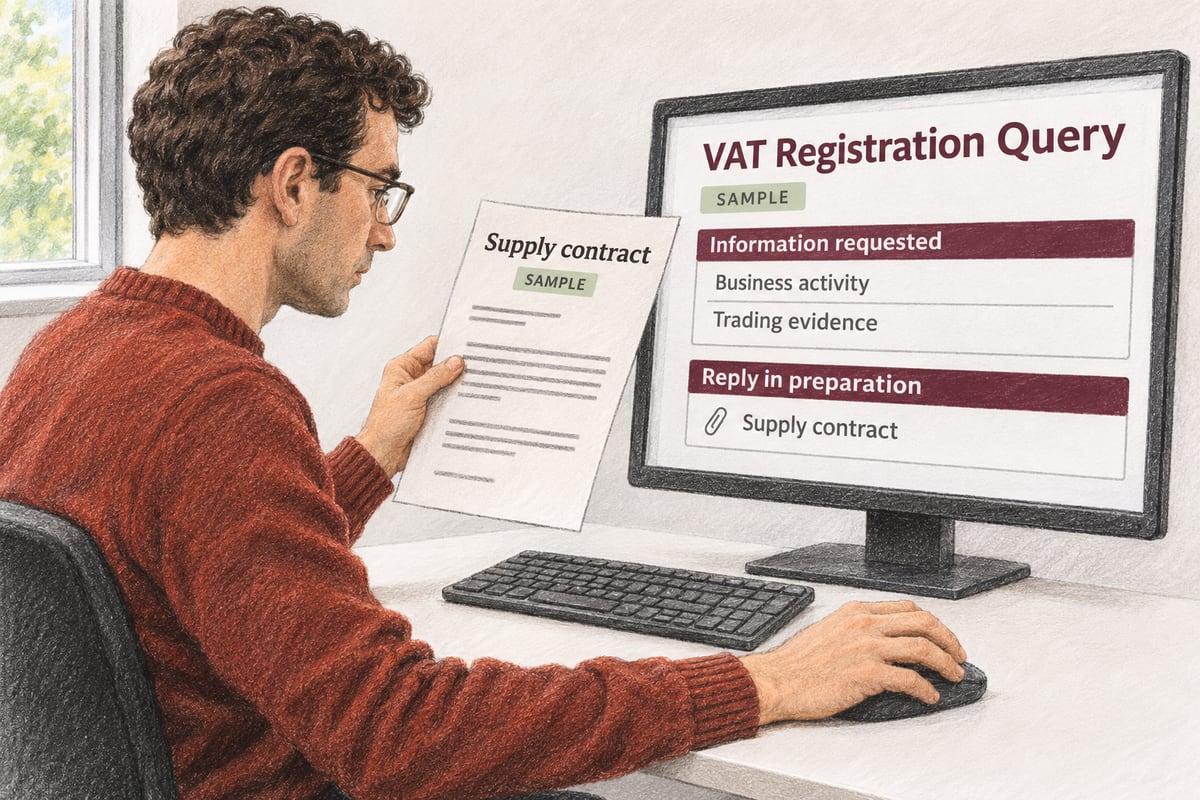
Your Irish company's VAT application has not produced the result you expected. Revenue has asked for more information, returned a form or issued a refusal. A customer is asking for a VAT number and the temptation is to submit everything again. First establish what has actually happened.
This guide helps directors prepare an organised handover to a tax adviser and distinguish a registration query from a decision requiring urgent attention. It is not an appeal template or a conclusion that your company qualifies. The right response depends on the actual notice, activities, evidence and dates.
1. Identify the status before choosing the next step
Keep the original message, attachments, application reference and date together. Ask the person who submitted the application for its final submitted version and any later correspondence. A founder's summary that Revenue rejected us may describe an information request rather than a refusal.
Revenue's VAT-registration manual distinguishes requests for missing particulars from disallowed applications and explains a right of appeal against refusal. Use the actual correspondence to establish which process you are in, not the tone of a supplier's email.
The table is a triage aid, not a substitute for reading the decision. If the status remains unclear, ask the adviser or Revenue to clarify it promptly while identifying any stated deadline.
| What you have | First action |
|---|---|
| Information request | List the questions, reply date and evidence needed. |
| Returned application | Identify the omitted particulars or required submission route. |
| Formal refusal | Read the reasons and obtain immediate advice on appeal rights. |
| Supplier or VIES error | Check the issued registration and validation result separately. |
2. Protect a refusal deadline before assembling a perfect folder
Revenue's VAT-appeals guidance identifies refusal to treat a person as an accountable person among appealable matters. It directs appeals to the Tax Appeals Commission, or TAC, within 30 days after the date on the relevant Revenue letter or decision notification. This is not a general 30-day response rule for every information query.
Read the appeal instructions on your own notice immediately. Do not count casually from the day you opened the post or forwarded it to an accountant. Ask a qualified adviser to confirm the applicable deadline and what must be submitted.
A request asking Revenue to reconsider, a service enquiry and a fresh registration application are different from a Notice of Appeal to the TAC. Do not assume any of them preserves appeal rights. If an adviser is being appointed, explicitly agree who is responsible for the deadline.
The TAC's guidance describes conditional acceptance of late appeals. It is not an automatic extension or a reason to delay. If time has already passed, seek advice immediately and preserve the facts explaining the delay; do not alter dates or assume that a new application removes the earlier decision.
3. Turn an information query into a question-and-evidence list
For a query rather than a refusal, copy each question into an issue list. Beside it, record the factual answer, supporting file, person responsible and any gap. This makes it easier to see whether the reply addresses the request rather than merely attaching a large bundle.
The registration manual's sample query covers missing particulars such as business activity, company details, dates and signatures. Its supporting-document section gives examples including contracts, existing invoices and evidence concerning premises. These are examples, not a universal requirement to produce every possible document.
Use meaningful file names and a short index. Identify which document supports which answer and distinguish a signed agreement from a quotation, an anticipated customer from a confirmed order, and actual turnover from a forecast.
If something is unavailable, explain the gap and ask what relevant alternative can be considered. Do not invent a customer, create a sale that never happened, backdate a contract or describe another group's company records as your applicant's own evidence.
4. Explain the actual activity, not just the company's existence
Describe what the company supplies, who buys it and where the relevant activity occurs. A useful explanation lets the adviser understand the transaction model: for example, a proposed consultancy service is different from buying goods for resale or making an exempt supply.
Revenue's public guidance ties registration to accountable-person status and addresses exempt and non-taxable activities, with special cases for certain cross-border purchases. An incorporation certificate does not answer all those VAT questions. The existing first-registration guide explains the broader eligibility assessment.
Where trading has not started, say so. Revenue's manual recognises intention-to-trade applications supported by satisfactory evidence. Give the adviser the genuine preparation undertaken and distinguish it from hoped-for future activity. Do not manufacture invoices to make the business appear operational.
For a premises question, explain the real arrangement. Separate the registered office, correspondence address and place where work is carried on. Do not describe an address-forwarding service as rented operating premises or a provider's staff as your company's employees.
5. Check whether the query concerns Intra-EU status
Revenue distinguishes Domestic-only and Intra-EU VAT registration. Its two-tier guidance asks Intra-EU applicants for extra information about customers, suppliers, supply arrangements, turnover and evidence of EU trade or substantive intention to trade.
Check what was requested in the original application and what has actually been approved. A pending Intra-EU request is not proof that there is no domestic registration, while domestic status is not evidence that the additional status has been accepted.
Explain the proposed EU transactions accurately, including whether they concern goods or services. Ask the adviser which questions are relevant to that model rather than copying a transport description from a different business.
If the immediate problem is an invalid VIES check or a supplier account rejecting the number, use the separate VIES troubleshooting guide. Repeatedly opening a new registration request may not address the validation issue.
6. Reply through the instructed channel and retain submission evidence
Follow the response instructions in the verified correspondence. Revenue's MyEnquiries service supports secure correspondence and tracking; businesses with a ROS digital certificate access it through ROS, and agents use their agent access. Do not assume every initial application or exceptional paper case uses the same route.
Verify unexpected messages through official channels before supplying private documents. Revenue warns against phishing and advises using secure communication for confidential information. Do not send ROS passwords, certificates or authentication codes in a reply or general website enquiry.
Before sending, reconcile the answers with the submitted application. If a date or activity changed, explain the change instead of silently presenting a different story. Check that attachments open, are legible and belong to the correct company.
Keep the sent reply, its attachments and the acknowledgement together. A draft approved by the director is not the same as a submitted response. Where an adviser handles delivery, ask who monitors follow-up and what evidence of submission you will receive.
7. For a refusal, assess the reasons before deciding to reapply
Read the reasons alongside the original application and evidence. Ask the adviser whether the issue is missing information, the legal basis for registration, the actual activity, the requested status or another stated reason. Do not assume every refusal can be fixed by adding more attachments.
Deciding whether to challenge the existing decision, provide further information or make a later application is company-specific advice. A later application based on different facts is not the same thing as appealing the original decision, and it should not be treated as protecting the original appeal deadline.
If an appeal is appropriate, the TAC's Notice of Appeal guidance calls for the relevant decision and grounds explaining the disagreement. Grounds matter; a generic statement that you need a VAT number for a customer does not explain why the decision is wrong.
Agree the professional role explicitly. Registration assistance does not automatically include legal analysis, appeal drafting, representation or conducting a hearing. Do not assume an ordinary contact form sends anything to the TAC or appoints an adviser to act.
8. Keep invoice treatment and the effective date under review
A pending application does not, by itself, decide whether VAT is due on a particular transaction. Revenue's registration guidance links obligations to accountable-person status, while the effective registration date needs its own review. Give the accountant the actual transactions and dates rather than asking for a blanket permission to invoice.
Revenue says registration generally takes effect from the date stated on the application and that backdating may be agreed in certain circumstances. For an election to register, the effective date cannot precede the beginning of the taxable period in which the application is made. Do not promise yourself unrestricted backdating.
Never invent a VAT number or borrow a related company's number to satisfy a customer or platform. Ask for advice on the correct documents, pricing, records and any corrections needed while the application is unresolved.
When a result arrives, check its contents and effective date against the invoice history. Arrange any required ongoing returns separately. Getting a decision does not automatically complete bookkeeping, earlier invoice corrections or future VAT filing work.
9. Example: the same delayed launch, two different responses
Imagine a fictional Irish consultancy has applied before its first project begins. Revenue asks for a clearer activity explanation and supporting evidence. The director prepares a factual reply with the relevant agreement and launch details, identifies that no sales have yet occurred and has the adviser check it against the submitted application.
Now imagine the correspondence instead expressly refuses registration and includes appeal instructions. The immediate priority changes: the director gets the dated decision reviewed and assigns responsibility for the appeal question before waiting for further paperwork. Sending the same evidence to a general Revenue inbox is not assumed to be an appeal.
Neither example promises acceptance. The distinction is procedural: answer the actual request, or assess the actual decision and deadline. Do not let a customer launch date pressure you into false trading claims or treating every unresolved application as an administrative delay.
10. Arrange support for the work you actually need
StartCompany.ie's Tax Services page describes VAT registration, advice, returns and Revenue correspondence support through the relevant professional service. Explain whether the company has an unanswered query, a formal refusal, an existing domestic registration or a separate VIES problem.
Ask which review can be provided, whether any specialist appeal adviser is needed and who will make each submission. Confirm availability, deliverables and the total payable before commissioning work. Do not assume appeal preparation or representation is included in standard registration support.
Use the checklist to prepare a first discussion without putting confidential documents into a general enquiry. State the type of correspondence and any approaching deadline, then agree how the detailed file should be supplied securely.
If a deadline is close, do not wait for a routine website reply as your only action. Seek prompt qualified advice and use the official appeal guidance. A service purchase cannot grant Revenue approval or extend a statutory time limit.
- Save the full request or refusal, its date, attachments and reference.
- Identify the reply deadline and any separate appeal deadline immediately.
- Obtain the submitted application and all previous correspondence.
- Map each question or refusal reason to the actual facts and evidence.
- Distinguish confirmed trade, genuine preparations and forecasts.
- Confirm the requested and approved Domestic-only or Intra-EU status.
- Assign responsibility for secure delivery, acknowledgements and follow-up.
- Agree review scope, any separate appeal work and the total payable.
StartCompany.ie service
Tax Services in Ireland
Official information and next steps
Official sources were checked on 2 November 2026, including Revenue's VAT-registration manual last updated May 2026 and current TAC guidance. This is general preparation guidance, not a decision on entitlement, an appeal template or deadline calculation for your notice. Obtain company-specific tax or legal advice promptly where needed.
- Revenue: VAT-registration manual, queries, evidence and refusals
- Revenue: VAT appeal rights and the 30-day time limit
- Tax Appeals Commission: Notice of Appeal and late appeals
- Revenue: Domestic-only and Intra-EU VAT registration
- Revenue: registration routes and effective dates
- Revenue: MyEnquiries access and correspondence status
- Revenue: secure communication and phishing precautions
- Revenue: who needs VAT registration, including new businesses