
A company number is useful when you are arranging supplier contracts, banking and a travel website. It is not permission to begin selling holidays. Before spending money on the booking engine, work out exactly what the proposed company will sell and which protection must be in place for those sales.
That decision is more specific than 'we are an online travel agency'. Selling flight-only travel from Ireland, assembling a package and retailing another organiser's product can lead to different requirements. The place where the business is established also matters.
This guide is a formation and launch-preparation checklist, checked against current CRO and Irish Aviation Authority guidance on 19 November 2026. StartCompany.ie can help with Irish company formation; it does not provide travel-trade licensing or arrange customer insolvency protection.
Describe one real booking before choosing the company setup
Start with a sample transaction, not the name you want on the shopfront. Who contracts with the traveller? Who combines the services? Where does transport begin? Who collects the deposit, pays suppliers and owes the customer a refund if something fails?
Write down whether the company is selling travel only, organising packages, retailing packages supplied by somebody else or facilitating linked travel arrangements. An attractive website can perform several of those roles, so the label 'agent' is not enough to classify the entire business.
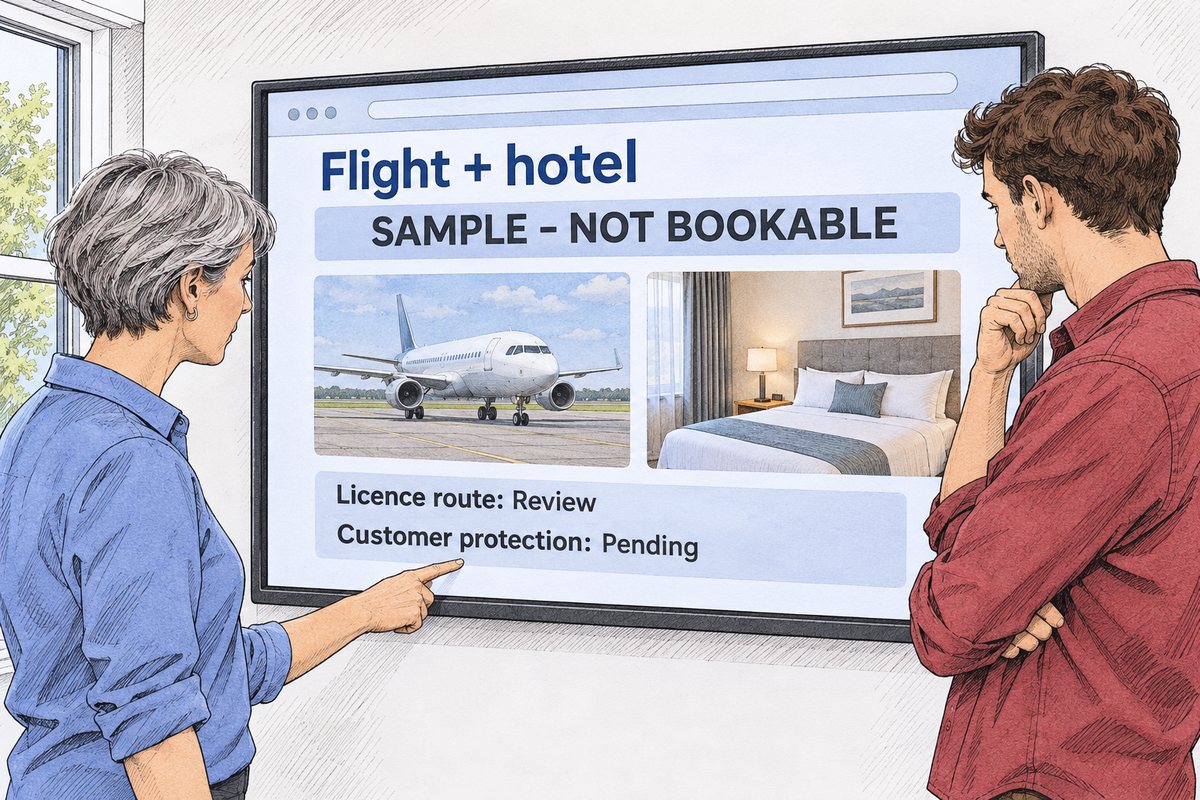
Prepare a simple money-flow sketch and a draft offer showing the services and contracting parties. Keep it internal and unbookable while the route is unresolved. That gives the IAA, adviser and insurer something concrete to assess instead of asking each to interpret a different description.
Check the current IAA route rather than assuming one licence covers everything
The IAA's Irish-established-business guidance says travel-only sales commencing in Ireland must be licensed. It describes a choice for certain package-organising business commencing in Ireland: licensing under the 1982 Act or the applicable alternative insolvency-protection arrangements.
It also distinguishes packages and linked travel arrangements outside the licence's coverage. A business holding a licence can still need additional protection for other sales. On the IAA's current protection page, full indemnity insurance is the accepted route for the specified package and linked-arrangement business under the 1995 Act, pending new bonding regulations.
Have the IAA confirm your proposed mix, including retailer versus organiser roles and departure points. Do not infer that domestic trips, online-only sales or customer payments made abroad remove every obligation. Equally, do not buy the wrong licence on the assumption that every travel-related service is treated identically.
Keep the company bond and travel protection in separate budget lines
The phrase 'we need a bond' can cause an expensive misunderstanding. For an Irish company without an EEA-resident director, a Section 137 bond is a company-law route addressing specified company liabilities. It is not an arrangement to refund holidaymakers or bring them home following business insolvency.
An LTD can have one director, but that sole director cannot also be its company secretary. Check the actual director-residence position and statutory alternatives when selecting a formation route. Buying an annual secretary appointment does not supply an EEA-resident director.
The comparison below is a planning aid, not a statement that every applicant needs every item. Obtain separate written confirmation of what each arrangement covers, its duration and its cost.
| Arrangement | Question it answers |
|---|---|
| Irish LTD incorporation | Has the company been formed with its constitution, officers and shares? |
| Section 137 director bond | Is the relevant company-law director-residence alternative in place? |
| Travel-trade licence | Is the particular licensable activity authorised for the stated period? |
| Travel insolvency protection | Which customer sales and exposure are covered by the accepted bond or insurance? |
Build the LTD around the proposed business, not around a licence assumption
CRO formation uses Form A1 and an LTD constitution. The filing identifies the proposed name, registered office, directors and secretary, their consents, subscribers and shares, together with the activity declaration. Agree those facts before asking a provider to prepare the documents.
Choose a name and activity description that accurately represent the proposed business, but do not treat name acceptance or a NACE classification as IAA approval. Make sure the company intended to contract with travellers is the same entity being considered by the regulator, suppliers and protection provider.
Provide an accurate ownership and management outline, particularly where founders live abroad or a foreign company will hold shares. Avoid opening supplier or payment accounts in one entity's name while planning to sell through another. Later changes can require fresh review by several counterparties.
A registered office does not decide where the travel business is established
The company needs a registered office in Ireland. That statutory address is a separate question from the travel business's actual operating and establishment facts. A mail-handling purchase is not, by itself, proof of a staffed travel office, local management or regulatory eligibility.
The IAA publishes different routes for businesses established in Ireland, elsewhere in the EU and outside the EU. If the founder, booking staff or operational management will be abroad, describe that arrangement to the IAA before relying on the Irish-established route.
Record where decisions, customer support and supplier contracting will happen, and who can access the company's records. Ask what evidence the authority needs for the actual setup. There is no universal minimum-staff number or approved-address promise in this article.
Use only an address allocated and confirmed for your company. Where a registered-office service is relevant, confirm its permitted use, partner details and mail terms separately from any workspace or travel-regulatory requirement.
Speak to the IAA before registering as a new portal applicant
The IAA currently requires a pre-application meeting for a new Travel Agent or Tour Operator licence to understand the business and explain the requirements. It says a full application pack is supplied if the proposed company meets the necessary licensing requirements.
Its current portal page tells first-time applicants to contact the Travel Trade Licensing Team before registering. Applications go through the portal, and the organisation must be registered and approved by the IAA before using the relevant services. Do not use an older downloaded form as your only guide to the current process.
Send a concise outline through the authority's published contact route: proposed company, establishment facts, sales model, departure points and expected timing. Ask which supporting material and regulatory pathway apply. StartCompany.ie is not submitting that enquiry or application as part of an ordinary formation order.
Keep the response and application instructions with the company project file. A portal account, submitted application or encouraging meeting is not an issued licence or confirmation that the necessary protection is operative.
Plan finance and customer exposure before setting a launch date
Section 6 of the 1982 Act addresses the applicant's financial, business and organisational resources and its fitness and suitability. A Certificate of Incorporation does not establish those matters. Prepare realistic forecasts and explain the experience and controls behind the proposed operation.
Budget separately for company formation, applicable IAA application fees, protection premiums or other security arrangements, professional advice and working capital. Use the current IAA fee schedule and an actual protection quotation; do not assume a company-formation total includes either.
Ask the IAA how to calculate projected licensable turnover for each activity. Do not substitute the founder's expected commission margin without checking the required basis. Separately model deposits held, balances due, supplier payments, cancellations and peak-season exposure.
For a small launch, test a lower-volume scenario and a delayed-launch scenario. Supplier commitments and software charges may begin before lawful sales can. A limited initial budget makes the sequence more important, not the regulatory assessment optional.
Two launch examples worth discussing before spending on the website
Example one is a fictional founder proposing to sell flight-only travel departing Ireland. The founder has selected an LTD formation package and, because no director is EEA-resident, a Section 137 route. That company bond does not address the separate travel-only licensing and customer-protection work. The founder should identify those workstreams before promising a first booking date.
Example two is a fictional business assembling flight-and-hotel packages, with departures both from Ireland and from another EU country. Its team should not assume one Irish licence and one quoted protection amount cover the whole website. They need the actual product and departure mix reviewed, including the applicable alternative protection route and sales outside any licence.
These examples do not decide whether either application would succeed. Their practical purpose is to keep the incorporation instruction, regulatory classification, customer-money exposure and website launch tied to the same business description.
Make the website wait for the readiness decision
The IAA warns against unlicensed trading where a licence is required and against operating without the required insolvency protection. Keep the public launch conditional on the route applicable to the actual business, not merely on receiving the CRO certificate.
During preparation, test offers and payment flows internally with synthetic details and no live customer charges. Have the relevant advisers review booking terms, the seller's identity, package information, cancellations and complaints. A working payment button is not a regulatory sign-off.
Plan ongoing responsibilities too. IAA licences generally run for 12 months from the May or November licensing cycle, and the authority identifies continuing financial monitoring and regulatory deadlines. Confirm the period and timetable for your own application; do not promise a start date by counting days from incorporation.
A handover checklist for the founder and formation provider
Before ordering, decide which person owns each task. Keep the company setup specific and the specialist work visible, rather than describing the project as a single travel-business package.
- Prepare a sample transaction showing seller, organiser, services and departure point.
- Explain where the business is established and where its team will operate.
- Ask the IAA to confirm the regulatory route for the proposed sales mix.
- Agree the LTD's name, officers, ownership, registered office and identity records.
- Separate any Section 137 director bond from customer insolvency protection.
- Obtain current licensing, protection and professional-advice costs separately.
- Keep live bookings disabled until the applicable requirements are met.
- Assign company compliance, regulatory monitoring, renewals and records to named owners.
What to ask StartCompany.ie to do
Use our existing company-formation packages for the incorporation work, comparing their current inclusions and total payable. Explain that the proposed activity is a travel business and describe the founder, director and shareholder arrangement before selecting the route.
StartCompany.ie does not provide IAA licence applications, travel insolvency insurance or specialist travel-law advice. A formation package is not a travel-business launch approval. Where a director bond, registered office or secretary service is relevant, confirm the exact package or separate engagement rather than assuming every item is included.
Company formation also does not guarantee tax treatment, banking acceptance or immigration permission. Arrange the relevant tax registrations, accounts, beneficial-ownership and annual-return responsibilities, and confirm any specialist support separately.
A useful first enquiry is short: what you plan to sell, where the company will operate, where its directors live and whether the IAA route has been discussed. That lets us clarify the company-formation request without presenting incorporation as the solution to a separate licensing question.
StartCompany.ie service
Company Formation
Official information and next steps
Official CRO, IAA and revised legislation checked on 19 November 2026. The IAA's current transaction-specific guidance and portal instructions take precedence over older process summaries. This is a formation-planning guide, not a determination of establishment, licence entitlement, protection adequacy or specialist travel-law compliance.
- IAA: Irish-established businesses and the different sales routes
- IAA: new-applicant meeting, licensing periods and monitoring
- IAA: current portal and first-applicant instructions
- IAA: licensable turnover, transaction categories and application fees
- IAA: bonding and insolvency protection for different sales
- 1982 Act, section 6: resources and suitability for a licence
- CRO: Form A1, constitution and company setup
- CRO: officers, EEA residence and the Section 137 bond
- CRO: the registered-office requirement
- IAA: travel licensing and insolvency-protection obligations