
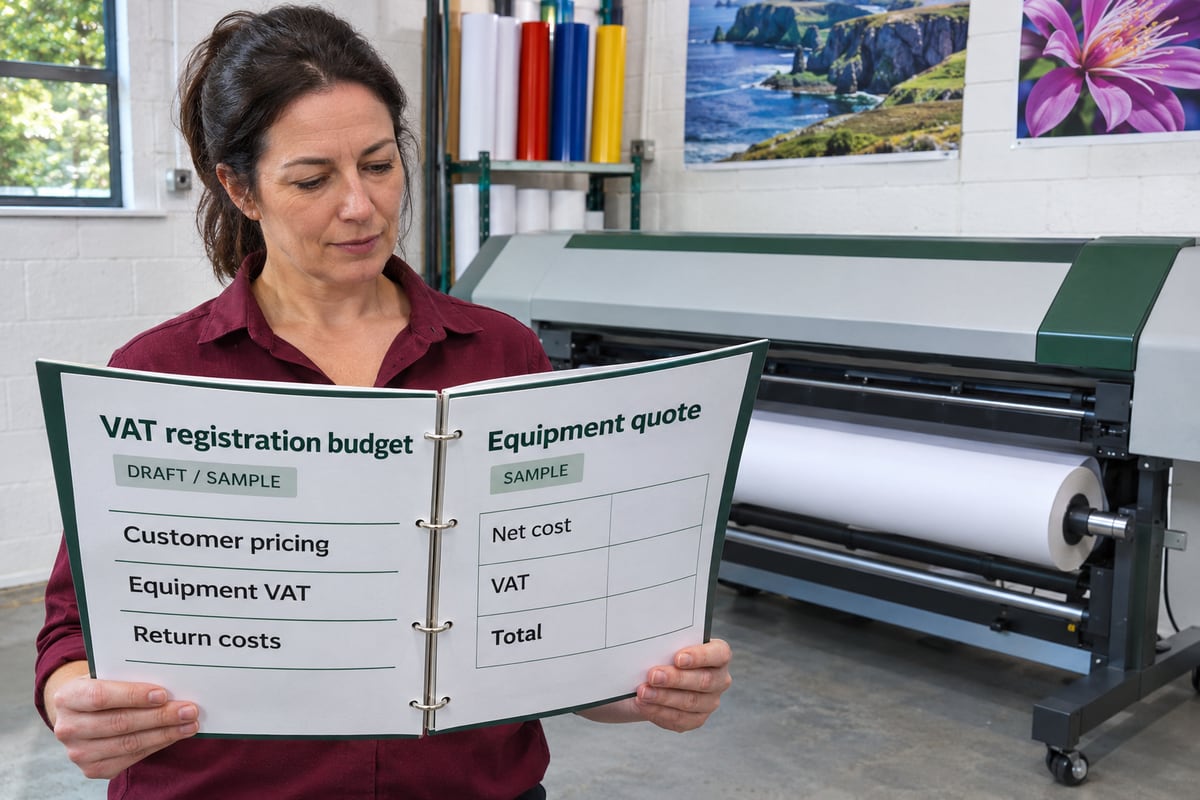
Your new Irish LTD is below the VAT threshold, but you are about to buy equipment or quote your first customers. Should you register now to recover eligible VAT, or wait? That is a commercial decision as well as a registration question: a refund on one purchase can be outweighed by the effect on selling prices and ongoing administration.
This guide focuses on an Irish-established LTD considering ordinary voluntary registration. It is not a substitute for checking whether registration is already compulsory, whether the supplies are exempt, or whether cross-border rules apply. Use it to prepare a decision brief for a tax adviser before instructing an application.
1. Check that registration really is optional
Revenue's principal thresholds are EUR42,500 for services-only businesses and EUR85,000 for goods businesses, with specific rules for mixed supplies and goods produced from zero-rated materials. Its current guidance measures annual turnover excluding VAT in a calendar year. Do not substitute profit, bank receipts or a remembered rolling-year test for the applicable calculation.
Being below a domestic threshold does not settle every transaction. Overseas services, EU goods acquisitions and other cross-border activity can create separate obligations. Identify what the company buys as well as what it sells. A small domestic turnover is not permission to ignore foreign software, advertising or stock purchases.
Prepare a simple turnover schedule by activity and customer location. Mark amounts already earned separately from forecasts, and ask the adviser which transactions belong in the threshold calculation. If registration is required, the question becomes how to comply and from what date, not whether the marketing benefits seem worthwhile.
2. Compare the customer price, not just the VAT refund
The customer mix often determines whether opting in is commercially workable. A customer entitled to full input VAT recovery may assess a quote differently from a consumer or exempt business that bears the tax as a cost. Do not assume every business customer can recover VAT simply because it has a company name.
Build two forecasts using the same expected sales volume: one without voluntary registration and one with it. For the registered forecast, decide whether quoted customer totals increase or whether the company absorbs the tax within an unchanged total. Then compare the resulting sales revenue, eligible purchase credits and additional compliance costs.
The comparison below is a planning aid, not a rule that one customer type should always register. Contract terms, rates, competitive pricing and the company's actual entitlement need separate review. A forecast is useful precisely because it makes those assumptions visible before the first invoice.
| Business position | Decision to test |
|---|---|
| Mostly fully taxable business customers | Can customers recover the VAT, and will they accept a revised quote? |
| Mostly consumers or exempt customers | Will a higher total reduce demand, or must the business absorb the tax? |
| Large planned equipment purchase | How much VAT is actually eligible, and what happens in later years? |
| Little VAT-bearing expenditure | What benefit remains after return preparation and administration? |
3. Worked example: keeping the same customer total
Suppose a fictional company sells a standard-rated service for a customer total of EUR123. The examples use the current 23% standard rate; the correct rate for a real supply must be checked. They are hypothetical trading calculations, not StartCompany.ie package or service prices.
Without VAT registration, that EUR123 is sales revenue before other costs. If the registered company keeps the customer total at EUR123, the split is EUR100 revenue and EUR23 output VAT. If it instead preserves EUR123 revenue, the customer total becomes EUR151.29. Neither option makes the price effect disappear.
Across 100 identical sales, keeping the original total means EUR2,300 less sales revenue before considering purchase VAT recovery and other costs. If eligible purchase credits were only EUR500 over the same period, those credits alone would not offset the pricing effect. This illustration ignores other taxes, demand changes and timing; it is not a forecast of the company's profit.
Now change the assumptions. If all customers accept the higher total and can recover the VAT, the comparison may look very different. Write down what the customers have actually agreed, rather than treating a hoped-for price increase as secured revenue. Test a slower-sales case as well as the optimistic forecast.
4. Check the equipment purchase line by line
A large equipment quote can make voluntary registration worth investigating, but the VAT shown is not automatically a recoverable amount. Recovery generally depends on taxable business use and valid evidence. Exempt or private use can restrict it, and specific exclusions include entertainment and many passenger-vehicle costs.
For example, a fictional printer quote of EUR10,000 net and EUR2,300 VAT creates a EUR12,300 supplier payment. Assuming full eligibility and the correct timing, the VAT may be claimed through the VAT3 process. The company still needs to fund the supplier payment and should not schedule an essential bill around an unconfirmed repayment date.
Obtain the quote before ordering and ask the adviser to review the actual asset, purchaser, intended use and documentation. A quote helps planning but is not itself a valid purchase invoice for a recovery claim. Keep VAT recovery separate from Corporation Tax deductions and capital allowances; buying an asset does not turn its whole cost into an immediate trading-expense deduction.
5. Agree the effective date before committing to a timetable
Revenue permits registration before taxable sales begin where a genuine intended business is demonstrated. Contracts, premises arrangements and tools of the trade can support that intention. An incorporated shell and an attractive refund calculation are not substitutes for evidence of the planned taxable activity.
For an election, Revenue states that the effective date cannot be earlier than the beginning of the taxable period in which the application is made. Do not assume a voluntary application can be backdated to any convenient purchase date. Have pre-registration expenditure and invoice timing reviewed rather than treating every earlier cost as automatically lost or automatically recoverable.
Plan the application, supplier order, customer quotes and bookkeeping setup together. If approval is pending, obtain transaction-specific advice about the intended effective date and invoicing treatment. Do not invent a VAT number or present an application as a confirmed registration. Preserve the decision and Revenue correspondence so the person preparing the first return can follow what happened.
6. Budget for returns even when sales are quiet
Voluntary registration is not a one-off refund application. Revenue normally uses two-month VAT periods, although other authorised arrangements exist. Registered traders also have an annual Return of Trading Details. Confirm who prepares, reviews and submits each return, what records they need and what their work will cost.
A period with no VAT payable or repayable still requires the relevant VAT3 return; Revenue instructs zero entries at T1 to T4 in that situation. Do not silently stop filing because sales have paused. The VAT3 and annual RTD are separate tasks, and a zero payment is not evidence that all returns are complete.
Set aside output VAT rather than treating the entire customer payment as available spending money. Reconcile the sales and purchase records regularly. Ask for a realistic recurring-work quote before opting in, including how corrections, overseas transactions or missing invoices would be handled. Application support should not be assumed to include unlimited future return preparation.
7. Consider the exit before claiming a large initial refund
Cancelling an election can involve a clawback. Revenue reviews the shorter of the period the election operated and the three years before the cancellation application. Its calculation includes refunds, deductible intra-Community acquisition tax and net tax paid. Do not assume cancelling later simply preserves every earlier repayment.
Ask the adviser to model a second scenario in which the planned trade is much smaller than expected or stops. Keep refund and payment records so that any cancellation calculation can be reconstructed. Property, stock and asset adjustments can require further specialist review; this guide is not a full cessation calculation.
The practical lesson is to compare more than the first equipment invoice. A front-loaded refund and weak later sales can produce a different outcome from a steady taxable business. Record what would trigger a review of the registration and who will obtain advice before any cancellation request.
8. Separate Irish registration from EU SME choices
Revenue's EU VAT SME Scheme is a separate cross-border option with eligibility conditions, an application and quarterly reporting. It is not automatically activated by staying below an Irish threshold. An Irish business may still elect to register for its domestic transactions; assess the actual transaction model before choosing a route.
Tell the adviser about overseas suppliers, EU business customers, consumer sales, stock locations and expected expansion. This article's domestic price example is deliberately simple and does not decide reverse charge, OSS, foreign registration or intra-EU status. Do not use a voluntary domestic VAT number as a universal answer to every platform's onboarding question.
9. Prepare a decision brief before applying
One clear brief is more useful than collecting documents without explaining the business. Give the adviser the assumptions behind the forecast, identify unanswered questions and agree whether suitability advice or application preparation is the immediate next step. The following checklist is preparation, not Revenue's exhaustive evidence list.
- List each supply, its proposed VAT treatment and where customers are located.
- Prepare current calendar-year turnover and a separate realistic sales forecast.
- Identify customers who can recover VAT and those who bear it as a final cost.
- Compare unchanged customer totals with revised totals and document contract assumptions.
- Attach planned equipment quotes and identify actual invoices already received.
- Separate eligible, restricted, exempt-use and private-use purchase costs for review.
- Agree the proposed effective date, evidence, filing responsibilities and recurring costs.
- Model a weaker-trading case and ask about cancellation consequences before opting in.
10. Choose advice and registration support in the right order
If the numbers are unclear, request a suitability review before instructing a voluntary election. StartCompany.ie's Tax Registration service supports the relevant Revenue registrations and remains subject to Revenue review. Check the current service page for the total payable and confirm the exact work before ordering.
A registration order does not automatically include a profitability assessment, equipment-purchase advice, ongoing VAT3 or RTD preparation, or a later cancellation calculation. Agree those items separately where needed. An existing LTD can seek registration support; a founder who has not incorporated should first arrange formation and keep the new company's transactions distinct from personal or sole-trader purchases.
Use the linked general registration guide for the application process, the pre-trading guide for earlier expenditure and the cancellation guide for an exit review. The decision to opt in should be based on the company's actual trade and a workable compliance plan, not on an assumed credibility boost or a promised refund.
StartCompany.ie service
Tax Registration
Official information and next steps
Checked against the Revenue sources below on 5 November 2026. Thresholds, tax treatment and registration routes can change. The examples are original hypothetical calculations, not quotations or individual tax advice; have the company's activity, purchases and dates assessed before acting.
- Revenue: VAT thresholds and calendar-year turnover
- Revenue: other VAT thresholds
- Revenue: who needs to register and new-business costs
- Revenue: current VAT rates
- Revenue: who can reclaim VAT and restrictions
- Revenue: business deductions and capital expenditure
- Revenue: VAT registration route and effective dates
- Revenue: Guidelines for VAT Registration, updated May 2026
- Revenue: taxable periods and annual RTD
- Revenue: completing VAT3, including zero amounts
- Revenue: cancellation by elected persons
- Revenue: EU VAT SME Scheme