
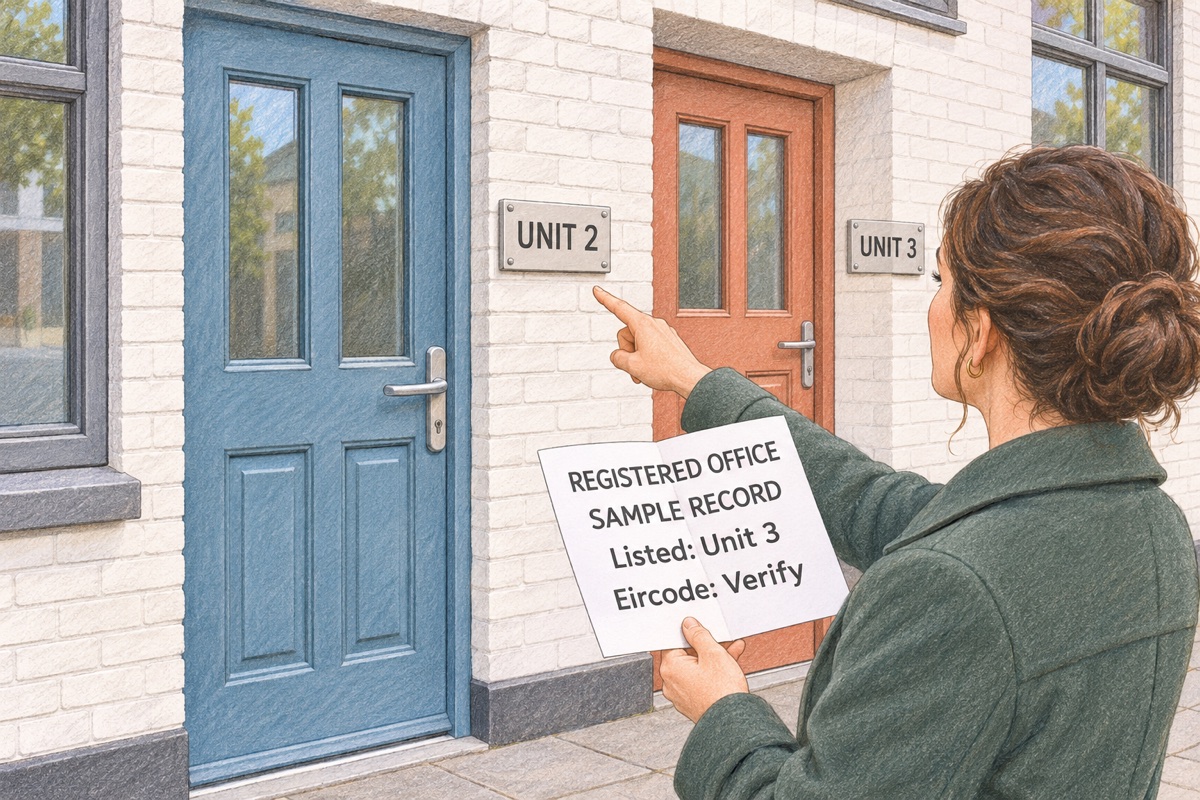
The CRO record says Unit 3. Your provider's written confirmation says Unit 2. Both are in the same building, but you would send a letter to a different door depending on which version you read. The first question is not which address looks better on a form. It is which physical place is actually your company's registered office, and whether that place has changed.
This guide is for directors of an Irish LTD checking a confusing registered-office address before or after a filing. It distinguishes postal formatting, an error on the CRO record and a genuine change of location. It does not advise on whether particular court papers were validly served or how to remove an address from historical documents. Official sources were checked on 22 November 2026.
Find where the mismatch started
Search the company by CRO number in CORE and save the current registered-office entry. Compare it with the address on the most recent registered A1 or B2, if available. A draft, order confirmation or internal contact list is not evidence of the active CRO record. Check that you are looking at the right legal entity, especially if two group companies share a building or use similar names.
Get the exact address in writing from the person responsible for the premises. Check the unit, entrance, floor if relevant, building, locality, post town and Eircode. For a provider address, ask which company is authorised to use it and from what date, and whether the office is formally in the care of an approved Registered Office Agent. The property search will not tell you whether your particular company can use that address.
Look up the Eircode and also search for the premises in Eircode Finder. Eircode says the same location can have different geographic and postal descriptions. A shorter locality name or a different post-town line is not by itself proof of an error. A code that resolves to a neighbouring unit, or a unit number that takes a visitor to a different entrance, deserves a closer check. A property having an Eircode is not evidence that it can receive legal documents on your company's behalf.
Decide whether it is the same office, a wrong entry or a move
Ask whether a visitor carrying an important letter can find the correct physical location using the current record, not just whether the building appears in a map search. CRO requires a physical location in the State, not merely a PO box. A single reception may serve several units, or separate entrances may route mail differently. Confirm which applies rather than assuming a shared street address makes the unit immaterial.
Suppose a fictional design company has always used Unit 2 and finds Unit 3 on its original filing. That is a potential filing error, not a reason to invent a move from Unit 3 to Unit 2. If the company did in fact leave Unit 3 and start using Unit 2 as its registered office, record the actual change and handle it as such, even if the street and building name are unchanged. In a third case, if CORE and the provider agree on Unit 2 and only a supplier template shows Unit 3, correct the template rather than submitting a company change to fix an outside record.
| What you found | Next step |
|---|---|
| Postal wording differs, same confirmed place | Compare the full address and Eircode before treating it as a move. |
| CRO lists the wrong unit; the office never moved | Send CRO the discrepancy and the filing reference; ask what it accepts. |
| The company actually moved its registered office | Prepare Form B2 for the actual change and verify registration. |
| Only a supplier or internal template is wrong | Fix that record; check CORE before ordering a filing. |
If you have not moved, identify the filing status first
If the address is on an unsent draft, correct the full address with the presenter before submission. If a filing is pending or has been returned with a query, contact the presenter and follow the CRO instructions for that submission. Do not create a second filing in the hope that it will override the first. Save the submission reference and the message describing the issue.
If the error is on a registered document, send CRO the company number, the form and reference, the address as filed, the confirmed address and a short explanation that the premises have not changed. Ask which procedure CRO accepts for the specific discrepancy. CRO's rectification guidance sets limits on amending or removing registered filings, and says a replacement A1 cannot be filed in place of the one on which incorporation was granted. A later correction to the current record is not a promise to erase the original filing.
If the building is new and the exact unit does not appear in Eircode Finder, don't use the entrance next door's code as a workaround. Ask the premises contact to confirm the postal address and ask Eircode about the missing listing. If the filing form will not accept that confirmed address, ask CRO how to proceed rather than assuming that omitting the unit or substituting a nearby code is acceptable.
If the office really moved, file B2 and follow it through
Record the company's approval, confirm the replacement address and arrange continuous access to statutory mail. Section 50 requires notice in the prescribed form within 14 days after the change, subject to section 50A. CRO identifies Form B2 on CORE and lists the filing itself as free. Professional preparation and the right to use an address are separate services. Where a formal Registered Office Agent arrangement applies, verify the approved agent's details and the company's consent rather than copying details from another entity's form.
Track the submission, respond promptly to any CRO query and check the live company record after registration. CRO says the change becomes legally effective only when it registers the form. Under section 51 a notice left at or sent by post to the registered address recorded by CRO can be treated as having been sent to the registered office even if the office has moved. A submitted B2 or provider welcome email is not registration evidence.
If mail is already missing, deal with that in parallel. Ask the current or former address provider for the dates and handling status of any letters it can identify. Where you expect a notice, contact the sender through an official channel and ask about reissue or retrieval. An address correction does not automatically extend any deadline. Get legal advice promptly if a court document or a dispute about service is involved.
Check which other address records need attention
Keep a record of the address, the date it was confirmed and the service that uses it. Revenue distinguishes the company's official address from its business address and provides separate routes in ROS. Check what Revenue actually holds and update the appropriate field where needed. Do not assume a CRO filing updates ROS, or copy a registered-office service address into a trading-address field if your business is carried on elsewhere.
Review official letterhead, invoices, website disclosures and service accounts that display or use the address. Ask banks or insurers about their own evidence requirements; a public CRO address does not prove a trading location or guarantee onboarding. Arrange a check of ordinary mail routing where practical, but don't use a test letter as evidence of legal service. Keep personal residential addresses out of notes sent more widely than necessary and don't confuse a company address change with an officer's particulars.
What to have ready before seeking help
Start with the documents that explain what happened, not a screenshot of a map on its own. If you've confirmed a real move, identify the last day you can reliably receive mail at the old office, who can deal with anything arriving later and who is checking CORE. If there was no move, bring the CRO response so any paid work is scoped to the route it identifies.
- Company name and CRO number, with the date you checked the live register.
- The previous address, the exact proposed address and the two versions side by side.
- Confirmed unit, postal wording and Eircode, or the reason a code is unavailable.
- The last relevant A1 or B2 reference, its status and any CRO correspondence.
- Written permission to use the premises, and agent details if the formal route applies.
- The actual move date if there was a move, and the person covering mail during the change.
StartCompany.ie service
Change of Registered Office
Official information and next steps
CRO, Revenue, the revised Companies Act and Eircode guidance were checked on 22 November 2026. The unit example is fictional; ask CRO to confirm the procedure for your own record.