
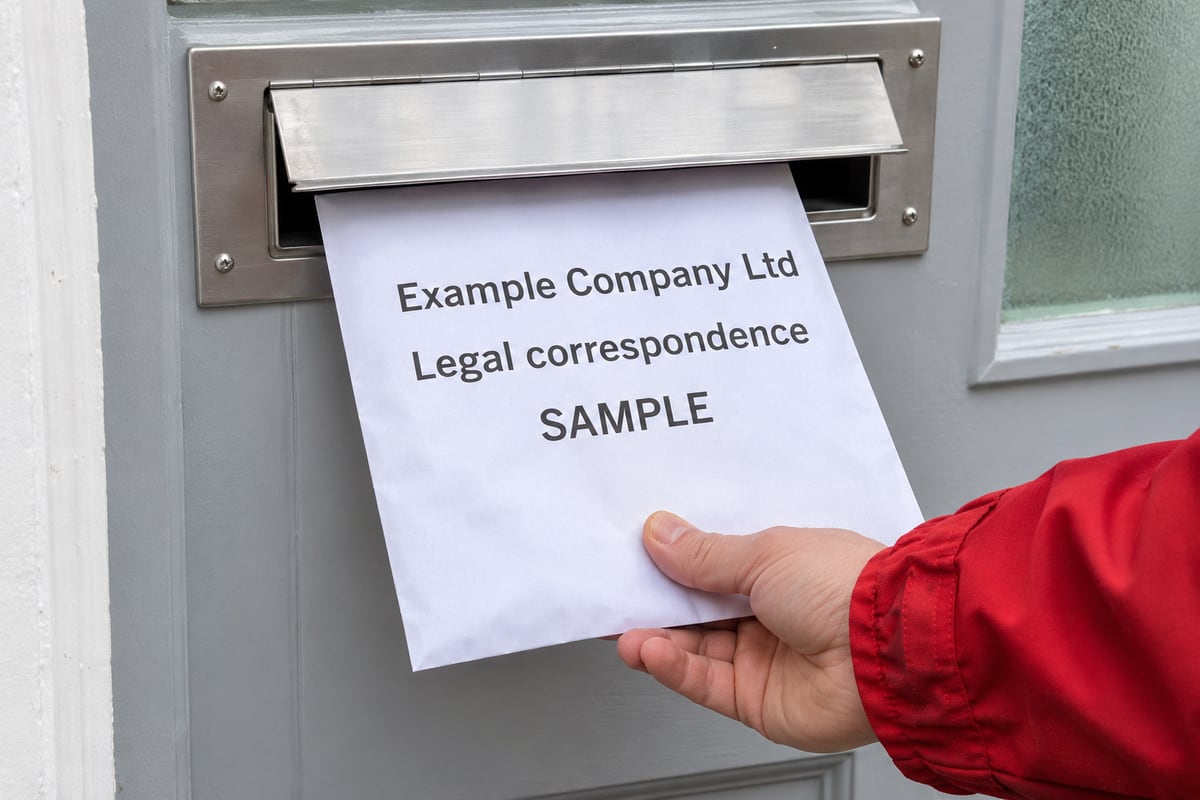
A registered office is more than the address printed on a company profile. Court papers may arrive there even when the director works elsewhere or lives overseas. Before choosing an address provider, understand both the legal role of the address and the practical route from delivery to a person who can act for the company.
This guide focuses on incoming civil court papers for an Irish company. It is not a guide to serving a claim yourself, calculating a response deadline or defending litigation. If papers have already arrived, preserve the complete material and obtain prompt advice from an Irish solicitor. Buying or changing an address service does not resolve an existing case.
1. Separate legal service from the mail-handling workflow
Section 50 requires a company to maintain a registered office in the State for communications and notices. The CRO describes a physical address that permits postal delivery and delivery by hand. A registered office can therefore be relevant to proceedings even if it is not where the company's customers, staff or directors normally work.
Receipt, notification and a legal response are different events. A provider can report what it received and when it forwarded it; that is not a determination of the legal service date or an undertaking to defend the claim. Use the distinction below when comparing services and assigning responsibilities.
| Event | What remains to be settled |
|---|---|
| Delivery at the office | Preserve the delivery facts; have a solicitor assess service. |
| Alert or scanned copy | Confirm the company has every page and has acted on the alert. |
| Instruction to a solicitor | Obtain confirmation of engagement, scope and urgent next steps. |
| Court response | Confirm the required document, recipient, deadline and evidence of completion. |
2. Do not assume every court document requires registered post
The District Court's civil service rules expressly provide for leaving a document at, or posting it to, a company's registered office. The Rules of the Superior Courts also identify service on a company in accordance with section 51. Those are important reasons not to dismiss papers simply because they arrived without a director signing for registered post.
The Courts Service's civil guidance also distinguishes ordinary post to a limited company's registered office from other methods of service. However, this does not mean every envelope is validly served in every proceeding. The relevant document, court, governing rules, any order and evidence of delivery must be assessed together.
Give the solicitor the facts rather than a conclusion that the papers do not count. Say whether the item was posted, left through a letterplate, handed to someone or received by another route, and identify what is known versus assumed. Do not ask reception staff to decide whether refusing or returning an envelope would prevent legal service.
3. Keep a chronology without inventing a new service date
Record the dates and times you actually know: delivery or collection at the office, the provider's alert, availability of a complete copy, onward dispatch and the company's acknowledgement. Preserve the original envelope and any delivery information. These facts may help an adviser investigate; they do not automatically identify the legally effective date.
Do not substitute the date you read a scan for the date of service. If there is a forwarding delay, state it accurately and obtain urgent advice about the actual response required. A support ticket or request for a clearer copy should not be treated as an extension of a court timetable.
Ask the provider to preserve relevant records while the matter is reviewed. For example, an incomplete scan and a later corrected scan should remain distinguishable. Do not overwrite the first message or retrospectively mark a delivery as occurring on a more convenient date. Good records allow the solicitor to assess the position without guessing what happened.
4. Identify the company, document and court before routing it
Check the full legal entity named, not just a familiar trading name. A group may have several companies using one address. Record the document title, court, case reference, parties and any stated hearing or response information. Keep documents addressed to an individual separate from those addressed to the company and ask the solicitor how each should be handled.
A solicitor's demand letter, a summons, a notice of motion and a judgment are not interchangeable. The Courts Service describes different originating documents and procedures in the High Court. A generic message saying legal post arrived is less useful than a complete readable pack that lets the adviser identify what requires attention.
For an unexpected document, verify contact details through an independent official source before disclosing information or paying anything. Use the Courts Service website to locate the relevant office where necessary. Court staff can provide procedural information, but they cannot select a legal strategy or draft the company's response for you.
5. Arrange a legal response, not just an email acknowledgement
An email to your address provider is not the same as entering an appearance or filing a defence. Ask an Irish solicitor to identify the procedure and confirm who is engaged to carry it out. Forwarding papers to a general inbox without acceptance of instructions leaves an important responsibility unresolved.
The Courts Service explains that judgment in default of appearance or defence can be available in specified High Court monetary claims when the relevant procedural requirements are met. It is not an automatic consequence of every missed email, but it is a reason to investigate promptly rather than assume the dispute will wait until the director returns.
There are also company-representation rules. The Courts Service states that a High Court appearance for a company may only be entered by a solicitor, except with the Court's leave. Do not assume a director or company secretary can use guidance written for an individual representing themselves. Obtain advice on the actual case and any urgent application needed; this guide provides no universal deadline or assurance of relief.
6. Send a complete, secure instruction pack
Give the solicitor all pages, schedules, attachments and the envelope, together with the delivery chronology and relevant correspondence. Explain any missing page, unreadable scan or uncertainty. Include relevant contracts, invoices or earlier exchanges if requested; do not decide that an unfavourable attachment is unnecessary and quietly omit it.
Use a verified recipient and an agreed secure channel. Court papers may contain personal details, commercial information or allegations that should not circulate across a broad company mailing list. The Data Protection Commission recommends oversight of what information is held, who can access it and how it is protected, with security appropriate to the risk.
Keep an untouched copy of what arrived and record who received the instruction pack. Ask the solicitor which originals and other records must be retained and how routine disposal should be suspended where appropriate. Do not apply an ordinary mail-shredding timetable to a live matter without checking preservation needs. A redacted working copy should not replace the complete original evidence.
7. Example: delivery on Monday, scan opened on Friday
Consider a fictional consultancy whose director works overseas. Papers are delivered to its registered office on Monday. A notification goes to an outdated contact, a corrected scan reaches the current company inbox on Thursday and the director opens it on Friday. Those are four distinct events, not four alternative dates from which the company may freely choose.
The useful response is to preserve the full pack and each message, explain the contact failure and obtain immediate legal advice. The solicitor assesses service, the applicable procedure and what can still be done. The company updates its operational contacts separately; correcting the email address does not itself answer the legal issue.
For future deliveries, the director nominates a monitored company contact and backup and agrees how urgent alerts are acknowledged. This example is a workflow comparison, not an actual client case, a statutory timetable or a promised StartCompany.ie handling speed. Avoid copying its weekday sequence into a deadline calculation for your own proceedings.
8. Changing address does not erase papers sent to the recorded office
Section 51 also addresses documents left at or posted to the address recorded by the Registrar even if the actual registered office has changed. Do not assume moving provider, cancelling a contract or buying a replacement address makes earlier delivery irrelevant. Give the solicitor both the register information and the actual handover history.
CRO identifies Form B2 for a registered-office change, with notification normally required within 14 days of the change. Online filing is free; commercial address use and paid filing assistance are separate matters. Check the recorded company address and resolve outstanding mail with the former provider instead of assuming an invoice or cancellation email completed the register update.
If papers have been delivered to the old office, ask for all held material and the factual delivery records promptly. Coordinate any new address permission and mail continuity, but keep that operational task separate from the solicitor's response to proceedings. A routine B2 filing is not a defence or an application for extra time.
9. Questions to settle before buying an address service
A service contract should explain its actual handling process. It is not a court ruling on valid service. Describe your company's circumstances, including directors abroad, and obtain answers to these practical questions before relying on an arrangement.
- Is use of the confirmed address authorised and activated for this exact company?
- What happens when court papers, solicitor correspondence or hand-delivered items arrive?
- Which contacts receive an alert, through what channel and during which service hours?
- What escalation is agreed if the main company contact does not acknowledge an urgent item?
- Are complete scans available, and who can authorise opening or forwarding correspondence?
- How are envelopes, originals and relevant delivery records retained and retrieved?
- Who inside the company instructs the solicitor, with what backup during absence?
- What handling is included, what is excluded and what is the total payable?
10. Confirm address-service scope; arrange litigation support separately
StartCompany.ie's Registered Office Address product lists receipt and forwarding of official CRO and Revenue correspondence, with notification and an agreed service term. Discuss court papers, legal correspondence, hand delivery, scanning and urgent escalation before ordering rather than assuming every handling detail or response time is included. The team reviews company details and confirms the allocated address before use.
Review current inclusions and total payable on the product page. Form B2 assistance is a separate service, and the address product does not include office rental, general parcel handling or annual-return filing. Where an authorised-partner arrangement applies, confirm the actual provider and allocation; do not infer that StartCompany.ie itself is a CRO-approved Registered Office Agent.
The address service is not litigation management or legal representation. It does not assess valid service, calculate court deadlines, enter appearances, draft defences or guarantee that a judgment can be avoided or set aside. For an existing case, obtain appropriate legal help first and discuss address continuity separately. For a new arrangement, settle the receiving and escalation process before making the address part of the company's legal contact details.
StartCompany.ie service
Registered Office Address
Official information and next steps
Primary company-law, CRO, Courts Service and Data Protection Commission sources checked on 6 November 2026. Court rules and orders can impose case-specific requirements. The operational examples and checklists are not a service-validity opinion, a deadline calculator, legal representation or a guarantee of relief from default.
- Companies Act 2014, section 50: registered office
- Companies Act 2014, section 51: service of documents
- CRO: registered-office requirements and address changes
- District Court Rules, Order 41: civil service on companies
- Rules of the Superior Courts, Order 9: service of summons
- Courts Service: serving and proof of service
- Courts Service: obtaining monetary judgments
- Courts Service: High Court preparation and company appearances
- Data Protection Commission: data security guidance