
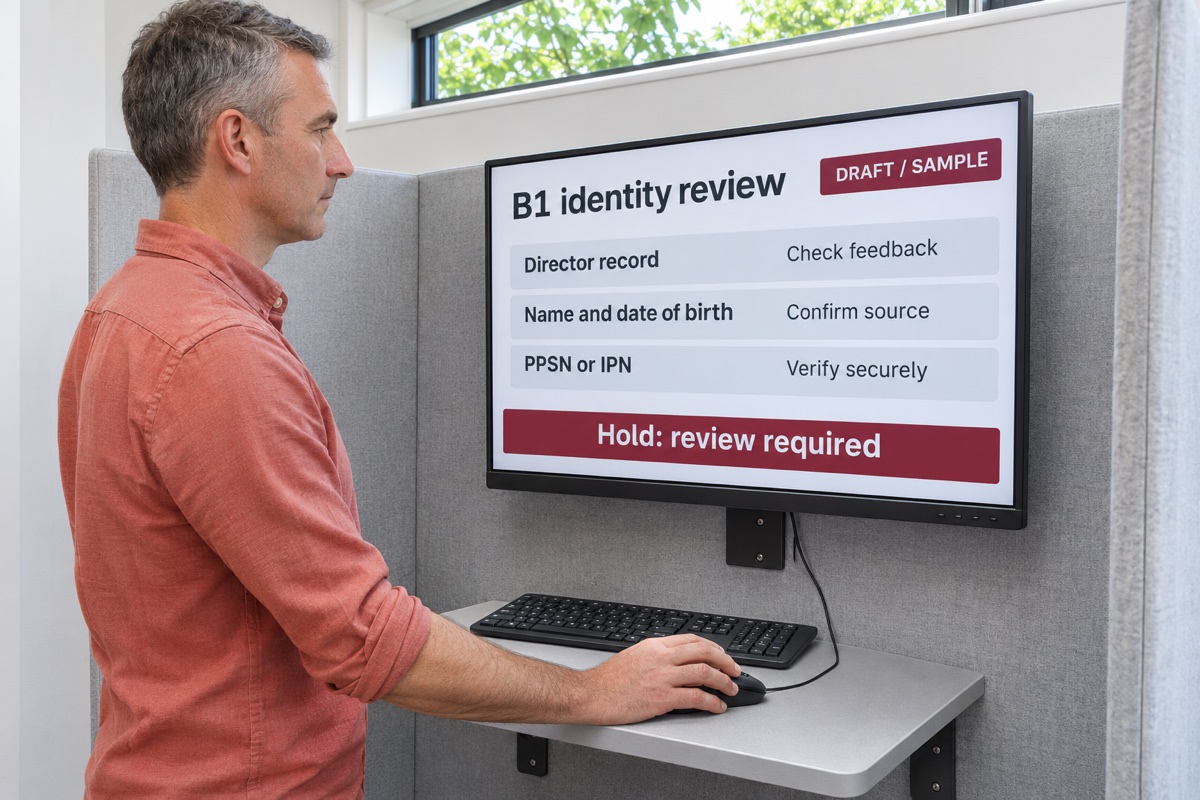
The accounts are ready and the directors are available to sign, but the annual return stops at an identity check. Which person failed? Is a PPSN wrong, has a name changed, or is an older IPN being used with different details? Repeatedly trying spellings is not a reliable way to complete an Irish company's B1.
This guide addresses a director-identity hold before a successful annual-return filing. It complements our wider sent-back B1 checklist; it is not a general IPN application guide or a promise that a particular rejection can be corrected in time. Official guidance was checked on 7 November 2026. Keep the actual feedback and submission status available when asking for help.
1. Establish that this is an identity hold, not another filing problem
CRO's B1 identity page describes an immediate return where one or more directors' identity details do not match official records. The submission remains on hold until those requirements are met. That is different from a later correction notice about the financial statements, an unsigned certificate or a technical problem with the presenter's software.
Record the company number, B1 reference, current status, exact message and when it appeared. Keep a private copy of the relevant correspondence. Tell the person taking over which tasks were actually completed; 'the annual return was done except for a number' can conceal a form that has not successfully progressed at all.
Work from one current submission and a named presenter. Before creating another draft, ask how it would relate to the existing attempt and which record should be followed. Avoid leaving two advisers making different changes without knowing what the other has submitted.
2. Check every relevant director, not just the person signing
Section 888A of the Companies Act 2014 requires a director's PPSN, or the Registrar's determined alternative where the director has no PPSN, in a company annual return. Treat identity information and the signing arrangement as different checks. A signatory being verified does not resolve another director's missing or inconsistent information.
Prepare a restricted-access progress list with each director, the expected identifier route, whether confirmation has been received and the person responsible for follow-up. The list need not repeat the actual numbers or birth dates. Use it to allocate work, not as a new unprotected identity database.
For a multi-director company, ask who is away, who uses a different everyday name and whether somebody has recently received a PPSN after previously using an IPN. These are questions to confirm with the individual, not assumptions to enter into the return. Do not omit a genuine director or change an appointment date to avoid verification.
3. Use feedback to identify the person before changing the data
CRO's common-errors guidance describes the director-details email field used for instant mismatch feedback. A presenter may use their own email to gather it, but somebody must monitor the messages and follow up with the affected director. Check the current CORE instructions rather than expecting the general company mailbox to receive every diagnostic message.
Ask for the complete relevant feedback, not a cropped screenshot that removes the company or submission context. Record the affected person in the task list. A generic failure message does not justify changing all directors' records or assuming the newest overseas appointee must be responsible.
If the presenter uses a secretarial software package, establish which submission and notification route it uses. CRO's annual-return guidance directs technical software-package questions to the vendor. Keep a software delivery issue distinct from a director confirming their identity data; clearing a browser cache is not a correction to an underlying record.
4. Reconcile the correct source record for the number being used
For a PPSN, CRO checks against Department of Social Protection records, not a company spreadsheet or a name remembered from a Revenue login. Its guidance accepts close name matches and provides an alternate-name facility, but the birth date and PPSN must match exactly. Do not confuse that with permission to invent an alternative identity.
For an IPN, compare the issued number and the details supplied with the VIF. CRO's identity guidance also addresses existing RBO numbers and the appropriate enquiry route. An application's draft, witness receipt or payment reference is not evidence that an IPN has been issued.
Use this comparison to decide what must be checked, rather than sending every document to every organisation. Where the director is unsure of the source details, follow the official CRO guidance to obtain confirmation from the appropriate authority. Keep the presenter informed about what has been verified and what is still awaited.
| Filing route | Record to reconcile | Avoid substituting |
|---|---|---|
| PPSN | The director's DSP-linked particulars | A CRO company number or another person's details |
| Issued IPN | The issued number and VIF identity particulars | An unprocessed application reference |
| Existing RBO number | The relevant issued record and official enquiry route | A fresh number requested without checking history |
5. Distinguish a typing error from a genuine change of particulars
Have the director and presenter compare the entered particulars with the evidence through the agreed secure process. Identify the precise difference before making an amendment. A transposed character, a different name order and a genuine change of name are not the same explanation, even if they produce a similar-looking hold.
If a genuine officer-detail change has not been notified, ask whether separate company-record and B10 work is required. Do not treat a B1 identity correction as a universal replacement for other officer filings. Likewise, do not retrospectively change a real birth date simply because an old filing or spreadsheet contains a different one.
Keep a short correction record stating which field was reviewed, the source confirmed and who authorised the amendment. It can record the action without copying the entire identity document into ordinary working notes. If documents conflict, stop guessing and obtain clarification; a deadline does not make knowingly inaccurate information acceptable.
6. Do not buy a second identity application as a workaround
CRO says an IPN issued after a successful VIF can be used for relevant CRO/RBO filings. Its eligibility guidance reserves the route for non-resident directors or beneficial owners and excludes Irish citizens resident in the State, including part-time residents. Check whether an identifier already exists and which route is appropriate before commissioning a new application.
If a new VIF really is required, use the current form and plan the appointment properly. CRO's rule from 30 April 2026 rejects online witnessing: the witness and declarant must be physically together in the same room. A quick video call is not a compliant substitute. Our separate witnessing-abroad guide covers that preparatory task.
Where an existing IPN or legacy number needs clarification, ask about correcting or confirming that record first. Explain any later PPSN to the presenter and seek the current official instructions. Do not tick 'no PPSN' simply because locating the existing information is inconvenient or somebody promises a faster number.
7. Keep the filing deadline visible during the investigation
Section 343 sets the annual-return delivery obligation. For an ordinary return, the 56-day period follows the effective return date; making it up earlier can bring that deadline forward. CRO also explains the financial-year-end limit where accounts are required. Have the presenter identify the actual deadline, not 56 new days from the latest unsuccessful attempt.
Do not assume the identity hold grants a 14-day correction period. Section 898 addresses a notice served by the Registrar and the required compliant replacement within 14 days after service. Check whether such a notice actually exists. A technical hold, a saved draft and a statutory correction notice should not be treated as interchangeable protections.
If time is short or already expired, say so immediately. Ask for assessment of the complete filing position, potential late-filing consequences and any appropriate separate extension advice. An enquiry, service payment or application awaiting consideration does not itself complete the return or guarantee extra time.
8. Share enough evidence, without exposing everyone's identifiers
The Data Protection Commission's security guidance calls for appropriate access controls, limited retention and secure handling. For this task, agree the recipient, purpose and transfer method before sending private identity evidence. A general website enquiry can explain the problem without including a PPSN, full birth date, passport image or a copy of every director's details.
Check the support contact on the current official page and ask what information is needed. Redact unrelated people and fields when sharing a diagnostic screenshot, while preserving the message and submission context needed to understand the issue. Do not obscure information that an authorised recipient specifically needs for a legitimate verification task; use their agreed secure process instead.
Never provide a CORE password, personal login, digital-certificate password or one-time security code as the way to solve a mismatch. Give the authorised presenter the required information and permissions through the proper route. Keep the final action record and handle extra working copies under the applicable retention policy.
9. Example: two directors, one unresolved source record
Imagine a fictional design consultancy with two directors. The presenter receives a B1 identity hold and initially suspects the director living abroad. Instead of buying a new IPN, they use the feedback arrangement to identify the affected person. It is the other director, whose business records use a different name from the source information requiring confirmation.
That director checks the evidence and obtains any needed official clarification. The presenter records the confirmed correction, checks whether separate officer-detail work is needed and resubmits the appropriate B1. The director abroad retains the already-issued identifier rather than starting an unrelated application.
They also check the outstanding signing and attachment tasks and follow the final filing status. The example illustrates why identifying the person first matters; it is not a claim that all name differences are accepted, that a particular authority will respond immediately or that an earlier attempted submission preserves the delivery date.
10. Buy the missing work and verify the complete return
StartCompany.ie's Annual Returns service covers B1 preparation and filing, company-detail verification, attachment of required financial statements, the filing fee and filing confirmation. Review the current scope and total payable. Tell the team about the identity hold and deadline before ordering routine support; do not assume it includes a new IPN, missing accounts preparation or a court application.
Agree who contacts the director, who deals with official clarification and who submits the corrected return. Resolving identity does not approve the accounts, supply signatures or complete another company's filings. An identity number also does not file a separate beneficial-ownership return. Keep each assignment and its completion evidence distinct.
Before marking the task finished, review the submission status and any further messages with the presenter. Keep the reference and final filing confirmation, not just the identity-check correspondence. For the next cycle, review all directors' information early and provide a monitored feedback contact so one unresolved record does not become a last-day surprise.
- Company number, B1 reference, current status and actual filing deadline.
- Affected director identified and the correct identifier route confirmed.
- Source particulars checked securely; any unresolved discrepancy escalated.
- Separate officer filings, signatures and required attachments reviewed.
- Corrected submission followed through to the final filing evidence.
StartCompany.ie service
Annual Returns
Official information and next steps
Official CRO guidance, Data Protection Commission guidance and the linked revised Companies Act provisions checked on 7 November 2026. This is a practical troubleshooting workflow, not a reproduction of a live CORE session, a guarantee of matching or advice about an individual correction notice. Follow current official contact and secure-document instructions for the actual case.
- CRO: Form B1 identity requirements
- CRO: common Form B1 errors
- Companies Act 2014, section 888A: director identity data
- CRO: IPN eligibility and use
- CRO: VIF amendment and physical witnessing
- Companies Act 2014, section 343: delivery obligation
- Companies Act 2014, section 898: correction notices
- CRO: annual-return filing and completion
- Data Protection Commission: data security guidance