
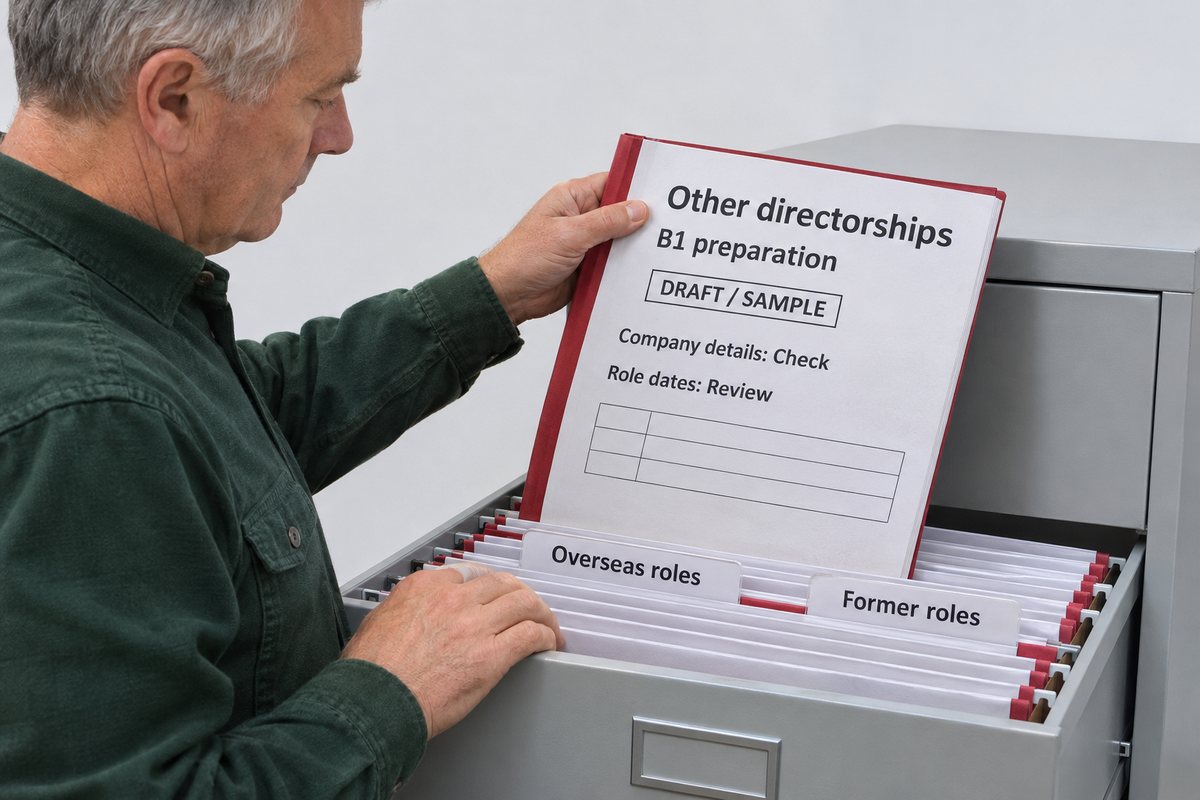
The annual-return preparer asks for your other directorships. You send the names of the Irish companies you currently manage, then remember a UK appointment you left two years ago. Does that belong on the list? What about a company owned by the same founder, or a wholly owned subsidiary?
This is a preparation guide for the other-directorships information on an Irish company's Form B1. It focuses on an ordinary LTD and its directors, not on every B1 field or every company type. Official CRO guidance and the relevant Companies Act provisions were checked on 19 November 2026. The examples are fictional, and a complex group or disputed appointment needs specific advice.
Fix the return date before editing the list
A B1 records company particulars at the date to which the return is made up. That date is not necessarily the day you email the accountant, sign the certification or upload the documents. Label the working schedule with the company, director and actual return date before deciding which information belongs in the filing.
For an earlier return, today's profile is not enough. Separate roles held at the relevant date from events afterwards, and retain the history needed for the applicable look-back. Do not silently replace a historic position with whatever the current online search happens to show.
Section 343 generally gives 56 days after the ARD, or after an earlier made-up-to date, for delivery. Accounts timing can also affect the filing deadline. Confirm the live dates and complete requirements with the presenter; a difficult role-history enquiry does not extend time.
Collect overseas roles as well as Irish appointments
CRO's Other Directorships guidance asks for the other body's company name and number, and its place of incorporation where outside Ireland. Section 149 addresses other directorships in bodies corporate incorporated in Ireland or elsewhere. Living abroad, receiving no fee or managing the role remotely does not by itself remove it from this review.
Use the exact legal entity, not a trading brand or a department. For each role, collect the registration reference, jurisdiction, appointment and cessation dates, and the evidence supporting them. Dates are useful working-paper evidence even where the form's required fields are narrower.
A foreign registration number is not an Irish CRO number. Do not invent a local-looking reference to make a spreadsheet consistent. If the entity has no familiar number, has changed name or has an unfamiliar legal form, flag that question for the presenter before the list is finalised.
A resignation does not automatically remove the former role
The look-back is not simply 'companies where I am a director today'. The relevant exception concerns a directorship not held at any time during the preceding five years. A role that ended recently can therefore remain relevant even though its cessation was properly recorded.
Do not delete every row marked resigned. Record the actual dates and let the preparer test them against the return's reference date. Where a role sits near the five-year boundary, obtain the underlying appointment and cessation evidence rather than estimating the year.
Keep old evidence even when an exception allows omission from the final particulars. The question is why the filing list is shorter than the complete history, not whether the excluded role ever existed. A dated review note makes that difference intelligible at next year's handover.
Wholly owned group exceptions are not a same-owner shortcut
The exceptions in section 149(4)(b) follow specified corporate chains: a parent that wholly owns the filing company, the filing company's wholly owned subsidiaries, and qualifying wholly owned fellow subsidiaries. The provision also covers specified former relationships. Have the adviser apply its exact terms to the structure and dates.
Two companies owned directly by the same individual are not, for that reason alone, a parent and wholly owned subsidiary. Nor does an informal group label establish every condition. Give the adviser the ownership chain and relevant dates, including former relationships where material.
Preserve the unfiltered schedule and mark a proposed exclusion with its reason and evidence. Do not replace a group of named companies with the words 'group directorships' without agreeing how the applicable disclosure is to be completed. For partial ownership, restructurings or an uncertain holding relationship, obtain a company-specific assessment.
Do not use the 25-company count as your B1 answer
Section 142 regulates the number of relevant directorships held at a particular time and has its own adjustments and exclusions. It is a separate eligibility exercise. A numerical result under that section is not the B1 list of company names, numbers and jurisdictions.
For example, the count rules expressly exclude public limited companies. That does not create a matching blanket exception from section 149's other-directorship particulars. Equally, a past role may matter to disclosure while not being an appointment held at the current counting time.
Keep two labelled outputs when both reviews are needed: the supported eligibility count and the B1 disclosure schedule. Use the full evidence as the starting point for each. If you are accepting another appointment, arrange the eligibility review separately; filing an annual return does not approve that appointment.
A worked history for a November return
Assume a fictional director is helping prepare a return made up to 19 November 2026. There are no relevant corporate-group relationships in this example. The working history contains the following four other roles. The table illustrates triage, not a completed form or a ruling on a real director's records.
The UK role ended in 2024, so it should not disappear merely because the current company search lists a resignation. The older French role ended in 2019 and was never resumed; that is the kind of history to test against the five-year exception. Retain proof of the dates and the conclusion.
The German appointment starts after the made-up-to date. Record the later event for ongoing administration, but do not rewrite the earlier snapshot as if the appointment had already happened. Check the actual dates if documents were signed before an appointment was intended to take effect.
| Other role | Working-paper treatment |
|---|---|
| Irish company, still serving | Collect legal name, number and confirmed role dates. |
| UK company, ceased in 2024 | Recent former role remains relevant to the disclosure review. |
| French company, ceased in 2019 | Test the five-year exception; retain date evidence. |
| German company, appointed 1 December 2026 | Keep as a later event, not an appointment at the November return date. |
Ask each director to confirm their own history
A shared founder spreadsheet can miss appointments held outside the main business. Send each director a dated request identifying the filing company, made-up-to date and information required. Ask for corrections to the complete working list, not just agreement that the names already typed look familiar.
Useful evidence can include appointment records, cessation notices, official register extracts and the company's own officer register. A register search is a cross-check, not a reason to discard conflicting documents. Similar names, late notifications and changed company names can all require clarification.
Distinguish director, shareholder, employee, adviser and secretary roles. An investment is not automatically a directorship. If someone served as a director as well as in another capacity, record the directorship rather than assuming the other title replaces it.
Where the dates disagree, keep the competing evidence and a named person responsible for resolving it. Do not mark an item 'none' just to close an outstanding checklist. Tell the presenter promptly if the history cannot be confirmed within the preparation timetable.
The B1 does not replace separate officer-change work
An annual snapshot is not a substitute for any separately required B10 notification. CRO says changes to a company's officers or their registered details must be notified within 14 days, and its guidance distinguishes appointment, cessation and changes in particulars.
If the filing company's own directors have changed, reconcile the appointment records, internal register and CRO notification before approving the return. Ask the presenter whether changes to other particulars also need a separate update. Do not assume the yearly form repairs every earlier omission.
Do not treat a B1 schedule as a way to resign from another company, change a foreign register or cancel a directorship that is still disputed. Those matters belong to their own legal entity and process. Explain any unresolved position instead of inventing a cessation date.
Review the actual filing output before certification
Give the presenter a working pack with the full history, proposed inclusions, proposed exceptions and unresolved questions. Then compare the final B1 particulars with the agreed schedule. An email attachment being received is not proof that its contents were entered in the return.
Check legal names, jurisdiction and registration numbers carefully, especially after a name change or group reorganisation. Confirm whether the same director appears under a former name in the supporting evidence. Supply sensitive identity information only through the agreed secure channel, not in a general enquiry form.
CRO's current forms catalogue directs B1 filing online. Follow the current CORE or professional software process rather than an old paper-form download. This guide does not prescribe an unverified upload button or promise that a separate PDF list will replace the required form particulars.
If CRO sends a correction message, read its actual reason and the applicable correction deadline. If a return is already registered and contains an error, ask about the correct amendment route instead of quietly changing the next year's schedule and treating the earlier filing as fixed.
A practical pack for the annual-return provider
The preparer should be able to see the evidence and the decision, without reconstructing years of correspondence. The checklist below is a practical handover aid, not a universal CRO attachment list.
- Identify the filing company, each director and the B1 made-up-to date.
- Collect full legal names, registration references and incorporation jurisdictions for other bodies.
- Keep appointment and cessation dates with their supporting records.
- Include relevant past and overseas roles in the unfiltered working history.
- Document any proposed five-year or wholly-owned-group exclusion.
- Keep the section 142 eligibility count separate from B1 disclosure.
- Flag unresolved dates, name changes and any separate officer filings.
- Retain the approved particulars, certification records and submission evidence.
Confirm the filing scope before buying support
StartCompany.ie's annual-return service covers the agreed B1 preparation and filing work. Use the existing service page to review what is included and the total payable. Provide the company record, deadline and checked director information before relying on a filing timetable.
Historical role research and legal group analysis are not automatically included in routine B1 support. If the source records are missing, the group relationship is complicated or an earlier filing may be wrong, contact us before ordering. Ask whether that additional review can be provided and agree the scope, cost and responsibility explicitly.
Keep financial-statement preparation, director eligibility, foreign-register corrections and other CRO forms separate where they are needed. A filing order does not complete those jobs or extend a deadline. A company-secretary appointment is also a distinct engagement, not evidence that every annual-return task has been commissioned.
A useful first enquiry states the company, return date, number of directors, jurisdictions involved and the uncertainty to resolve. You do not need to send passports, PPSNs, login credentials or a complete private portfolio through the public contact form.
StartCompany.ie service
Annual Returns
Official information and next steps
Current CRO annual-return and officer guidance and the available revised Companies Act provisions checked on 19 November 2026. This guide addresses B1 other-directorship preparation, not a legal opinion on a disputed appointment, group exception or the section 142 count. Use current filing instructions rather than archived paper forms or old deadline summaries.
- CRO: filing a B1 and the Other Directorships requirements
- Companies Act 2014, section 149: director particulars and disclosure exceptions
- Companies Act 2014, section 142: the separate directorship-count rules
- Companies Act 2014, section 343: return date and delivery period
- CRO: officer changes, current officers and B10 notifications
- CRO: common B1 errors and correction messages
- CRO: current forms and the online B1 route