
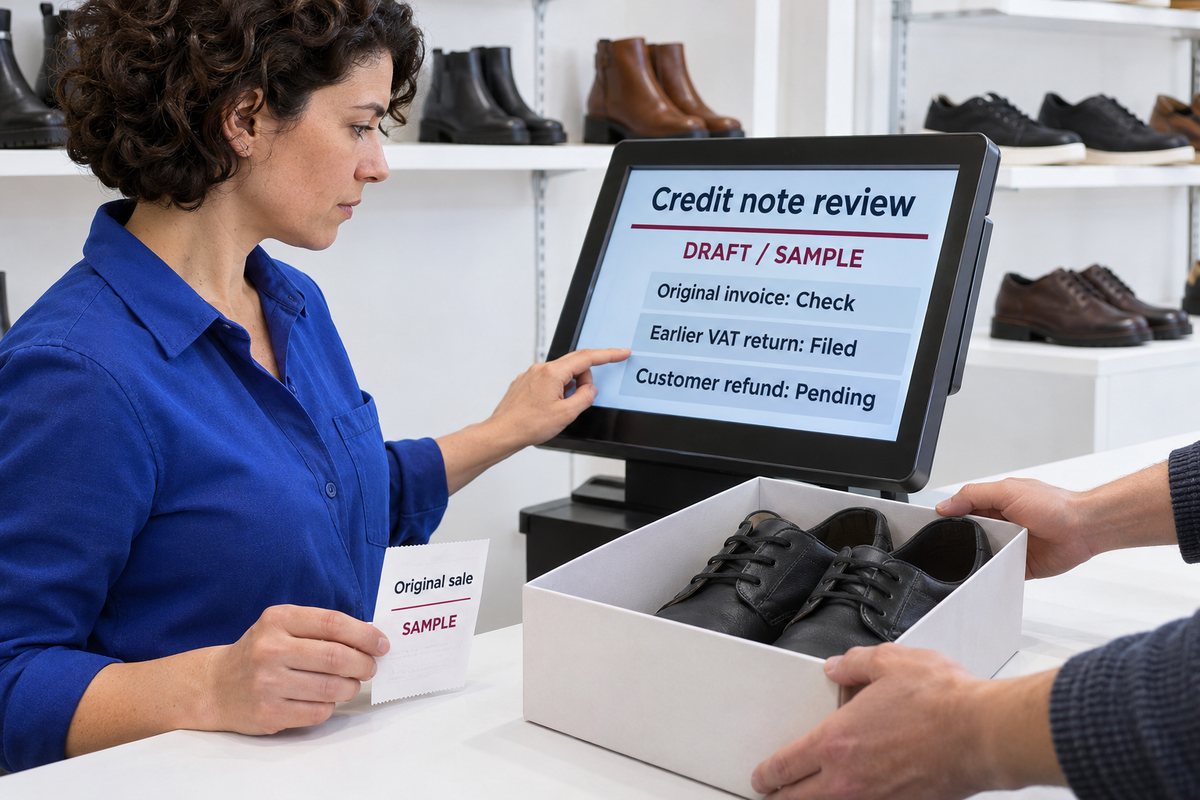
Your Irish LTD has filed its VAT3 and paid the tax. A customer then returns goods, agrees a lower price or receives a refund. Should you reopen the old return, delete the invoice or simply put the bank payment into expenses? First establish what changed and when; those shortcuts can create a second error.
This guide is for ordinary domestic VAT-invoiced transactions, principally on the invoice basis. Official sources were checked on 15 November 2026. Cash-receipts accounting, reverse charges, cross-border supplies, margin schemes and disputed compensation can need different treatment. Use the checklist to brief your accountant, not as an instruction to submit a particular figure without reviewing the records.
1. Identify the event before changing the books
Revenue says returned goods and subsequent discounts or price reductions can require an adjustment to VAT payable and a credit note where an invoiced supply's price falls. Start with the underlying agreement, not the label attached to a bank transaction.
Record whether the customer returned the goods, accepted a partial-service settlement, received a discretionary reduction or recovered an accidental duplicate payment. Establish the invoice, contracting customer, agreed amount and relevant dates. A duplicate collection can involve refunding money without reducing the valid sale; it should not automatically create a second sales credit.
Keep a short timeline: original supply, invoice, payment, VAT3 submission, later agreement, credit note and refund. The dates may fall in different periods. Ask the preparer to explain any difference rather than forcing everything back into the original sales month.
| What happened? | Review route | Do not assume |
|---|---|---|
| Later price cut | Credit-note review | Old return was wrong |
| Wrong VAT rate | Invoice correction | Refund alone fixes it |
| Duplicate payment | Cash allocation | Sale was reduced |
| Customer default | Bad-debt review | Commercial discount |
2. Preserve the invoice and issue the right correction
For a reduced price, Revenue identifies a credit note for the reduction. A price increase calls for a supplementary invoice. Where the original VAT rate was wrong, its guidance calls for a credit note and revised invoice; an undercharge requires crediting the full original invoice before issuing the corrected one.
Do not overwrite an invoice already sent to the customer so the saved copy looks as though it was always correct. Keep the original, corrective documents and delivery evidence connected. A draft in accounting software is not proof that the required document reached the customer.
Separate the correction from the payment instruction. A credit can reduce an unpaid balance, leave a customer-account credit or accompany an actual cash refund, depending on the agreement. Record the agreed outcome and allocate the refund to that credit, rather than posting another independent expense for the same amount.
3. Distinguish a later adjustment from an earlier return error
A return can have been correct when submitted even though a genuine commercial reduction happens afterwards. Regulation 9(3) addresses supplier adjustments by reference to the period in which the relevant deficiencies are ascertained. Section 39(4) withholds the reduction relief until the required credit note has been issued. Have the preparer align the evidence and timing.
That is different from discovering that the original VAT3 omitted a sale, used the wrong figures or included an unsupported deduction. Ask whether an earlier-period correction is needed. Do not assume that issuing a document today permits every historic error to be absorbed into today's return.
Give the accountant the submitted VAT3 and its supporting calculation, not only the current ledger. Ask them to identify the event, adjustment basis, document date and return period explicitly. The refund date is evidence of a payment movement; it does not decide every VAT timing question.
If a reduction exceeds the relevant current sales amounts, flag that rather than entering an unexplained negative T1. Regulation 9 contains an excess-adjustment mechanism. Let the preparer apply the correct return treatment instead of trying to make a software warning disappear.
4. Observe the credit-note deadline for the actual event
Regulation 23(f) distinguishes two credit-note triggers: for a discount, 15 days from receipt of the related money; otherwise, 15 days from the parties agreeing the decrease. This is important where a later agreement occurs after the original supply month. Do not wait for the next VAT3 deadline to prepare the document.
Revenue's short credit-note webpage also gives a general month-end formulation. For a later reduction, use the detailed regulation and have the adviser confirm the trigger for your circumstances. The 2012 amendments to regulation 23 add or remove other categories; they do not replace paragraph (f). Do not backdate a credit note to manufacture compliance.
If the document is already late, preserve the real dates and tell the adviser immediately. Explain when the reduction was agreed, why the note was delayed and whether the customer already received money. A corrected record should make the history intelligible, not pretend the later agreement happened months earlier.
5. Check the note's contents, not just its total
Revenue's particulars include an issue date and unique number, supplier and customer identity details, relevant VAT numbers, the reason, original-invoice reference, amended consideration, applicable rates and tax at each rate. Its guidance also requires corresponding euro figures where a credit note uses foreign currency.
Use a line-by-line review for mixed-rate invoices. Identify which product, service or quantity has changed, and trace the rate back to the related invoice. Do not apply the rate on your newest sales template automatically to an older supply. Where a rate was wrong originally, use the separate correction route rather than preserving an incorrect charge.
Check that the trading brand has not displaced the actual legal supplier or customer. Use a clear reason, such as the agreed reduction for a specified returned item, rather than an unexplained goodwill entry. Keep customer-facing wording accurate without adding bank credentials or unnecessary personal information.
A copy of the card-provider refund confirmation is useful settlement evidence, but it does not supply missing tax-document particulars. Connect it to the final note and original invoice so someone else can reproduce the reconciliation.
6. Worked example: a partial refund after a correct return
Assume a fictional Irish VAT-registered company made an ordinary domestic supply correctly taxable at 23%, accounted on the invoice basis, and received full payment. Its invoice was EUR1,000 net plus EUR230 VAT, total EUR1,230. The original return was correctly filed. In a later taxable period, the parties agree a 20% reduction for returned goods and the company issues the credit note promptly.
The credit is EUR200 net plus EUR46 VAT, total EUR246: EUR1,230 x 20% = EUR246, and EUR246 / 1.23 = EUR200. The remaining transaction is EUR800 net plus EUR184 VAT, total EUR984. These are invented arithmetic assumptions, not a conclusion about the correct rate for your own product.
Have the preparer record the later adjustment in the appropriate period and reconcile the EUR246 refund to the credit. Do not delete the EUR1,230 original invoice, claim EUR246 as input VAT, or post the cash refund as a second expense after reducing sales. The VAT component of this example is EUR46, not the whole refund.
Revenue describes T1 as VAT on sales and T2 as deductible VAT on purchases, with credit-note adjustments possible. An ordinary supplier reduction must be distinguished from receiving a supplier credit against input VAT. Confirm the direction and any excess-adjustment treatment; a bank debit is not automatically a T2 amount.
7. Check exceptions and the customer's side
Section 67(5) allows a particular agreement with a registered customer to reduce consideration while leaving the invoiced tax unchanged. That is not permission to reclaim that tax as well. Subsection (6) excludes an issuer authorised on the cash-receipts basis at the time of the invoice from that exception.
Do not assume a commercial instruction such as refund 10% means both parties have agreed to preserve the original VAT. Tell the accountant exactly what was agreed, whether the customer is registered and whether the company's accounting basis changed. Obtain advice before using an exception rather than treating it as the default process.
The customer must also consider any input deduction already taken. Regulation 9(4) links the recipient's reduction to the period in which the note is issued and addresses excess reductions through carry-forward. Send the note promptly and do not promise that the customer can keep its original VAT deduction after a tax credit.
An unpaid but still valid invoice is another case entirely. Revenue's bad-debt manual distinguishes default from a price reduction. Do not issue an invented commercial credit to remove a debt while also claiming bad-debt relief on the same amount.
8. If the old VAT3 really needs amendment, use the proper route
Revenue says a VAT3 can take up to three working days to process fully. Its ROS help directs users to proceed as if filing a VAT3 and use Additional to find periods available for amendment. This is a processing explanation, not an extension of a payment or filing deadline.
Ask the preparer to distinguish replacing or correcting a return from any supplementary-return instruction on the actual screen. A saved draft, an accounting-software adjustment and a Revenue submission are not the same completion evidence. Keep the final calculation, acknowledgement and any payment reconciliation together.
Where an old error means VAT was paid late or an excessive repayment was received, interest may need attention. Revenue explains daily interest for those situations. Do not assume that a later credit note automatically eliminates earlier underpayment exposure; disclose the full chronology before agreeing the correction work.
9. Prepare a refund review pack and agree the scope
Send an initial non-confidential summary through the normal enquiry route, then agree secure transfer of the records. The following is an accountant briefing pack, not a mandatory set of attachments to every credit note or VAT3.
- Original invoice, supply date, rate breakdown and evidence of the original payment.
- Submitted VAT3 period, acknowledgement and supporting sales or purchase schedule.
- Return, discount or settlement agreement, including the date and reason.
- Credit-note number, issue date, customer delivery evidence and any revised invoice.
- Refund amount, date, payment reference and allocation to the customer account.
- Confirmation of invoice or cash-receipts basis, and any special transaction treatment.
- Earlier adjustments, bad-debt claims, disputed amounts or unexplained ledger entries.
- Upcoming deadline, intended preparer and authority to approve and submit corrections.
10. Request the work you actually need
StartCompany.ie's tax-services page lists VAT return and advisory support. Describe whether you need a one-off credit-note review, invoice repair, customer-account reconciliation, current VAT3 preparation or historic-return correction. These are related tasks but they are not automatically one engagement.
Ask which work can be provided, who reviews the transaction, which periods and documents are covered, who submits anything to Revenue and what completion evidence you receive. Agree the scope and total payable before instructing support. New VAT registration is not itself a historic corrections service.
Accounting support does not decide a contested customer's legal entitlement to a refund, recover a debt or conduct litigation unless separately agreed with an appropriate professional. Explain a live dispute rather than asking the bookkeeper to settle it through a journal.
Once the case is resolved, keep a single trail from sale to credit, refund and return treatment. Reconcile outstanding customer balances and retain the approved working papers. A repeatable correction process is more useful than a tidy-looking ledger that no longer explains what happened.
StartCompany.ie service
Tax Services in Ireland
Official information and next steps
Primary official sources checked on 15 November 2026. The detailed credit-note timing discussion uses regulation 23(f), rather than treating Revenue's short month-end wording as a universal deadline for later price reductions. This is a preparation guide, not a determination of your return figures.
- Revenue: correcting a VAT invoice's price or tax rate
- Revenue: when a VAT credit note is required
- Revenue: credit-note particulars and foreign-currency figures
- Revenue: returned goods and later discounts
- VAT Consolidation Act 2010, section 67: amendments and unchanged-tax exception
- VAT Consolidation Act 2010, section 39: relief and the required credit note
- VAT Regulations 2010: regulations 9 and 23(f), adjustments and credit-note time limits
- VAT Amendment Regulations 2012: regulation 23 amendments
- Revenue: VAT3 T1, T2 and credit-note adjustments
- Revenue: VAT3 processing and the ROS amendment route
- Revenue: interest on late VAT and excessive repayments
- Revenue: bad-debt relief is separate from a commercial credit note