
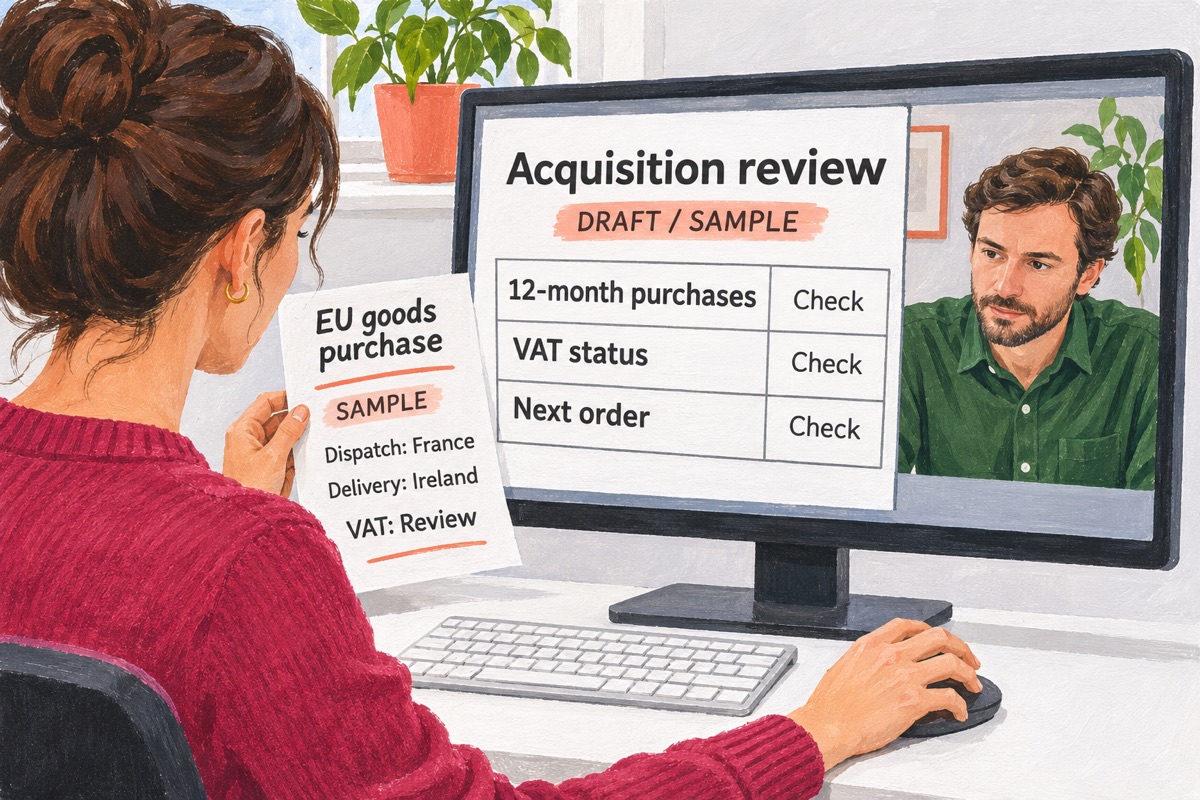
Your new Irish LTD has modest sales, but its first sizeable stock order will come from another EU country. The supplier asks for an intra-EU VAT number. Looking only at the company's Irish sales threshold will not answer whether registration is needed, how the invoice should be treated or what must appear in the VAT return.
This guide is for companies planning ordinary business purchases of goods dispatched from another EU Member State to Ireland. It separates the acquisition test, registration status and deduction decision. It is not a guide to customs imports, consumer shopping, special goods schemes or every cross-border chain. Revenue sources were checked on 11 November 2026. Obtain transaction-specific advice before committing to a treatment.
1. Separate the company's sales from its EU purchases
Revenue lists EUR85,000 as the principal goods-supply turnover threshold, with different rules for some supplies. That is a sales test. Its separate acquisition threshold is EUR41,000. A company can therefore need to address EU-goods registration before its own sales reach the ordinary compulsory-registration level.
First establish the company's current VAT position. If it is already registered, do not treat EUR41,000 as an annual allowance for buying goods without self-accounting. If it is not registered, review actual and expected acquisitions rather than assuming that low sales settle the question. The table is a routing aid, not a determination of eligibility.
Wholly exempt businesses also need attention. Revenue describes acquisition registration for exempt or out-of-scope bodies exceeding, or likely to exceed, the test. That registration does not automatically make exempt activities taxable or create a right to recover purchase VAT.
| Position | Main check | Avoid assuming |
|---|---|---|
| Not registered | EU purchase forecast | Low sales settle VAT |
| Already registered | Self-accounting | EUR41,000 allowance |
| Exempt activities | Acquisition obligation | Automatic deduction |
| Domestic-only status | Intra-EU application | Supplier approval |
2. Forecast the purchases before the threshold is crossed
Revenue's goods-from-abroad guidance uses more than EUR41,000 acquired, or likely to be acquired, in any 12-month period. The forecast matters: do not wait for the bank account to show payments above that figure before seeking a review. Nor should the company reset this test automatically at its accounts year-end.
Take a fictional company with EUR33,000 of relevant acquisitions already identified by its adviser in the review window. It plans another EUR12,000 order in that window. EUR33,000 + EUR12,000 = EUR45,000. The planned purchases indicate a likely excess; low current customer sales do not remove the need to assess registration before proceeding.
Keep a dated schedule linking the amounts to suppliers, purchase documents and proposed orders. Separate confirmed transactions from forecasts and explain cancellations or credit notes. Have the adviser establish which values and dates belong in the test. This example assumes all amounts count; it is not a rule that every foreign bank payment is an acquisition.
3. Identify the actual goods movement, not just the supplier address
Revenue's acquisition overview concerns goods moving between businesses in different EU Member States. Record where the goods are dispatched, where they arrive, who buys them and the company's business use. An EU supplier's postal address or a euro invoice alone does not describe the physical supply chain.
Ask the purchasing team for the order, invoice and delivery arrangements. Explain goods held abroad, direct deliveries to customers, returns, installation or other parties in the chain. If the route is not an ordinary supplier-to-Ireland acquisition, obtain a specific assessment instead of forcing the purchase into this checklist.
Keep software subscriptions, advertising and consultancy separate. They are services, not stock purchases, and received-services rules can apply without a monetary threshold. Equally, do not use the EUR41,000 goods test as a customs-import allowance. The linked services and import guides cover those separate questions.
4. Check domestic-only versus intra-EU registration early
Revenue operates domestic-only and intra-EU VAT-registration statuses. Its guidance says businesses intending to trade with businesses elsewhere in the EU should apply for intra-EU status. A domestic-only registrant can apply to change status. Do not treat the existence of an Irish VAT number as proof that this application is already complete.
Prepare evidence of genuine intended EU trade. Revenue lists supporting material such as contracts, invoices and business plans, alongside information about customers, suppliers and due-diligence checks. Describe the actual proposed purchases, trading activity and delivery route; do not invent completed sales or contracts to strengthen the application.
Agree who submits the application and monitors queries. Keep the decision and effective details with the company records, then tell the supplier the confirmed position. A pending request is not approval, and waiting for a response does not itself postpone a tax obligation. Ask the adviser how to handle orders already underway.
5. Understand self-accounting before negotiating the invoice
In an ordinary qualifying acquisition, the supplier's supply is zero-rated in the dispatch Member State and the Irish purchaser accounts for acquisition VAT at the appropriate Irish rate. Supplier-side conditions still matter. Do not tell a supplier to remove VAT merely because the company has incorporated or wants a cheaper invoice.
Self-accounting and deduction are separate decisions. Revenue allows a corresponding input credit only where the purchase is deductible. Business purpose, taxable or exempt use, supporting evidence and restrictions matter. If the company has mixed activities or acquires a restricted item, have the reviewer assess the actual recovery rather than copying the tax due into the deductible amount.
If an invoice contains another Member State's VAT, give the adviser the original and the transaction facts. Do not simply enter that foreign tax as Irish input VAT or alter the supplier's PDF yourself. A supplier correction and any eligible foreign-refund process are separate questions; Revenue describes an Electronic VAT Refund route subject to conditions, not a guaranteed refund.
6. Worked example: a zero net result still needs reporting
Assume a fictional, already appropriately registered Irish trader makes an ordinary qualifying acquisition costing EUR2,400. Its adviser confirms a 23% Irish rate and full deductibility for the company's taxable activity. Assume no other transactions or adjustments. Acquisition VAT is EUR2,400 x 23% = EUR552.
The acquisition contributes EUR552 to T1 and EUR552 to T2, while E2 records EUR2,400 of goods value. The tax amounts offset in this simplified example, but the company has a reportable acquisition. E2 is not EUR552, and a zero net result is not permission to omit the purchase. The complete return must include other activity too.
Now change the facts: assume an acquisition-registered business uses the same goods solely for wholly exempt activity and has no deduction entitlement. On those assumptions, T2 is zero for this purchase and EUR552 remains payable from the acquisition. Registration alone has not made the cost tax-neutral. Both examples illustrate the distinction, not the treatment of any reader's goods.
7. Give the accountant dates and records for the right return
Acquisition reporting is not based only on the date the company pays the supplier. Revenue's guidance identifies the invoice issue date or, if no invoice issues, the 15th day of the month following acquisition. Supply both the invoice and acquisition dates so the preparer can confirm the correct taxable period and any unusual timing.
Revenue also requires acquisition details in the annual Return of Trading Details. Agree that work separately from the periodic VAT3. Its guidance distinguishes VIES reporting on EU supplies from Intrastat statistics on goods movements. Buying goods is not, by itself, a reason to invent an EU customer sale on a VIES return; ask which additional reporting actually applies.
Preserve the invoice, order, delivery evidence, classification, rate and deduction workings, and links to any correction. For a foreign-currency invoice, provide the original currency and dates; Revenue specifies conversion at the relevant exchange rate when the tax becomes due. A single bank debit does not contain this full reporting trail.
8. Flag exceptions and existing problems before applying
This guide assumes ordinary goods. New means of transport and alcohol have specific Revenue rules. Margin-scheme goods, excisable products, chain transactions, stock transfers, goods installed by a supplier and unusual territorial routes need their own review. Do not use an ordinary stock example to price a vehicle purchase or an alcohol shipment.
If purchases have already started, disclose the dates, values and invoices promptly. Ask for the registration history, effective date, outstanding returns and correction needs to be reviewed together. Do not hide older orders, backdate evidence or assume a new application automatically fixes past liabilities.
Finally, explain the company's own sales. For a taxable business, compulsory or voluntary registration can affect domestic invoicing and pricing as well as purchases. For exempt activities, acquisition accounting does not create a blanket deduction. Agree the whole position rather than requesting a number solely to satisfy a supplier's checkout field.
9. Request the right tax-registration support
StartCompany.ie's Tax Registration service covers listed tax-registration and ROS setup assistance. Describe whether the company is unregistered, domestic-only, already intra-EU registered or has an unresolved historic position. Ask whether the required acquisition assessment and intra-EU application can be provided, and agree the scope and total payable before ordering.
Registration assistance is not automatically supplier-invoice correction, foreign VAT recovery, customs representation, ongoing VAT3 or RTD preparation, Intrastat work or a historic disclosure. Confirm each needed task and its owner. Revenue decides the application outcome; buying a service is not registration approval or a guaranteed deduction.
Use this brief to make the initial enquiry useful without sending identity documents, customer information or ROS credentials through an informal message.
- Company identity, actual activity, existing VAT status and relevant dates.
- Supplier countries, dispatch points, destinations and goods descriptions.
- Dated acquisition schedule and planned orders for the relevant 12-month review.
- Orders, invoices and genuine evidence supporting the intended EU trade.
- Taxable, exempt or mixed use, with deduction uncertainties flagged.
- Already completed purchases, invoice disputes and missing returns.
- Agreed application, review and ongoing filing responsibilities and total payable.
StartCompany.ie service
Tax Registration
Official information and next steps
Revenue sources checked on 11 November 2026. The threshold forecast and VAT examples are fictional, simplified and conditional. This is general preparation guidance for ordinary EU goods acquisitions, not an assessment of a particular registration, invoice, deduction, territorial rule or special scheme.
- Revenue: other VAT thresholds, including EU acquisitions
- Revenue: principal sales thresholds
- Revenue: registering for goods and services from abroad
- Revenue: intra-Community acquisitions overview
- Revenue: registered and exempt businesses acquiring EU goods
- Revenue: two-tier VAT registration
- Revenue: self-accounting for acquisition VAT
- Revenue: acquisition VAT reporting, timing and RTD
- Revenue: deduction rights and restrictions
- Revenue: foreign EU VAT refund route
- Revenue: VAT3 field definitions
- Revenue: VIES and Intrastat
- Revenue: new means of transport
- Revenue: alcohol acquisitions