
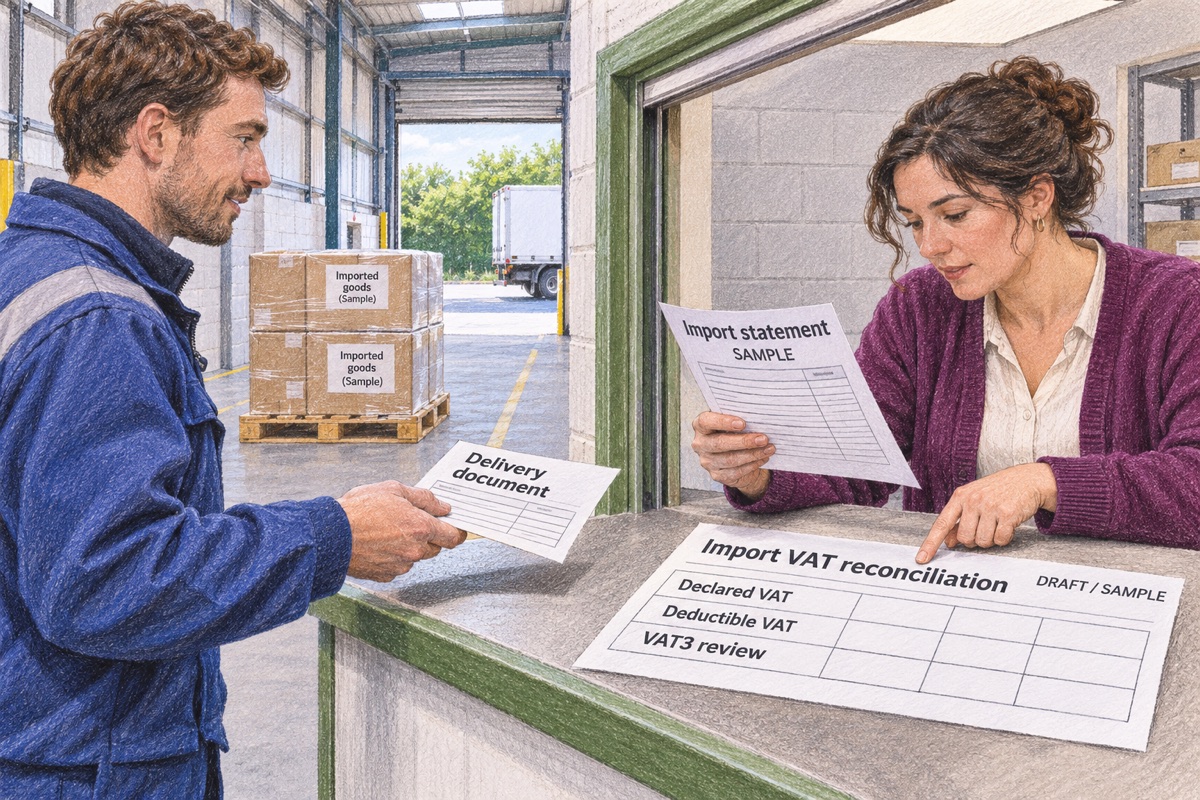
Your new Irish LTD is ordering its first shipment from Great Britain or another country outside the EU. The freight agent asks whether import VAT should be postponed. You have a company certificate, perhaps a VAT number, and a delivery date approaching. Which of those actually establishes that the company can use postponed accounting?
This guide follows the decision from registration to the first VAT3 return. It is not an EORI application tutorial or an ecommerce sales-VAT guide. Revenue sources were checked on 8 November 2026. Use the checklist to brief your tax adviser and customs representative; the goods, route, importer and company's circumstances still need individual assessment.
1. Decide whether this is the right transaction
Revenue makes postponed accounting available to traders registered for VAT and Customs and Excise for imports from third countries, including Great Britain but excluding Northern Ireland. It is optional. Do not apply the same instructions indiscriminately to goods arriving from Belfast, a supplier's EU warehouse and a shipment entering Ireland from China.
Start with a one-shipment map: seller, buyer, physical dispatch country, customs entry country, final destination and legal importer. The seller's website address is not a reliable description of the goods' route. Give the map to the broker before agreeing how taxes will be handled.
If stock enters another Member State first, or the supplier proposes to be the importer, ask for a separate review. This article concerns the Irish company's own imports into Ireland. Incorporating an Irish LTD does not itself settle establishment, overseas registrations, banking access or immigration permission.
2. Separate the registrations from the identifiers
The CRO number identifies the incorporated company. VAT registration and Customs and Excise registration concern Revenue obligations; EORI identifies the trader for customs interactions. A valid identifier is not evidence that every registration, authorisation or filing arrangement has been completed.
Revenue requires ROS registration before applying for EORI and currently requires the Eircode in the official address for new and existing EORI registrations. Check the actual issued EORI rather than constructing one from the CRO number or assuming the VAT number works. Our EORI guide covers that setup separately.
Make a short status register with a separate line for each item: requested, evidence supplied, issued or approved, effective date, and person holding the correspondence. 'Our accountant is dealing with it' is not enough information for the colleague who must instruct the first shipment.
3. Follow the new-applicant route before shipping
Revenue's VAT registration manual, updated May 2026, distinguishes applicants with no previous Irish tax registration number. They indicate their postponed-accounting request on the VAT application, complete VAT and C&E registration, then notify Revenue and request authorisation. The manual provides a MyEnquiries route once both registrations are approved.
Other applicants with an existing tax registration should review section 8 with their adviser: a live C&E registration is needed, and eligible online VAT applications can include the request. Section 8.2.1 also describes a subsequent application for traders registered for VAT after 31 December 2020. Do not rely on older descriptions of automatic entitlement for an earlier population of traders.
Ask the person handling registration to identify your route and confirm the outcome before you promise the broker that postponed accounting is available. Keep the decision or status evidence with the shipment instructions. An application acknowledgement alone is not an approval guarantee, and a booked delivery slot does not accelerate Revenue's assessment.
4. Budget for the charges that remain
Without an applicable alternative arrangement, import VAT is payable at importation. A deferred-payment account delays collection; postponed accounting instead brings the import VAT into the VAT return. These are different arrangements, not interchangeable names for a freight agent offering credit.
Postponed accounting does not eliminate Customs Duty, excise, handling, carriage or the agent's own fees. Import VAT valuation can also include duty and relevant transport or insurance costs, so the supplier's goods-only invoice is not necessarily the VAT calculation base. Ask for a landed-cost estimate rather than budgeting from the product price alone.
For planning, split the estimate into goods, freight, duty and other import charges, VAT treatment, agent fees and onward delivery. Identify which sums must be funded before release. Agree a fallback if approval is not available by shipment day; do not assume all charges can wait until customers pay you.
5. Give the broker written, shipment-specific instructions
Revenue's Customs Manual on Import VAT describes using code 1A05 with the narrative IEPOSTPONED in AIS data element 2/3. Give that reference to a competent customs representative, not as a substitute for their current declaration instructions. Ask them to confirm how the approved arrangement will be applied to the actual entry.
Your instruction pack should identify the company's exact legal name, issued VAT and EORI details, importer role, shipment reference and agreed accounting method. Ask for the accepted declaration, its movement reference number and the import VAT calculation. Do not send ROS passwords or certificates to a carrier to make the process quicker.
If a courier requests import VAT despite your instruction, pause and compare the declaration with the request. It could concern a different charge or an entry made on a different basis. Do not simply refuse every invoice or book the same amount both as VAT paid and as postponed VAT; ask the representative and return preparer to resolve the actual record.
6. Check deductibility before assuming a zero cash cost
Revenue allows VAT recovery for taxable supplies and qualifying activities, subject to the normal restrictions. VAT relating to exempt supplies or non-business activities is not generally reclaimable. Some costs remain blocked even for a VAT-registered business. Postponing the accounting does not create an input deduction that the company would otherwise lack.
For example, imported trading stock and an item with private use should not automatically receive identical treatment in the books. Ask the adviser to document the use of the goods and the basis for the deduction. A percentage copied from last year's spreadsheet is not a reasoned answer for a different activity.
The practical buying question is therefore twofold: can the company use postponed accounting, and how much of this shipment's VAT can it recover? Resolve both before using the forecast saving to fund another purchase. Keep a separate budget for any irrecoverable amount.
7. Put the correct values into PA1, T1 and T2
Revenue's VAT3 guidance distinguishes the value field from the tax fields. PA1 contains the customs value of goods imported under postponed accounting, as shown on the declarations, plus Customs Duty. It is not the VAT amount. T1 includes the import VAT due; T2 includes only the VAT the company is entitled to reclaim.
The table is a reconciliation prompt, not a completed return. Your VAT3 also includes other transactions. Give the preparer the declarations and calculation records rather than one unexplained total called 'imports'. Ask them to reconcile the period and any adjustments before filing.
| Field | Import-related entry | Common mistake to avoid |
|---|---|---|
| PA1 | Customs value plus Customs Duty for the relevant postponed imports | Entering only the VAT amount |
| T1 | VAT due on the postponed imports | Omitting VAT because none was collected at release |
| T2 | Deductible import VAT only | Assuming every T1 amount is fully recoverable |
8. Worked example: full versus restricted recovery
Assume a fictional company's accepted declaration shows EUR 2,300 of import VAT under postponed accounting. Its adviser confirms that all of this VAT is deductible. The import contributes EUR 2,300 to T1 and EUR 2,300 to T2, leaving no net VAT payable from that import alone. This is not a prediction that the whole VAT3 return will have a zero balance.
Now assume, solely to illustrate the arithmetic, that the adviser determines only 80% is deductible. The contribution to T1 remains EUR 2,300, but T2 is EUR 1,840. The EUR 460 difference is not erased by postponement. Revenue requires an appropriate apportionment where costs serve taxable, exempt or non-business activities; 80% is not a standard entitlement.
Neither example supplies the goods' VAT rate, commodity code, customs value or PA1 figure. Those come from the real transaction and supporting records. Use the examples to challenge an incomplete cash-flow forecast, not to calculate a shipment from its purchase price or choose your own recovery percentage.
9. Reconcile customs reports with the books
Revenue provides a Postponed VAT report for importers in ROS, listing the latest versions of declarations for a selected period. It also provides importer declaration reports. Monthly declaration and payment statements are produced for the payer; do not assume every importer receives the same monthly statement in their own inbox.
Agree who retrieves the available reports and who obtains missing declaration details from the representative. Match by movement reference number and check amendments, rather than adding every document received as another import. Keep the supplier invoice, transport evidence, declaration, report and reconciliation together so the return can be explained later.
Build this into month-end work before importing regularly. A useful handover has a named owner, period covered, unresolved entries and confirmation that the VAT preparer has the complete pack. 'No bank payment appeared' is not a reliable filter for deciding which customs transactions belong in the review.
10. Keep entitlement and annual reporting under review
The importer, not the customs representative, accounts for postponed VAT on the VAT3 and Return of Trading Details. The RTD has relevant postponed-accounting value fields. Arrange annual reporting as well as the periodic return; broker submission is not a replacement for either.
Revenue can exclude a trader who cannot demonstrate compliance with the conditions, from the date specified in the notice. Escalate any Revenue query or notice promptly and review future shipment funding. Also flag any section 56 authorisation: Revenue says authorised persons should use that relief for qualifying imports rather than postponed accounting.
Before ordering tax-registration support, explain the planned imports and ask which work is included. StartCompany.ie's service covers listed tax-registration and ROS support. Do not assume the purchase also includes EORI registration, a postponed-accounting application, customs declarations, deductibility advice or ongoing VAT3 and RTD preparation. Confirm availability, responsibilities and total payable for any additional work.
- Map the shipment and confirm who is the importer.
- Check VAT, C&E, EORI and postponed-accounting status separately.
- Give the broker written instructions and request declaration evidence.
- Budget for duty, fees and any irrecoverable VAT.
- Agree the VAT3 reconciliation, ROS reports and annual RTD owner.
- Confirm the registration service scope and separate ongoing filing costs.
StartCompany.ie service
Irish Company Tax Registration
Official information and next steps
Official Revenue guidance checked on 8 November 2026, including VAT registration guidelines updated May 2026, the Customs Manual on Import VAT updated May 2026 and the postponed-accounting manual reviewed April 2025. This is an import-planning checklist, not a customs declaration, registration approval, VAT valuation or deductibility opinion. The actual goods, importer, route, authorisations and records require case-specific review.
- Revenue: postponed accounting overview
- Revenue: EORI system
- Revenue: VAT registration guidelines, section 8
- Revenue: when import VAT is payable
- Revenue: Customs Manual on Import VAT
- Revenue: who can reclaim VAT
- Revenue: VAT3 field guidance
- Revenue: VAT apportionment
- Revenue: C&E reports on ROS
- Revenue: VAT record keeping
- Revenue: postponed-accounting manual