
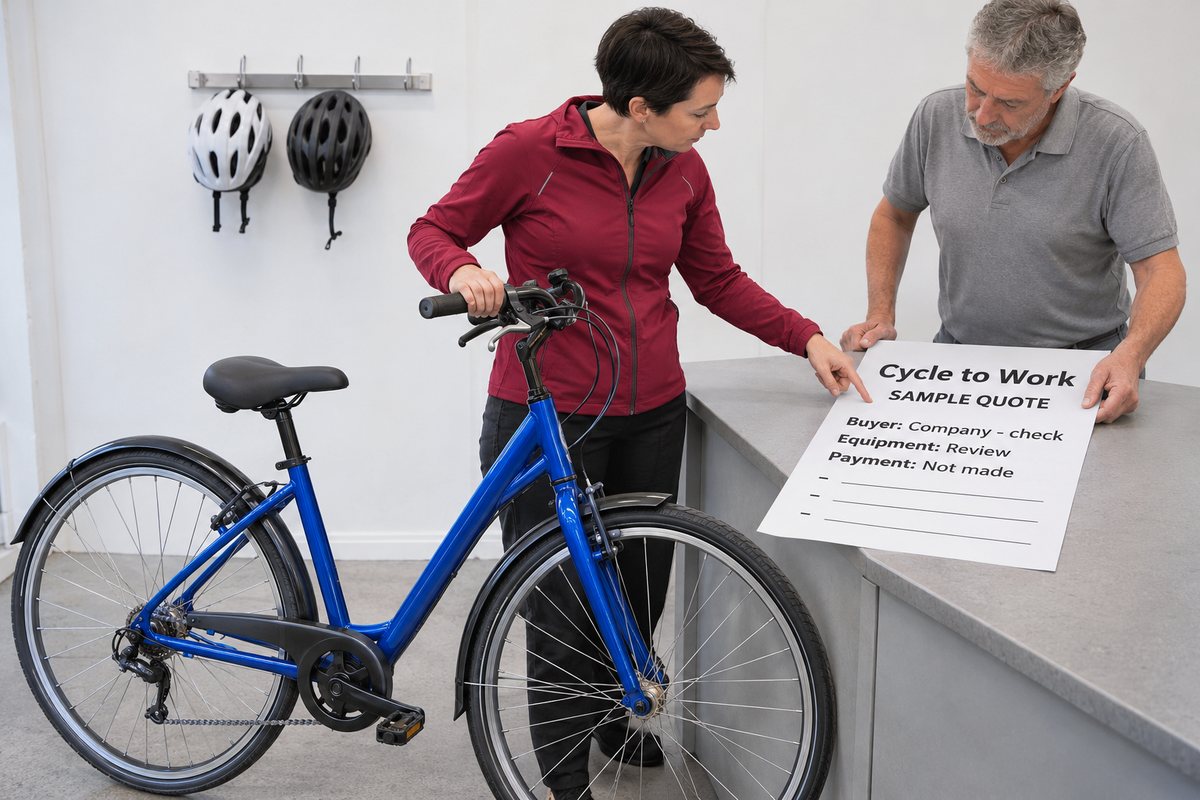
You have found a bicycle you would like to use for work and the company has the money to buy it. Before paying, settle one question: is the LTD arranging a qualifying Cycle to Work benefit, or are you buying something personally and hoping the accountant can sort it out later?
That distinction matters for an owner-director as much as for an employee in a larger business. This guide is a pre-purchase checklist for an Irish LTD director, not a retailer recommendation or a promise of a particular tax saving. It covers the purchase decision and the records to give your accountant.
Being a director does not rule you out
Revenue expressly includes directors in the Cycle to Work scheme. It recognises both employer-funded provision and salary-sacrifice arrangements, subject to the qualifying conditions. Owning the company is therefore not, by itself, a reason to dismiss the option or a reason to assume it is approved.
Revenue requires a participating employer to make the scheme generally available to all employees, not selected recipients only. If your LTD has staff, do not design the arrangement solely around the shareholder-director. Record the company's policy and how other employees can participate.
Describe your position accurately when asking for advice: director, shareholder, employment arrangements, remuneration and where you actually work. If you do not currently draw a salary, explain that rather than inventing a salary sacrifice in the bookkeeping. Ask which funding route fits the real arrangement.
The LTD and its owner have different records and payment responsibilities. Make the decision as a company purchase, with the necessary internal approval and a clear recipient. A personal online-shopping account and a company card do not, on their own, settle the buyer's identity or the tax analysis.
Confirm the buyer before placing the order
The employer must purchase the bike. Revenue says the exemption does not apply where the individual buys it and is then reimbursed. Send the supplier the company buyer details and agree invoicing and payment arrangements before a deposit or final payment is made.
Ask for an itemised quote identifying the actual model and each accessory. Check that the quote, order, invoice and payment trail tell the same story. If the shop has already put the order in your own name or you have already paid personally, explain the exact facts to the accountant before treating a later refund as exempt.
Do not ask a supplier to invent a different transaction date or describe unrelated goods as cycling equipment. A corrected genuine document is different from a document designed to conceal what happened. Keep the original correspondence so any review can follow the sequence.
Match the limit to the actual bicycle
The current limits are EUR1,250 for other bicycles, EUR1,500 for pedelecs and e-bikes, and EUR3,000 for cargo and e-cargo bicycles. Related safety equipment shares the relevant limit; it is not an extra allowance. Employer-paid delivery also needs to be included in the cost review.
Get the supplier's model specification, not just a website category or an enthusiastic sales description. A cargo classification depends on the specially designed frame; adding a trailer does not turn an ordinary bike into a cargo bicycle. Ask the accountant to resolve an uncertain category before using the higher figure.
The scheme concerns new equipment within its rules. Do not assume a second-hand bargain, an electric conversion kit, an e-scooter or a motorbike qualifies. For accessories, work from the eligible list and separate excluded items. A shop selling an item beside a bicycle is not evidence of its tax treatment.
Use one complete quote, not a rolling accessory allowance
Prepare the intended bicycle and eligible safety-equipment purchase together. Revenue's manual illustrates why buying equipment later is not simply a top-up to an unused limit: a later provision can be a second use of the exemption within the restricted period.
At the quote stage, decide what is needed now, what is eligible and who will pay for anything outside the agreed company provision. Avoid budgeting on the assumption that every future helmet, light, repair or replacement part can be put through the same claim.
Keep routine maintenance and later purchases visible as separate transactions. Ask for their treatment on their own facts rather than hiding them under the original bicycle invoice reference. This also makes it easier to reconcile the supplier account when an order changes or an item is refunded.
Home working does not automatically exclude you
The bicycle must be mainly for qualifying journeys, and the company needs the recipient's signed own-use and qualifying-use statement. Revenue's detailed manual allows home-based workers to qualify for work-related trips, giving post-office and office-supply journeys as examples. It sets no minimum number of cycling days, but the main-use condition remains.
Write down the actual intended pattern. For a home-based director, what company work requires travel, how will the bicycle be used and what other riding is planned? An occasional invented errand is not a sensible foundation for a benefit intended mainly for weekend recreation.
Likewise, the professional registered office used for post does not automatically become your normal workplace. Give the accountant your real working locations. A declaration should describe the arrangement you reasonably expect to follow, not a story chosen because the supplier has a tax-saving promotion.
Employer-funded and salary-sacrifice routes are different
The company can provide the qualifying benefit without requiring repayment. Salary sacrifice instead replaces agreed gross salary with the benefit. Revenue's general guidance requires a genuine written employment change made in advance, not a retrospective reclassification of pay already earned.
For Cycle to Work, the repayment arrangement must be completed within a maximum of 12 months. Settle the agreed amount, deduction schedule, start date and treatment of any taxable excess with the payroll provider before the first affected payroll. A bank standing order or director-loan entry is not automatically a salary-sacrifice agreement.
If the arrangement is starting near year-end, ask the provider to check the proposed dates against Revenue's general and scheme-specific conditions. Do not assume that the 12-month maximum is an instruction to make twelve deductions across any chosen tax years.
Compare the company's cash outlay with the director's actual net-pay effect. There is no universal saving percentage in this guide: tax bands, PRSI circumstances, funding and the approved arrangement matter. Ask for a personalised calculation rather than relying on a retailer's maximum-saving headline.
A worked e-bike cost review
Assume a fictional director meets the use and participation conditions. The company is considering a qualifying e-bike, related eligible safety equipment and delivery from an Irish supplier. All figures below are final supplier costs on a consistent gross basis. They are not a live quotation or a description of a customer transaction.
The total is EUR1,700 against the e-bike limit of EUR1,500. If the company pays the whole amount on the director's behalf, the EUR200 excess is a taxable benefit; it does not make the entire purchase exempt. Have payroll deal with that excess, rather than silently increasing the tax-free salary sacrifice.
If the intended arrangement is for the director to meet the excess personally, agree the supplier's invoice and payment split with the accountant before payment. Do not treat an after-the-event transfer as interchangeable with a correctly structured purchase. Confirm which costs the company actually incurred and what is being provided.
The important output is an agreed cost allocation and an evidence trail. The arithmetic does not establish that the model, accessories, use, timing or funding qualifies. Keep those separate checks alongside the calculation.
| Quoted item | Cost or review result |
|---|---|
| Qualifying e-bike | EUR1,600 |
| Eligible safety equipment | EUR80 |
| Delivery | EUR20 |
| Company pays EUR1,700 | EUR1,500 limit; EUR200 excess requires tax treatment |
Check the four-year history before choosing a provision date
The exemption is available once every four years, counted by tax year, with the provision year included first. Revenue's current example allows someone who used it in 2022 to use it again from 1 January 2026. It is not a fresh annual allowance or simply a calendar reminder four years after an invoice day.
Ask the director for the earlier provision date and supporting information, including participation through a previous employer. Put that evidence in the new purchase file. A new LTD, a new accountant or a new supplier should prompt a history check, not an assumption that no earlier benefit exists.
Record the date the bicycle is actually provided and retain the agreed conclusion about eligibility. If the date, order or intended arrangement changes, ask whether the assessment must be refreshed before the company pays.
Keep VAT, payroll and ERR as separate questions
Revenue says the employer cannot reclaim VAT on bicycles and safety equipment bought under this scheme because they are not used for taxable supplies. Do not reduce the review cost by an assumed input-VAT recovery. For overseas suppliers or unusual invoicing, obtain a specific VAT assessment before ordering; this example is not a cross-border purchase guide.
If part of the provision is taxable, follow the benefit-in-kind payroll process. Revenue requires taxable benefit value to be included with the employee's pay for deductions and reporting. A company-card payment being reconciled in the bank feed does not complete that payroll task.
Cycle to Work is not one of the three current ERR categories listed by Revenue: small benefits, remote-working daily allowance, and travel and subsistence. Keep the cycle-scheme records; do not label it a small-benefit voucher merely to find an ERR entry. If another benefit or reimbursement is also provided, assess that separately.
Ask the accountant to confirm the company's accounting entry and tax treatment as well as the benefit treatment. The director's exemption is not a complete instruction for depreciation, capital allowances or the company's tax return.
A compact file for the accountant
Revenue's scheme guidance requires the supporting records, while its general business guidance says originals must generally be kept for six years. The business remains responsible even where an accountant holds them. Agree a storage and retention process rather than relying on a supplier's order-history page.
- Company buyer details, internal approval and the identified director recipient.
- Supplier quote, model specification and itemised eligible or excluded equipment.
- Final invoice, delivery evidence, payment details and any genuine correction.
- Signed own-use and qualifying-journey statement.
- Earlier scheme participation and the checked provision date.
- Funding decision and any advance written salary-sacrifice agreement.
- Cost allocation, personal excess payments and taxable-benefit calculations.
- Agreed bookkeeping, payroll responsibilities and retained submission evidence where required.
Arrange advice before you buy, not after the payroll deadline
StartCompany.ie's Accountant Services page offers matching with a qualified Irish accountant for bookkeeping, payroll and tax support. Ask whether a director Cycle to Work review and implementation can be provided, then agree the accepted scope and total payable.
An accounting referral is not an automatic Cycle to Work setup or payroll engagement. Formation, registered-office and annual-return services do not by themselves approve the bicycle purchase or operate the arrangement. Supplier purchases and financing are separate from the accounting enquiry.
A useful first message gives the company reference, intended bicycle category and approximate cost, earlier participation, working pattern and proposed funding route. Explain whether any order or payment already exists. Do not send PPSNs, payslips, bank credentials or identity documents through the public contact form.
The most economical time to resolve these questions is while the order is still a quote. You can change the proposed purchase, remove an excluded item or choose a different funding approach before there is a transaction to correct.
StartCompany.ie service
Accountant Services in Ireland
Official information and next steps
Revenue webpages and the Cycle to Work manual were checked on 20 November 2026. The manual is marked last reviewed November 2024; the linked current scheme pages were published in June 2026. This is general preparation guidance, not a personal tax computation, approval of a purchase or a cross-border VAT opinion. Apply the current rules and company-specific advice before committing.
- Revenue: Cycle to Work for employees and directors
- Revenue: current bicycle limits, payment, timing and VAT treatment
- Revenue: Cycle to Work manual, Part 05-01-01g
- Revenue: written salary-sacrifice arrangements
- Revenue: benefits in kind and company directors
- Revenue: applying tax to benefits in kind
- Revenue: current Enhanced Reporting Requirements categories
- Revenue: business record-keeping responsibility and original records