
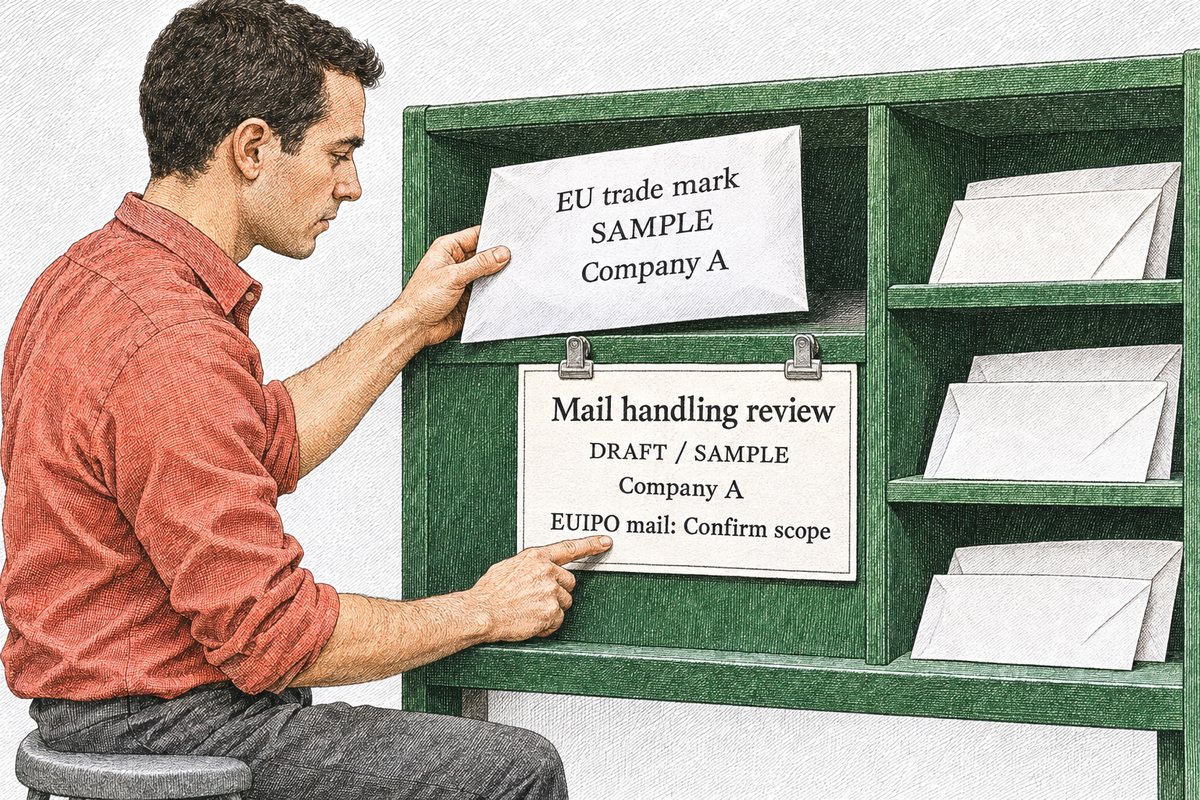
You run an online business and want one Irish address for company registration and a European Union trade mark application. Before buying an address, separate three questions: who will own the mark, what address correctly identifies that applicant, and who will receive and act on correspondence. One address order does not settle all three.
This guide concerns ordinary EU trade mark applications to the European Union Intellectual Property Office (EUIPO), not an Irish national trade mark application or an EU design filing. Official material was checked on 14 November 2026, including EUIPO's guidelines effective from 1 July 2026. Use it to prepare an enquiry, not as a clearance opinion or assurance that a particular filing will be accepted.
1. Start with the applicant, not the brand name
Write down the proposed owner in full before discussing address options: an individual, an existing Irish LTD or another legal entity. Then identify the business name or sign being protected separately. CRO business-name registration identifies the people or bodies behind a trading name; it is not the creation of a new company.
Ask your trade mark adviser to check the proposed applicant against your ownership plan. Who pays for the brand, signs customer contracts and needs control if the business is sold? These questions are especially important when a founder already uses the name personally but intends a new company to operate the business.
Do not casually substitute your address provider, formation agent or an Irish acquaintance as the applicant to obtain an Irish-looking address. That changes whose name appears as owner, rather than merely where letters arrive. Keep an accurate record of the intended owner and ask for advice before filing where the company is still being formed.
2. Separate the legal address from a correspondence address
EUIPO distinguishes a legal address from an optional address for service. For a legal person, its guidance points to the registered headquarters or head office shown on a company-register extract. A forwarding address alone is insufficient unless it can be evidenced as the company's registered address. An address for service does not replace that identification requirement.
Prepare the latest company extract and the provider's written allocation in the same legal name. Check spelling, legal suffix, street details and country across the documents. If they disagree, ask which record needs correction before copying one address into every form. Do not alter an extract yourself or treat a sample address on a sales page as allocated to your company.
Use the comparison below to decide what needs confirming. It is not a list of interchangeable address products. Describe the role you need the address to perform, rather than asking only whether the provider offers an Irish postcode.
| Address or role | Purpose | Check first |
|---|---|---|
| CRO office | Statutory mail | Allocated office |
| EUIPO address | Applicant record | Owner and proof |
| Mail address | Postal contact | Handling terms |
| Agent | Proceedings | Authority |
3. An address contract is not an exemption from representation
Article 119 of the EU Trade Mark Regulation generally requires applicants without EEA domicile, principal place of business or a real and effective industrial or commercial establishment to be represented, except for filing the application. It also contains an employee-representation exception involving economically connected legal persons. Article 120 specifies eligible professional representatives; not every administrative agent qualifies.
EUIPO assesses the applicant's legal address, not nationality. A PO box, correspondence address or an agent's address alone does not satisfy the establishment test. Do not assume that every overseas-owned Irish LTD needs representation simply because its shareholder or director lives abroad; assess the company that is actually applying.
Ask EUIPO or a qualified trade mark adviser to assess uncertain cases before relying on self-representation. Tell them where the applicant is legally based, how it operates and what evidence is available. Explain any proposed economically connected-company arrangement rather than describing an outside consultant as an employee.
Budget for the application and subsequent proceedings as separate stages. EUIPO's representation FAQ explains that a non-EEA applicant may file initially but must arrange required representation afterwards. Being able to open the form or pay the filing fee does not establish that the rest of the process can be completed without a representative.
4. Two examples: a foreign individual and an Irish company
Consider a fictional individual living outside the EEA who has not incorporated an Irish company. Buying mail handling does not change the identity or legal circumstances of that individual. The sensible next step is a representation and address enquiry, not entering the provider's address as a new personal domicile.
Now consider a separately incorporated Irish LTD intending to own the brand, with its registered seat evidenced on the company register. The company's application must be assessed as that company's application, not automatically as its overseas founder's personal application. Match the evidence to the applicant and have any uncertainty reviewed.
Neither example is a promise of acceptance. The practical lesson is to send a precise brief: proposed owner, current status, address role and requested service. If the mark is to stay personally owned and be licensed to the company, tell the adviser that too; do not quietly switch ownership because a different name makes the address form easier to complete.
5. Confirm what the CRO address service actually provides
CRO requires an Irish company's registered office to be a physical location in the State, not merely a PO box. Documents must be deliverable there. Its guidance also explains that a B2 address change takes legal effect when registered. Ordering a replacement service is not itself the filing or proof that the public record has changed.
Ask for the allocated address, the contracting provider's legal identity, and who actually operates the premises and receives documents. If an authorised registered-office agent arrangement is proposed, ask whose authorisation and agent details apply. Do not infer that a marketing brand is itself an approved agent or that a sample address is available for immediate use.
Keep confirmation for your own company, not a generic letter covering another client. Coordinate the start date with incorporation or an existing-company change. If you are buying only for a sole trader or a foreign entity, ask whether the product can support that use rather than assuming a company registered-office plan is a general-purpose virtual-office subscription.
6. Agree EUIPO mail handling separately
StartCompany.ie's published registered-office scope includes official CRO and Revenue correspondence under the service terms. That is not confirmation that EUIPO correspondence is covered. Describe the proposed trade mark use before ordering and obtain written confirmation of any additional handling, exclusions and total payable.
Both annual plans have one combined allowance of up to 10 incoming letters/documents per month by post or courier. Standard has no document scanning; the scanning plan includes scanning within the same allowance. General parcel handling is excluded. Neither option automatically supplies trade mark filing, clearance, legal representation, workspace or annual-return filing.
Ask how originals would reach you: permitted destination country, dispatch frequency, tracked delivery options, postage or handling charges, and retention before collection or disposal. Do not treat an annual price as an unlimited international forwarding promise. Explain whether your expected documents include signed originals, bulky enclosures or time-sensitive notices.
Agree who monitors the relevant online account and instructs any representative. Mail notification, opening a scan, legal review and responding to a deadline are different tasks. Name a responsible person and an escalation contact; buying scanning is not buying a deadline-management or response service.
7. Keep company-name approval and brand clearance separate
CRO says it does not check proposed company names against the business-name and trade mark registers. An accepted company name therefore does not establish trade mark availability. IPOI also advises checking protected rights before choosing a company name or brand. Do not describe a routine formation name check as a clearance opinion.
Prepare the exact sign, intended goods or services and markets for the trade mark adviser. Distinguish the public-facing brand from the company name that contracts with customers. The address question should be resolved alongside these instructions, not used as a substitute for deciding what protection is actually needed.
If your budget is limited, ask for clearly separated quotations: formation if needed, annual address service, any additional mail handling, and specialist trade mark work. Compare like-for-like scopes. A cheap address does not answer whether a mark is registrable, whether an earlier owner can object or what services an adviser will undertake after filing.
8. Send this checklist before purchasing an address
A useful initial enquiry can be short and non-confidential. State whether the company already exists and the address roles you need, then ask the provider and trade mark adviser to confirm their separate responsibilities. This is a practical briefing checklist, not an official EUIPO attachment list.
- Identify the intended applicant and whether it is an individual or legal entity.
- State incorporation status and provide the full company name and CRO number if available.
- Explain whether the address is needed as registered seat, correspondence address or both.
- Ask which company-register evidence and written address allocation will be supplied.
- Have the representation position checked using the applicant's actual circumstances.
- Confirm EUIPO-mail permission, scanning, monthly limits and excluded items in writing.
- Request forwarding destination, dispatch method, charges, retention and urgent-notice arrangements.
- Agree activation, annual renewal, termination handover and who monitors deadlines.
9. Plan privacy, renewal and a later address change
Article 111 of the EU Trade Mark Regulation provides for a public register containing proprietor identity and address information, with specified register data retained indefinitely. Do not assume an address-service purchase erases earlier disclosures or turns the application into a private record.
Before filing, ask which details will be published and what lawful address options fit your circumstances. Provide required evidence through an agreed secure route, not by placing passports, banking credentials or personal tax identifiers in a general enquiry message. Keep provider permission, adviser instructions and application references together.
Add the address-service end date to your own renewal schedule. StartCompany's published order covers 12 months; renewal is arranged separately, not through an automatic subscription. If you move provider, coordinate both the company record and the trade mark correspondence arrangements. Do not assume a CRO update propagates to every other register or that a cancelled provider will keep forwarding indefinitely.
Compare the current registered-office plans and total payable on the service page. For a proposed EUIPO use, contact us before purchase so the requested address and mail scope can be confirmed. Use a qualified trade mark adviser for applicant eligibility, representation and protection strategy; the address order is not an approval or legal opinion.
StartCompany.ie service
Registered Office Address
Official information and next steps
Official sources checked on 14 November 2026, including EUIPO guidelines effective 1 July 2026. This is a buyer preparation guide for EU trade marks, not advice on a particular applicant, clearance or a representation engagement.
- EUIPO: July 2026 parties and professional representation guidelines
- EU Trade Mark Regulation 2017/1001: Articles 111, 119 and 120
- EUIPO representation FAQ: initial EU trade mark filing and later representation
- CRO: registered-office physical location, agents and changes
- CRO: business names identify the legal persons behind a name
- CRO: company-name checks and trade mark rights
- IPOI: avoiding infringement when choosing a name or brand