
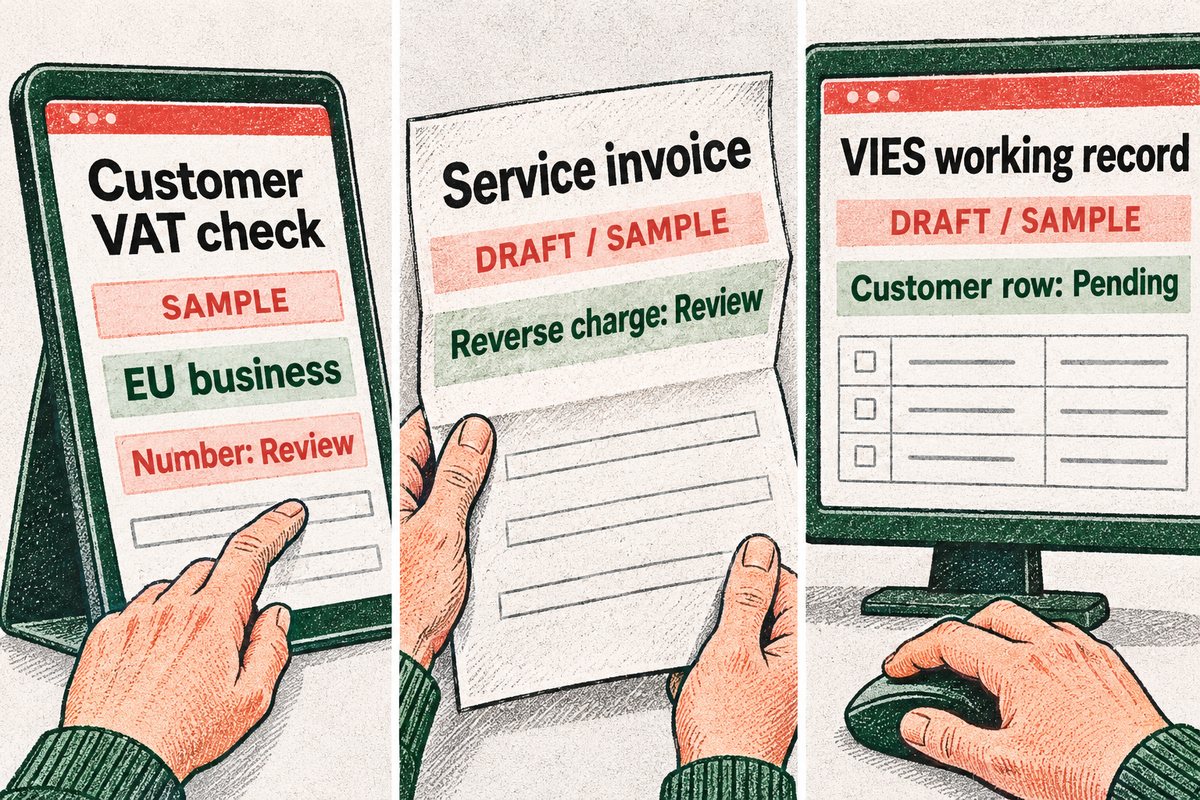
Your Irish LTD has agreed its first project for a business elsewhere in the EU. The client asks for an invoice without Irish VAT, but your accounting software offers several different zero-tax codes. Which one is right, and does anything still have to be reported?
This checklist concerns ordinary general-rule services supplied by an Irish-established, VAT-registered business to an EU business customer. It is not a goods-export guide or a universal rule for every online sale. If registration, customer status or an exemption is unresolved, settle that first rather than copying the example into a live invoice.
1. Identify the service and the establishment receiving it
Revenue's general B2B rule places the supply where the business customer is established, including a relevant fixed establishment. For an Irish supplier serving an overseas business under that rule, the customer generally accounts for the tax. A foreign billing address alone does not decide which establishment actually receives the work.
Write a one-sentence description of what you deliver and to whom. For example: ongoing management consultancy for a client's overseas head office, with no other establishment receiving the service. Send the contract and actual delivery facts to the adviser, not just the client's country and a request to remove VAT.
Property-related services, event admission, passenger transport and other exceptions need their own review. Consumer sales are a different branch of the decision, particularly electronically supplied services. Neither an EU email address nor a business-looking website makes every transaction a standard B2B reverse-charge supply.
2. Check registration before choosing an invoice code
If you already have an Irish VAT registration but only domestic status, do not assume the same setup is ready for EU business trade. Revenue directs businesses intending to trade with businesses elsewhere in the EU to apply for intra-EU status. Domestic-only traders can apply to change their status; approval brings automatic VIES registration.
Not registered at all? This article's registered-supplier example is not an instruction to elect into VAT automatically. The principal services threshold is currently EUR42,500, but domestic turnover alone does not resolve every cross-border obligation or exemption. Ask for a written decision covering the actual supplies, purchases, effective date and necessary registration or identification before using a VAT invoice template.
Irish incorporation and a CRO number are not proof of VAT registration or Irish establishment for VAT purposes. If the business is actually operated abroad, disclose that fact. The correct registration route and place-of-supply analysis must reflect the operating arrangements, not the most convenient address on the incorporation certificate.
3. Keep small-business exemptions separate from reverse charge
The optional cross-border EU VAT SME Scheme has its own application and reporting rules. Revenue lists conditions including the EUR100,000 Union turnover ceiling, the relevant destination threshold and establishment requirements. Staying below an Irish threshold does not activate that scheme in another country.
If you use or intend to use an EX identification number, tell the adviser before applying this checklist. A qualifying SME-exempt supply and an ordinary taxable service for which the customer accounts for VAT are different treatments. The worked example below assumes no SME exemption is being applied to that supply.
Put the exemption question in the engagement brief rather than expecting an invoice-setting change to answer it. Record which transaction is covered and from what date. A choice made for one country or activity should not silently be copied to all clients, and an application in progress is not evidence that an exemption already applies.
4. Build a customer-status file, not just an address book
Revenue requires the EU business customer's VAT number to be obtained and its validity checked, the number included on the invoice and transaction records retained. Keep the dated validation result with the legal customer's details, contract and receiving-establishment explanation. A valid number is useful evidence, not a substitute for identifying the actual supply.
Where a new business has no VAT number yet, Revenue points to a letter from its tax authority; the VIES statement will still need the correct number. Do not invent a placeholder or borrow another group company's number. Have the adviser resolve the evidence, invoice timing and reporting process for the specific case.
Make someone responsible for unresolved checks. A useful internal note states what is missing, who requested it and when the case will be reviewed. If the customer changes its contracting entity between quotation and billing, repeat the identity check rather than treating the original onboarding email as permanent authority.
5. Prepare the invoice as a reverse-charge service invoice
Use the supplier's correct registered details, a unique sequential invoice number, issue date, customer details, service description, supply date and consideration. Revenue requires the customer's VAT number and a reverse-charge notation for this type of invoice. Where reverse charge applies, the VAT payable is not displayed on the invoice.
Do not label the transaction simply 'VAT exempt' or copy wording for an intra-Community supply of goods. Those labels can produce different bookkeeping and reporting outcomes. Ask the accountant which software code both produces the required wording and sends the transaction to the correct return reports; a visually plausible PDF is only half the check.
Save the approved sample and the reasoning with your billing procedure. Before releasing the first invoice, compare the rendered document with the customer record and draft return output. This is a controlled first-use check, not a reason to delay statutory invoicing deadlines indefinitely while waiting for an application or client response.
6. Worked example: EUR2,000 of ordinary consultancy
Assume a fictional Irish-established LTD is VAT registered with intra-EU status. It supplies EUR2,000 of ordinary management consultancy to a VAT-registered business established in another EU Member State, which has no other receiving establishment. Customer checks are complete, the service is taxable there and no SME exemption or place-of-supply exception applies.
On those assumptions, the Irish supplier invoices EUR2,000 without adding Irish VAT and includes the required customer VAT details and reverse-charge wording. It does not calculate the customer's foreign VAT liability on the supplier invoice. The customer deals with its own local accounting obligation; full recovery by that customer is not something the Irish supplier should promise.
The useful comparison is between outcomes, not a menu from which the customer chooses its preferred tax result. Changing the contract, recipient or service can change the answer. The amounts below illustrate a client's hypothetical trade, not StartCompany.ie service prices.
| Facts | Action before billing |
|---|---|
| Confirmed ordinary EU B2B service | Apply the agreed reverse-charge invoice and reporting treatment |
| Customer VAT details unresolved | Resolve evidence, timing and reporting with the adviser |
| Consumer or special service | Review the applicable place-of-supply rules separately |
| SME exemption proposed | Confirm scheme coverage and effective date first |
7. Schedule VIES separately from the VAT3
Section 83 covers statements of intra-Community services where the recipient is liable under Article 196 of the VAT Directive. For services statements, the normal statutory cycle is quarterly, due by the 23rd of the following month, with a monthly election available. Once relevant filing obligations exist, a quiet period can still require a nil statement unless Revenue authorises otherwise.
For example, a services-only quarterly statement for October to December 2026 is ordinarily due by 23 January 2027. Confirm the company's actual filing frequency, reporting period and any combined goods activity with the preparer. A goods-trading business should not adopt a services-only timetable without checking its existing obligations.
The VAT3 has a separate ES1 field for intra-EU services supplied. Filing the VAT3 does not file VIES. Give the preparer the invoice register, customer VAT identifiers, supply details and any adjustments so both sets of figures can be checked. In the hypothetical EUR2,000 case, have the ordinary reverse-charge service reflected consistently in the appropriate VIES and ES1 reporting, not treated as a vanished sale because Irish VAT was not charged.
8. Assemble one first-client handover pack
Use the first transaction to establish a repeatable procedure. One organised pack lets the adviser spot inconsistent facts before a registration request, invoice and return each tell a different story. This is a practical preparation list, not Revenue's exhaustive document requirement.
- Describe the service, contract and actual establishment receiving the work.
- Record the company's current registration, intra-EU status and effective dates.
- List expected customer countries, types and transaction values.
- Keep the customer's legal identity and dated VAT validation evidence together.
- Flag missing numbers, special services and proposed SME exemptions for review.
- Provide the draft invoice and accounting-code output, not only the PDF design.
- Assign VAT3 and VIES preparation, review, submission and deadline ownership.
- Agree which questions need specialist advice and which are registration administration.
9. Buy the support required, not a duplicate registration
StartCompany.ie's Tax Registration service supports relevant Revenue registrations. Review the current scope and total payable, then confirm whether you need a new registration, an intra-EU status application or advice before either. Revenue may request evidence of genuine intended trade; an order is not a guaranteed number, approval or completion date.
A registration order does not automatically include review of every foreign contract, destination-country tax advice or ongoing VAT3 and VIES preparation. Agree these separately. If you already have the correct status, the immediate need may be invoice setup and recurring compliance rather than another application.
Use the linked VIES-validation guide if an existing identifier is rejected, and the overseas-director guide if the application route is uncertain. If the company also buys software or professional services from abroad, review that separate purchase-side trigger. Resolving the outgoing invoice does not settle the company's incoming-service obligations.
StartCompany.ie service
Tax Registration
Official information and next steps
Primary sources checked on 16 November 2026. The worked example is fictional and assumes a VAT-registered Irish-established supplier, an ordinary taxable general-rule EU B2B service and no SME exemption. It is not a determination of a particular company's establishment, registration liability or foreign tax treatment.
- Revenue: general place-of-supply rules for services
- VAT Consolidation Act 2010, section 34: general services rules
- Revenue: exceptions for particular services
- Revenue: customer identification and EU services obligations
- Revenue: two-tier VAT registration
- Revenue: VAT thresholds
- Revenue: registration methods and effective dates
- Revenue: optional EU VAT SME Scheme
- Revenue: invoice details and reverse-charge presentation
- VAT Consolidation Act 2010, section 83: services statements
- Revenue: VAT3 and ES1
- Revenue: services received from abroad