
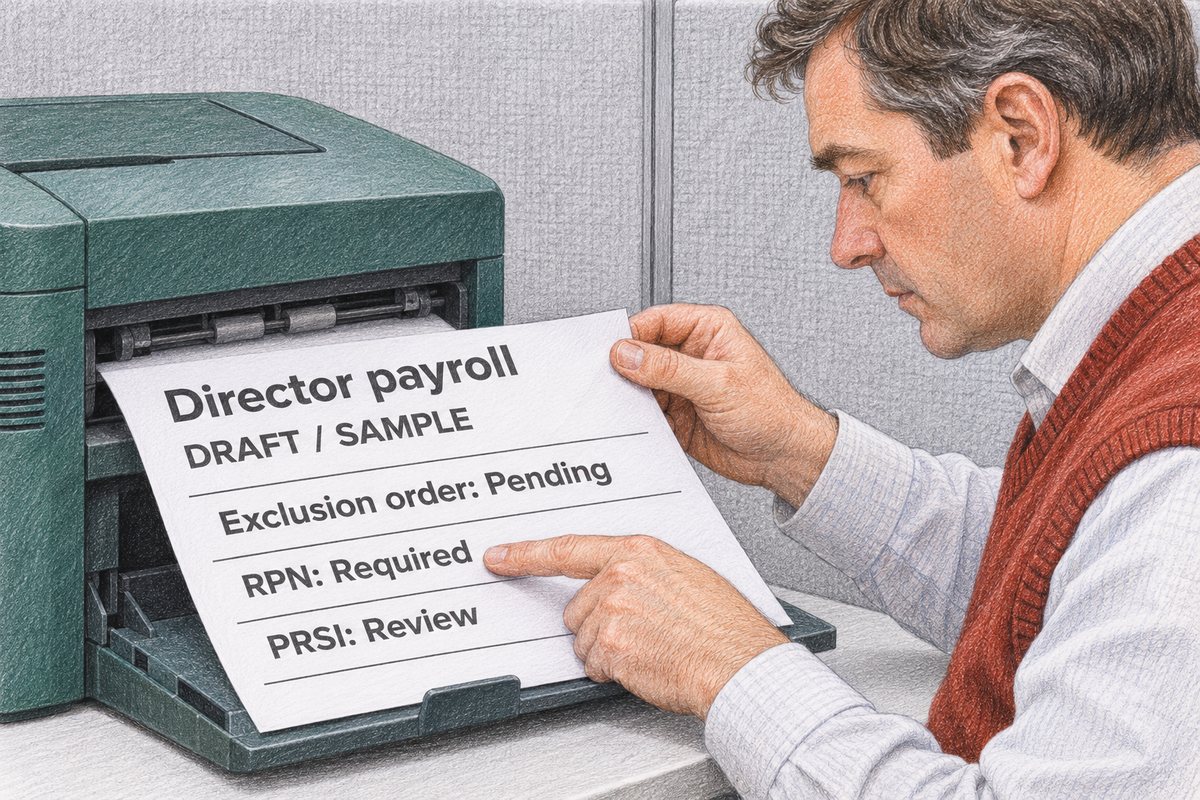
Living outside Ireland does not, by itself, let an Irish company pay its director without Irish payroll deductions. That can be an unwelcome discovery when a founder has already agreed a monthly payment and assumed that working from home abroad settles the tax position.
The useful question is narrower: does this particular director's income qualify for treaty relief, and has Revenue issued the payroll instruction the company needs? Establish that before changing deductions, rather than treating the application as a formality.
This guide is for the company preparing that decision and its payroll handover. It is not a country-specific treaty opinion or a guide to the director's personal tax return. The Revenue pages were checked on 18 November 2026; the application, pending-order and PRSI pages carry publication dates of 6 November 2026.
Start with the directorship, not the home address
Revenue treats the director of an Irish-incorporated company as holding an Irish public office. Remuneration from that office falls within Irish Income Tax and USC rules regardless of where the director lives or performs the duties, subject to applicable treaty relief. Paying into a foreign bank account does not answer that question.
Ask the adviser to identify the relevant treaty provision and explain why it changes the treatment of this payment. The existence of a treaty is not an exemption. Revenue's Exclusion Order manual also says orders should not issue for directors resident in countries without a tax treaty with Ireland.
Keep the question concrete: which company is paying, what is the payment for, which tax year is involved, and what facts support the claimed residence? A short written conclusion tied to those facts is more useful to the payroll operator than a general statement that the founder is an overseas resident.
Do not borrow the ordinary overseas-employee exception
Revenue describes a separate route for certain non-resident employees recruited and working abroad. One express condition is that the person is not a director of the company. Even for qualifying employees, that route requires prior Revenue authorisation through MyEnquiries; it is not an informal decision to leave someone off payroll.
Nor should ordinary employee guidance about incidental Irish duties be treated as a director safe harbour. A travel calendar remains useful evidence, but counting days alone does not establish the treatment of directorship income.
Revenue distinguishes a directorship from other offices, employments and occupations a person may hold. If different roles are genuinely relevant, supply the contracts and actual duties for review. Do not relabel director remuneration as consulting fees or manufacture a split merely to seek an exclusion.
Four different decisions can sit behind one payment
A founder may hear that the company needs PAYE registration and assume this includes permission to pay without deductions. It does not. Use the following comparison when agreeing the work with an accountant or registration provider.
The separation also helps when changing advisers. Ask the outgoing provider for the actual registrations, application history and instructions, not simply confirmation that the account was set up.
| Decision or record | What to establish |
|---|---|
| Employer and employment setup | The company's PAYE position and the director's registered employment and Employment ID. |
| Exclusion Order application | The eligibility case, correct applicant type and supporting evidence; submission is not approval. |
| Payroll instruction | An issued order's actual coverage, dates and conditions, or the RPN while approval is pending. |
| Social insurance and personal tax | The separate PRSI position and any Irish or overseas personal-return obligations. |
Prepare the evidence before opening the application
Revenue's application page lists the individual's name, PPSN, foreign address, country of work and a letter explaining the period working abroad. It also requires a registered employment with an Employment ID. Establish who will arrange that setup before promising a first pay date.
For a director case, those identity and employment details do not replace the treaty analysis. We suggest preparing one indexed file containing the factual timeline, explanation of the payment and the adviser's relief analysis, with documents supporting each point. Ask which residence evidence Revenue needs for the specific claim rather than assuming one universal certificate settles every case.
If a PPSN or payroll identity issue is unresolved, raise it at the outset. Do not invent a number or enter the company number into a personal-identifier field to get past validation. Our separate director-payroll identity guide covers that setup problem.
Send sensitive records through an agreed secure channel. The person preparing the application needs enough evidence to support it, but a general sales enquiry is not a reason to email a passport and a complete tax history indiscriminately.
Use the right application type and keep the submission trail
The published ROS route is Other Services, PAYE Exclusion Order, then New PAYE Exclusion Order. Choose the appropriate order type, complete the details, attach the required evidence and review the declaration before submission. This describes Revenue's published route, not a private-account test carried out for this article.
The online guide includes a directors' fees applicant category. Its presence in the menu is not an eligibility decision. The guide says the portal is for current-tax-year applications; requests concerning earlier years need the relevant tax-return and supporting-letter route rather than a backdated current-year portal selection.
Save the submitted summary, attachments and reference together. Revenue's guide explains that progress can be checked through previous submissions and that further information may be requested through MyEnquiries. Appoint somebody to monitor that inbox. A submitted application left unanswered is not a completed payroll handover.
Before clicking submit, compare the employment, payment description and dates with the evidence pack. A neat cover letter cannot fix contradictory underlying facts. If another adviser prepared the treaty analysis, make sure the applicant is using its final version.
While Revenue is deciding, keep the payroll instruction clear
Revenue says to request a Revenue Payroll Notification, or RPN, where an application has been made but an order has not yet been granted. A submission acknowledgement is not an issued order. Give the payroll operator that distinction explicitly before the next payment.
Once an Exclusion Order is in effect, Revenue says the employer need not request an RPN and may operate the granted order. For payments outside a part-year order's coverage, the manual requires the latest RPN. Check the actual coverage before switching payroll settings.
Build a small control into the payrun: record who checked the decision, which document they used and the period it covers. If the decision arrives after a payment, obtain advice on the correct treatment of that earlier run. Do not promise a refund or reverse deductions simply because an application was later successful.
Two practical examples, without predicting a treaty outcome
Example one: a founder works from another country throughout the year and asks the bookkeeper to pay director fees gross because there were no Irish visits. The missing step is not a travel spreadsheet. It is the director-specific analysis of the income and any treaty relief, followed by the appropriate Revenue instruction. Until then, the bookkeeper should not treat the founder's request as an approved exclusion.
Example two: a company's payroll operator receives an email headed 'application complete'. Before changing the payrun, they ask whether that means the form was submitted or Revenue issued a decision. The founder and adviser use a shared status record to prevent an ambiguous message becoming a payroll instruction.
These are fictional workflow examples, not examples of approved clients or an indication that either person qualifies. Their purpose is to show where responsibility can be lost between the founder, adviser and payroll operator.
PRSI and the expiry date need their own follow-up
An Exclusion Order concerns Income Tax and USC deductions. Employee PRSI and employer PRSI may still apply. Revenue directs employers to the Department of Social Protection for advice and says any PRSI deducted, the PRSI class and insurable weeks belong on the payroll submission.
Obtain a separate social-insurance conclusion for the actual cross-border arrangement. Do not assume the order establishes the correct PRSI class, proves coverage abroad or removes all employer reporting. Ask which evidence the payroll operator should retain.
The order has an expiry date and may cover only part of a tax year. Put its start and end dates into the payroll handover and assign a review owner. Revisit the position if the facts change, rather than waiting for the last covered payment. A further application is not an automatic renewal.
What to have ready before the first affected payrun
Use this as a handover checklist, not as a declaration that the director qualifies. The payroll operator should be able to identify the instruction to follow without interpreting a chain of informal messages.
- Identify the paying company, director, payment type and tax year.
- Record the residence and work-location facts and the relevant dates.
- Obtain the director-specific treaty analysis before relying on an exemption.
- Resolve the PPSN, registered employment and Employment ID requirements.
- Save the application summary, evidence and any Revenue questions securely.
- State whether an order is pending or actually issued; identify the RPN or operative order.
- Document the separate PRSI decision and the order's coverage and expiry.
- Name the adviser, payroll operator and person responsible for monitoring changes.
Agree registration support separately from the exemption review
StartCompany.ie's tax-registration service is a starting point if the company needs help establishing the relevant Revenue registrations. Before purchasing, explain that the proposed payment is to an overseas director and ask us to confirm the accepted scope and total payable.
Registration support is not automatically an Exclusion Order application, a treaty opinion, recurring payroll, personal Form 11 work or advice on foreign employer obligations. Those tasks need separate confirmation; specialist advice may be required. An Irish company registration also does not settle where the company is tax resident.
Send a short outline first: the company stage, whether PAYE already exists, the director's country of tax residence, the proposed duties and the intended payment date. We can then clarify the registration request and what further professional review needs to be arranged. Do not buy a routine registration service on the assumption that Revenue will grant an exclusion.
StartCompany.ie service
Tax Registration
Official information and next steps
Official Revenue guidance checked on 18 November 2026. The web application, order and PRSI pages are dated 6 November 2026; the portal guide is dated July 2025, the Exclusion Order manual July 2026 and the director-income manual March 2025. General guidance only, not a personalised tax or social-insurance opinion. No private Revenue account or real payroll submission was used.
- Revenue: non-resident directors and the different employee exception
- Revenue: application information and registered Employment ID
- Revenue: pending applications, RPNs and the order's expiry
- Revenue: PRSI can remain payable under an Exclusion Order
- Revenue: online application guide, July 2025
- Revenue: PAYE Exclusion Orders manual, updated July 2026
- Revenue: directors' remuneration and distinct roles, reviewed March 2025
- Revenue: what a PAYE Exclusion Order authorises