
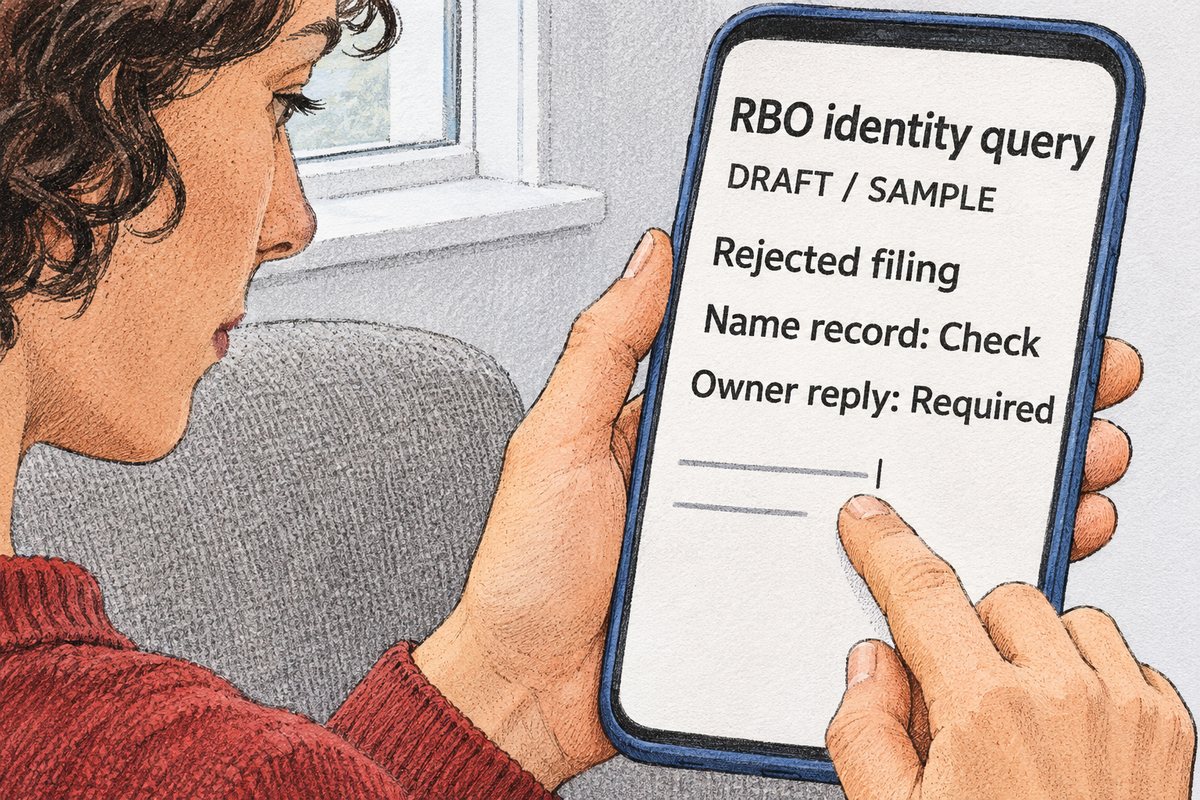
Your company is incorporated, the ownership details have been collected, and an RBO filing has been attempted. Then it appears as rejected. Should you change the name, ask the formation agent to try again, or buy an IPN?
Start with the exact failure and the person's existing identity route. A rejected submission, a record needing official correction and a genuinely new identity-number application are different jobs. This guide helps an ordinary Irish LTD prepare a useful brief without guessing personal details or treating another purchase as an automatic solution.
1. Establish whether the filing was rejected, pending or registered
Save the submission reference, date, status and any notice before changing anything. Ask the presenter which company and attempt the message concerns. Do not confuse a saved draft, an upload acknowledgement and a completed registration, or assume an old rejection describes the latest attempt.
RBO says an unvalidated owner can cause the whole submission to be rejected. A Submitted status can instead mean verification is pending. The first task is therefore to establish the actual position, not automatically enter another identical filing.
Keep a short event log: what was submitted, what happened, who is checking the issue and the next agreed action. Separate personal correspondence from the general company task list. This prevents one person repeatedly resubmitting while another is still arranging an underlying correction.
2. Identify the right route before ordering number work
Establish whether the person already has a PPSN, an issued IPN or an older RBO identifier. Obtain the original confirmation securely where needed. Living abroad does not prove that someone has never held an Irish PPSN, and a company number is not a personal identity number.
RBO's PPSN guidance says an IPN must not be requested where a PPSN has already been assigned. For an eligible person without a PPSN, the VIF process can produce an IPN reusable for future beneficial-ownership filings. It is not a number to order anew for each company or failed attempt.
CRO also says the IPN route is not open to an Irish citizen resident in the State, including part-time residence; that person must obtain a PPSN. Check eligibility and any existing number before commissioning an application. A provider should be able to explain why new-number work is actually needed.
| Situation | Starting point |
|---|---|
| PPSN already assigned | Check the entry and DSP identity record |
| IPN already issued | Retrieve the issue record and resolve any mismatch |
| Older RBO identifier | Confirm the existing record and applicable route |
| No number, eligible applicant | Assess the current VIF application process |
3. For PPSN filings, compare with the DSP record
The forename and surname entered for the PPSN must match the Department of Social Protection record. Check the date of birth and number too. Do not substitute a nickname, preferred everyday name or a convenient spelling merely because it appears on company emails.
Compare each owner separately with the information actually entered. A correct document in the folder does not prove its details were transcribed correctly into the form. Check first-name and surname fields, date entry and whether information from two people was mixed during preparation.
If the entry was wrong, arrange an accurate correction through the presenter. If the underlying official record is uncertain or wrong, establish the authoritative details first. Repeatedly trying variations until one passes is not a reliable identity-review process.
Revenue confirms that DSP manages PPSN name changes and that Revenue updates its name record after DSP has done so. A tax-portal profile edit is therefore not a substitute for resolving the underlying PPSN record. An adviser cannot make that official change merely by changing the company's spreadsheet.
4. Allocate owner contact and presenter work correctly
RBO says it can engage about personal data only with the beneficial owner as data subject, by email at enquiries@rbo.gov.ie. Its guidance separately explains the DSP enquiry route, including signed authority where a representative makes that enquiry. Presenter status is not blanket permission to obtain the owner's personal record from RBO.
Agree a practical division of work. The presenter can organise the company reference and filing history; the owner checks their record and follows the appropriate official instructions; the company tracks the outstanding filing. Do not promise that a paid agent can bypass the owner's involvement.
Navigate independently to the official guidance and verify the contact route before supplying identity documents. Do not send passwords, one-time codes or account access. Keep full identifiers out of general support tickets and shared project notes; arrange any necessary evidence transfer through a specifically agreed process.
5. Existing IPN: recover and review before applying again
If an IPN has already been issued, start with the issue confirmation and the identity details used in its application. Confirm that the number belongs to the actual owner, not another director or an unrelated entity. Explain any name change or suspected error to the relevant authority rather than creating a replacement story.
CRO's VIF guidance highlights name-part ordering, punctuation and date-of-birth consistency. Its B1 guidance identifies directorid@cro.ie for IPN questions and RBO for older RBO-number queries. Those are useful record-enquiry routes, not a promise that a CRO filing instruction is the RBO resubmission procedure.
Provide the authority with a concise description of the issue and follow its current evidence instructions. Keep the reply and any corrected-record confirmation for the presenter. Do not amend a sworn declaration or reuse somebody else's identifier to get past validation.
6. New IPN only where genuinely needed and eligible
A fictional overseas founder has no PPSN and no existing alternative identifier. After eligibility is established, new IPN work may be appropriate. This differs from a founder who already has a PPSN but has used an everyday shortened name in the filing. The second founder needs a record-and-entry review, not a new-number shortcut.
For a new application, use the current VIF available through CORE and coordinate the form, identification and witness requirements before signing. CRO no longer accepts online witnessing from 30 April 2026: the witness and declarant must be physically in the same room. Older versions received after that change are rejected.
IPN issuance is not RBO registration. Once the correct identifier is available, the company still needs the appropriate ownership filing and confirmation of its outcome. Witnessing, identity-number work and the RBO submission should have named responsibilities rather than being assumed to form one automatic purchase.
7. Keep ownership, authority and deadlines separate
RBO's current guidance gives a newly incorporated relevant entity five months from incorporation to register. Do not assume an unsuccessful attempt pauses that period. If the deadline is near or already passed, promptly ask the presenter or appropriate adviser about the actual compliance position and preserve the filing history.
An identity problem does not justify omitting a real beneficial owner, substituting a willing director or changing the nature of control to make a form easier. RBO is concerned with the relevant natural people, who are not necessarily all the shareholders or directors. Obtain separate advice where the ownership analysis itself is uncertain.
CRO and RBO are separate processes. CRO's B1 guidance allows certain close-name matching and alternate-name facilities; RBO's PPSN guidance requires an exact match to DSP. A successful CRO submission is not proof that the RBO attempt registered, and CORE feedback tools should not be described as RBO portal controls.
A rejected attempt is also different from an incorrect entry already registered or a formal discrepancy notice. RBO gives those their own processes. Identify the actual problem before asking for a resubmission, amendment or specialist review; an ordinary entry error should not automatically be described as fraud.
8. Prepare a correction brief before the next attempt
A useful brief states what is known, what is uncertain and whose action is outstanding. Send a general enquiry without personal identifiers first. After the scope and secure route are agreed, supply only the evidence needed for that task.
Once the underlying issue is resolved, have the presenter use the current portal workflow appropriate to the filing's status. Retain the resulting registration evidence and reconcile the internal company record. Do not count an email saying documents received as proof that the RBO filing itself has completed.
- Company number and the actual RBO submission reference and status.
- Filing dates, notices and the relevant company deadline.
- Affected owner's identity route, without publishing the identifier in shared notes.
- A secure comparison of the entry with the authoritative or issued record.
- Any confirmed record change and outstanding owner or authority response.
- Ownership and control analysis unchanged unless the underlying facts require review.
- Named responsibility for evidence, correction, resubmission and follow-up.
- Separate completion evidence for IPN issuance, RBO registration and any CRO filing.
9. Buy the work that is actually missing
StartCompany.ie's IPN/VIF service supports eligible applications and existing-number checks. Review that scope before ordering. If the person already has a number or the issue concerns an RBO rejection, describe the problem first and ask what assistance can be accepted; do not buy a fresh IPN merely because checkout is available.
A new IPN application does not automatically include correcting DSP records, obtaining confidential information from RBO, resolving an ownership dispute or completing an RBO resubmission. Confirm any separate work, witness arrangements, responsibilities and total payable in advance. There is no fixed authority-processing or registration guarantee.
For a new formation, compare the current package inclusions separately. Premium lists RBO registration support; that does not remove the need for accurate owner information or automatically include every historic correction. Ask what is covered for your actual company and stage rather than assuming incorporation or a number application completes all first-year compliance.
StartCompany.ie service
IPN/VIF Number Application
Official information and next steps
Primary RBO, CRO and Revenue guidance checked on 17 November 2026. This guide distinguishes entry errors, official identity records, alternative identifiers and separate filings; it does not determine an individual's identity, eligibility, ownership or compliance outcome. Follow the current authority instructions for personal-data enquiries and evidence transfer.
- RBO: rejected and submitted filings, owner contact and correction guidance
- RBO: PPSN matching, reuse and no alternative-number workaround
- CRO: beneficial owners without a PPSN and IPN eligibility
- CRO: VIF name and date-of-birth consistency
- CRO: VIF physical witnessing and current-form rule
- CRO: B1 identity matching and IPN enquiry routes
- Revenue: DSP-managed PPSN changes and online security
- RBO: relevant entities, five months and ownership responsibilities
- RBO: discrepancy and non-compliance processes