
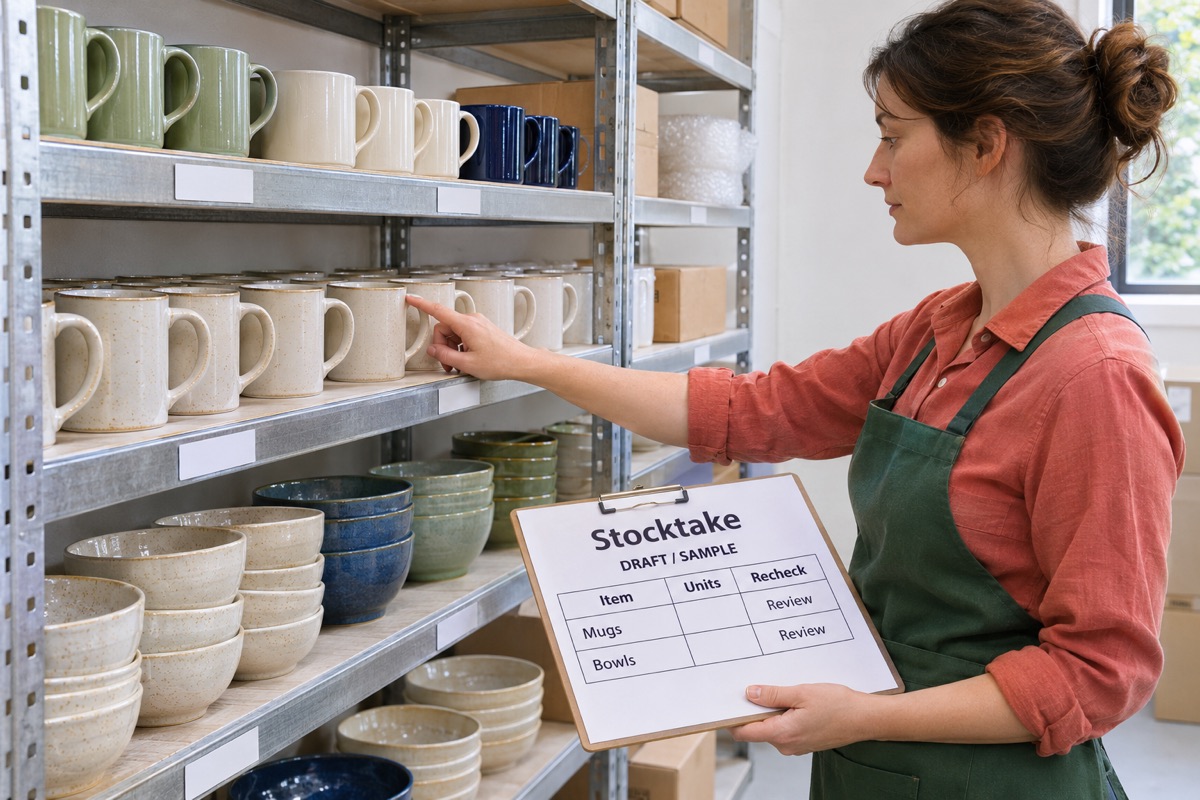
Your Irish LTD has paid its suppliers and reconciled the bank account, but some goods are still on the shelves, with a fulfilment provider or awaiting return. Those unsold units are part of the year-end accounts question. A list of supplier payments does not tell the accountant what remains, where it is or what its carrying amount should be.
This guide is for small retailers, online sellers and other Irish companies dealing in ordinary goods. It explains a practical stocktake handover, not a complete inventory accounting policy, audit procedure or tax calculation. Manufacturing, construction, agricultural assets and complex contracts need specific advice. Official sources were checked on 11 November 2026; the numerical example is fictional and simplified. Confirm the reporting framework and current amendments applicable to your period with the accountant.
1. Know what the accounting records must support
Section 282(3)(c) specifically addresses companies whose business involves dealing in goods. Alongside purchase and sales records and invoices, it requires statements of stock held at each financial year-end and the stocktaking records from which those statements are prepared. The CRO's proper-books guidance repeats that requirement.
Do not treat this as a requirement to buy one particular app or use a prescribed count-sheet design. The useful question is whether the records explain the stock position and allow the accounts preparer to follow the quantities and values. A warehouse photograph or an unexplained total called closing stock is not an adequate handover by itself.
Ask early how the accountant wants the information presented. Explain the product range, locations, stock system, returns process and whether counts have been maintained throughout the year. If an auditor is involved, agree any separate attendance or evidence requirements in advance rather than assuming ordinary accounts-preparation support includes them.
2. Fix the accounts date and the count date separately
The legal stock statement concerns the financial year-end. Do not substitute the annual return date, the date you emailed the accountant or today's software balance. Write down the relevant accounts date and the actual date and time of the physical count. If different people count different locations, preserve their individual timings.
Where a count is proposed before or after year-end, discuss whether the available movement records will support a reliable reconciliation. Record receipts, dispatches, transfers, returns and other changes across the interval. Do not backdate the count sheet or suggest this guide gives blanket permission to count whenever convenient.
Choose a practical movement-control method. You might pause picking in a counted area, or keep a separate movement log while trade continues. This is an operational suggestion, not a statutory stocktake method. What matters for the handover is that the preparer can identify which units were present at the target date without counting the same movement twice.
3. Make the quantity count traceable
Use an item code and a description that distinguish similar products, sizes or variants. Record the location and unit of measure: one carton of twelve is not one individual item. Separate sealed packs, loose units and part-used materials where relevant, and explain conversions rather than leaving the accountant to guess.
Record who counted, when, and which areas were covered. Mark a counted area clearly and review exceptions, unexpected nil quantities and large differences from the stock system. Keep the original count and a separate explanation of corrections. Do not overwrite the physical result simply to agree with the software balance.
The table is a suggested handover structure, not an official template. Add fields appropriate to the business and keep sensitive or irrelevant information out of a widely shared working file. A consistent product reference is usually more useful than a collection of unlabelled shelf photographs.
| Record | Include | Check |
|---|---|---|
| Count sheet | Item, site, units | Date and counter |
| Movement log | Receipts and dispatch | Cut-off and transfers |
| Cost schedule | Invoice references | Unit cost basis |
| Exceptions | Damage and disputes | Evidence for review |
4. Map every location and unresolved ownership question
List shop shelves, home storage, warehouses, fulfilment providers, goods in transit and returns locations. Obtain appropriate dated reports or confirmations for stock held by others and reconcile transfers between sites. A dispatch from one warehouse and receipt at another should not become either two lots of stock or a missing lot in the combined handover.
Flag consignment goods, customer-owned items, supplier returns, disputed deliveries and goods sold but not collected. Provide the relevant terms, delivery records and invoices so the accountant can assess what belongs in the company's year-end position. Physical possession alone is not the entire accounting analysis, and neither an unpaid invoice nor a payment alone settles every case.
Distinguish stock from equipment used by the business. A display computer or storage rack is not automatically merchandise because it stands beside goods for sale. Explain the intended use and any changes during the year. Overseas stock may also raise separate tax questions: a quantity reconciliation does not resolve registrations or cross-border reporting.
5. Give costs and condition evidence, not just retail prices
For ordinary inventory within its scope, FRS 102 paragraph 13.4 uses the lower of cost and expected sale proceeds after the remaining costs of completion and sale. This is not a rule to value every shelf at its advertised retail total. Ask which framework and inventory policy apply to your company; this guide does not cover every scope exception or prescribe an accounting election.
Supply supplier invoices, discounts, freight and relevant import-cost information. FRS 102's purchase-cost guidance distinguishes directly attributable acquisition costs from taxes recoverable from the tax authorities. Let the accountant assess the actual cost basis rather than simply copying a VAT-inclusive invoice total, a bank payment or a product's website price.
Keep damaged, obsolete, slow-moving or returned goods identifiable. Record the quantities, condition, dates and evidence supporting any expected recovery or disposal. Do not quietly delete them from the physical count or apply an arbitrary percentage reduction to every item. A condition problem needs a valuation review, and any tax or VAT consequences require their own assessment.
6. Worked example: count after year-end, then reconcile
A fictional retailer has a 31 December year-end and physically counts 126 units of one product on 2 January. Between year-end and the count, it received 10 units and dispatched 4. Assume ownership and cut-off treatment are already agreed, all movements are recorded, and there are no returns, transfers or other changes.
The bridge back to year-end is 126 - 10 + 4 = 120 units. Subtract the later receipts and add back the later dispatches. Keep the receiving and dispatch records so the preparer can verify both the quantities and the period. Without reliable movement evidence, the arithmetic alone does not establish the closing quantity.
Assume separately that the reviewed cost is EUR 8 per unit, with no further cost adjustments needed for this simplified example. The cost subtotal is 120 x EUR 8 = EUR 960. An advertised price of EUR 20 does not turn that cost subtotal into EUR 2,400 of inventory. The final carrying amount still needs the applicable valuation and condition review. This example is not a stock journal, VAT calculation or approved tax deduction.
7. If the count was missed, disclose the gap promptly
Tell the accountant what was not counted, when it was discovered and what evidence still exists. Preserve dated stock-system exports, supplier and fulfilment reports, sales records, deliveries, returns and any later physical count. Ask what reconstruction and verification work is possible; do not label a newly invented spreadsheet as an original year-end count.
Where the software and the physical count disagree, supply both versions and a discrepancy log. Possible causes to investigate include pack-size errors, unrecorded returns, duplicate transfers, dispatch timing and damaged goods. These are review prompts, not reasons to force the system to match without evidence.
A clean bank reconciliation does not repair a missing stock trail. Nor should you assume an approaching filing deadline makes an unsupported estimate acceptable. Agree the remaining work and its implications for accounts preparation with the accountant, and seek separate filing advice where necessary.
8. Retain the original trail and the approved adjustments
Keep the count sheets, movement bridge, source reports, cost support, condition review and explanations for adjustments together. Section 285 requires relevant accounting records to be preserved for at least six years after the end of the financial year containing their latest relevant date. That is not permission to discard records automatically when a timer expires; check other obligations and unresolved matters.
Revenue says records should show the accounting process and that the business remains responsible even where an accountant keeps them. Retain company access to the necessary evidence and exports, rather than relying on a warehouse portal or subscription that may later close. Ask what originals and formats must be preserved before replacing or deleting records.
Finish the handover with a version-controlled final schedule, clear unresolved items and the accountant's adjustment references. A suggested stock adjustment is not the same as a reviewed, posted entry. Confirm who authorises and posts changes, then reconcile the resulting inventory ledger to the agreed supporting schedule.
9. Scope the accountant handover before requesting a quote
StartCompany.ie connects companies with accountant support for bookkeeping, financial statements and tax work. Describe the accounting period, product range, number of locations, stock-system access and any missing count or valuation information. Ask whether the adviser can undertake the specific inventory work and when it can be completed.
An accounts-preparation quote is not automatically an on-site stocktake, an audit attendance engagement, a professional valuation or a forensic investigation of shortages. Agree who counts, obtains warehouse evidence, checks cut-off, reviews valuation, posts adjustments and prepares the accounts. Confirm the accepted scope and total payable, including any separate historic reconstruction.
Use this checklist as the initial brief. Do not send customer data or access credentials in a casual enquiry; arrange the appropriate secure handover once the adviser confirms what is needed.
- Financial year-end, actual count dates and responsible counters.
- Itemised quantities, units of measure and every relevant stock location.
- Receipts, dispatches, transfers and returns bridging count and year-end.
- Ownership or cut-off uncertainties with supporting contract and delivery records.
- Cost evidence, discounts, freight and condition or recoverability issues.
- System differences, missing evidence and proposed adjustments clearly marked.
- Named reviewer, posting responsibility, final schedule and retention arrangements.
StartCompany.ie service
Accountant Services in Ireland
Official information and next steps
StartCompany.ie provides preparation and filing support for the service described above. Final acceptance, registration, tax treatment or court approval remains with the relevant authority. Check the current official guidance before acting, particularly where a deadline, tax position, dispute or unusual transaction is involved.
- Companies Act 2014, section 282: accounting and stock records
- Companies Act 2014, section 285: retaining accounting records
- CRO: proper books and year-end stock statements
- Revenue: record keeping and linking documents
- FRC: FRS 102 September 2024, Section 13 Inventories
- FRC: February 2026 amendments to FRS 102 and FRS 105