
You already have an Irish company and an address service. Now you are forming a second LTD, perhaps for another venture or a group subsidiary. Can it use the same registered office? And does the existing order cover the new company?
These are different questions. Sharing suitable premises can be possible, but permission, company records and service coverage need checking for each legal entity. This guide is for buyers arranging a shared registered office, not a recommendation to create a group or a claim that a particular address has been approved for your companies.
1. Sharing an address is not sharing a legal identity
Section 50 requires each company to maintain a registered office in the State and permits an address care of an approved agent. It does not require each company to occupy an exclusive building. Read together with CRO guidance, this supports suitable shared-address arrangements; it does not make every mailbox or workspace acceptable.
The physical location must meet the registered-office requirements, including delivery and access arrangements. A PO Box alone is not sufficient. Establish who controls the premises, who can authorise your company's use and how the relevant requirements will be met.
Section 25 describes the body corporate created on incorporation. Common owners or a shared address do not turn two incorporated companies into one company. Keep their full legal names and CRO numbers separate, including when instructing a provider.
First check that you actually mean two companies. One LTD using two brands is a different situation from two separately incorporated LTDs. Our multiple-businesses guide covers that structural choice; an extra trading label should not be mistaken for another incorporated entity.
2. Ask whether the service accepts both companies
Give the provider a short list of the entities, identifying which already exist and which are proposed. Ask for explicit confirmation of each company's acceptance. The fact that a related company already uses the premises is not permission to put the same address on another company's documents.
Do not assume the provider's existing checks transfer to a new entity. Ask what onboarding information is needed and how it should be supplied. Keep identity documents and private group information out of a general enquiry unless a suitable process has been agreed.
Also identify the actual arrangement. A registered office at premises you are entitled to use and an address care of an approved agent are not interchangeable descriptions. Ask who provides the address and whether an authorised-agent arrangement applies; do not infer that every address seller is itself a CRO-approved Registered Office Agent.
3. Separate the address, order, filing and mail instructions
A useful group schedule has one row per legal company, even when every row contains the same address. The following checks prevent the common mistake of treating one completed purchase as evidence that every company is ready.
Ask the provider to confirm the scope in writing rather than relying on an invoice description such as group address. It should be clear which entities are included, which work remains outstanding and when use is permitted.
| Item | What to confirm per company |
|---|---|
| Address permission | The accepted legal entity, exact address and permitted start date. |
| Service coverage | The entities covered, service period, inclusions and total payable. |
| CRO record | Who prepares the incorporation or applicable address-change notification. |
| Post routing | The authorised recipient, notification contact and handling instructions. |
4. A practical example: an existing LTD and a new LTD
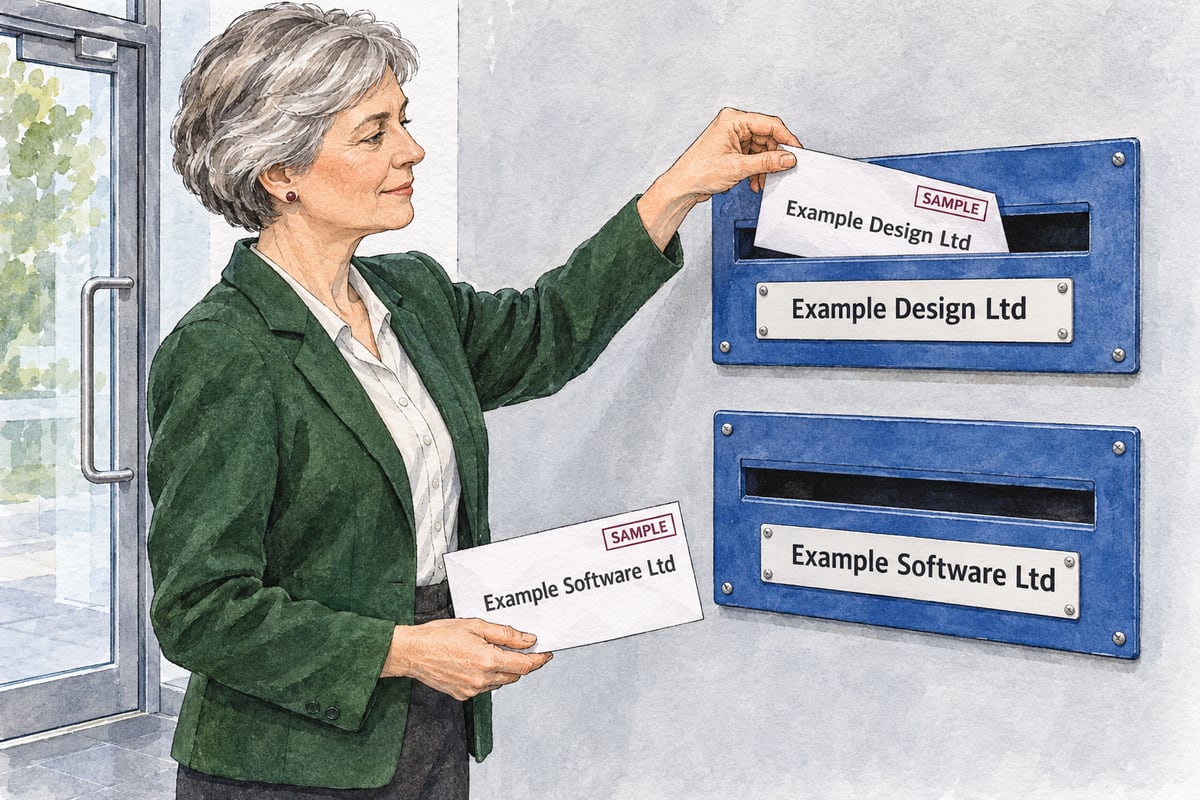
Suppose a fictional founder runs Example Design Ltd and plans to incorporate Example Software Ltd. Both businesses will use the same accounting firm, but they will have separate customer contracts and company records. The founder wants the same professional registered office for both.
The existing address order names Example Design Ltd only. Before using it for the proposed company, the founder asks whether Example Software Ltd can be accepted, what checks remain and whether a separate order or expressly documented multi-company arrangement is needed. No group discount or unlimited-company entitlement should be assumed.
The presenter preparing the new company's Form A1 needs the confirmed address and relevant instructions. CRO's incorporation guidance lists registered-office details among the A1 information. The existing company's record does not need changing merely because another company joins the premises, provided its own registered-office particulars remain correct.
Once the new company is incorporated, its CRO number can be added to the provider's records. The mail schedule identifies each legal company and its authorised contacts. Paying for the second arrangement is still not evidence that incorporation, tax registration or another filing has been completed.
5. Keep company names visible and post distinguishable
Section 49 requires a company to display its name conspicuously and legibly outside its registered office and other offices or places where it carries on business. With a shared location, ask how each company's name-display obligation is addressed. A name in an internal spreadsheet is not an answer to a physical-display question.
This guide does not prescribe a sign material, size or one separate plaque per entity. Confirm the practical arrangement for the actual premises. Our company-name display guide explains the wider question, including a separate home workspace.
For post routing, use the full legal name rather than just the founder's name or a group brand. Ask how the provider distinguishes similarly named entities, handles uncertain addressees and updates the routing record after an authorised name change. Do not assume a letter can be assigned to either company because the same person owns both.
6. Set contacts and response responsibility for each entity
Decide who receives notifications, who receives any scans or originals under the terms and who is responsible for acting on the contents. A group administrator can coordinate delivery, but a particular company's notice still needs a named owner and a backup.
Section 51 deals with service of documents at a company's registered office, including the office recorded with the Registrar where the actual location has changed. Do not assume forwarding a letter resets a legal deadline, or that a scan timestamp is necessarily the date from which a deadline runs. Seek prompt legal advice for a legal notice.
StartCompany.ie's published address service covers receipt and forwarding of official CRO and Revenue correspondence under the agreed terms. Ask separately how other notices or unexpected items are handled. Do not treat mail forwarding as legal representation, answering Revenue, preparing accounts or filing an annual return.
Restrict access to appropriate contacts. The DPC recommends risk-based security and need-to-know access. A shared address does not justify sending every company's private post to a broad group mailing list. Confirm authorised recipients and a process for changing them when staff or advisers leave.
7. Check each company's filing route when addresses change
For an ordinary registered-office change, section 50 provides a 14-day notification deadline and CRO explains the Form B2 route. CRO also states that the change becomes legally effective when the form is registered. Do not cancel an old arrangement just because a replacement order has been paid.
There is an important qualification for groups using an approved agent: section 50(5) provides a mechanism by which the agent's notified office change can satisfy the relevant client company's notification duty. Do not assume every situation requires a separate B2, or that one company's B2 automatically changes all related companies.
Ask the presenter which route applies to each entity, who is responsible and what evidence confirms completion. Check each company's current CRO record afterwards. If only one company is moving into an address already used by another, distinguish that move from any change affecting the existing occupant.
Use the provider-switching guide for a full handover. For a multi-company move, the extra control is an entity-by-entity completion list, not merely a single group-level message saying the address has changed.
8. Keep billing, renewal and tax identities separate
The buyer paying the bill may be a founder, parent or another group company. That payment identity should not obscure the legal entities receiving the service. Ask which company each service line covers, the service start and end dates and the total payable for the agreed arrangement.
StartCompany.ie's address checkout is for 12 months of service, with renewal arranged separately; it does not create an automatic subscription. Do not assume renewing one company's service renews another's, or that companies added later inherit the same end date. Obtain the actual schedule.
Revenue issues a tax reference number on registration and requires its use when trading and filing tax returns. Keep each company's tax identity with the correct correspondence. A shared registered office is not permission to use another company's tax number.
Address sharing alone does not determine tax residence, guarantee banking approval or supply operating premises. It also does not combine the companies' bookkeeping or compliance responsibilities. Ask the relevant adviser about those separate matters rather than expecting the address order to resolve them.
9. Confirm what the address purchase does not include
The published standalone address service does not include office rental, general parcel handling or annual-return filing. An address shared by several companies does not expand that service scope. Confirm any CRO address-change work separately.
Mail receipt also does not automatically include statutory-register custody, inspection arrangements, company-secretary appointment or B3 filing. Explain any records requirements before buying; do not describe files held somewhere else as being maintained at the address without an agreed, compliant arrangement.
If buying formation as well, check the current package inclusions for the particular company. An included registered office for one formation is not automatically a registered office for every other entity owned by the founder. Compare the confirmed scope, not just the fact that both products mention an address.
10. Use this multi-company ordering checklist
Start with a concise entity list and the intended arrangement. For an existing company, include its legal name and CRO number; for a proposed company, identify it as proposed rather than borrowing a related company's number. Ask how to update the record after incorporation.
Review the Registered Office Address service and contact the team before ordering where several entities or an existing package are involved. Confirm acceptance, responsibilities and the total payable. This avoids duplicate purchases while also preventing an unaccepted company from being treated as already covered.
- List every legal entity, distinguishing existing companies from proposed formations.
- Get confirmation that each company may use the exact address and from what date.
- Identify the provider and whether an authorised-agent arrangement applies.
- Record the entities covered by each order or agreed multi-company arrangement.
- Confirm each company's mail contacts, authorised recipients and response owner.
- Settle name-display, delivery and any required inspection arrangements.
- Assign the correct incorporation or address-change process and check completion.
- Record each service period, renewal responsibility, exclusions and total payable.
StartCompany.ie service
Registered Office Address
Official information and next steps
Official sources were checked on 2 November 2026. Shared-address suitability and agent procedures depend on the actual arrangement. The fictional example is not an approved address, client arrangement or service quotation. Obtain company-specific advice where needed and confirm the provider's written acceptance and terms.
- CRO: registered office requirements
- Companies Act 2014, section 50: registered office and agent arrangements
- Companies Act 2014, section 25: effect of incorporation
- Companies Act 2014, section 49: company-name display
- Companies Act 2014, section 51: service of documents
- CRO: address changes and Form B2
- CRO: incorporation documents and Form A1
- Revenue: tax reference numbers
- Data Protection Commission: data security guidance